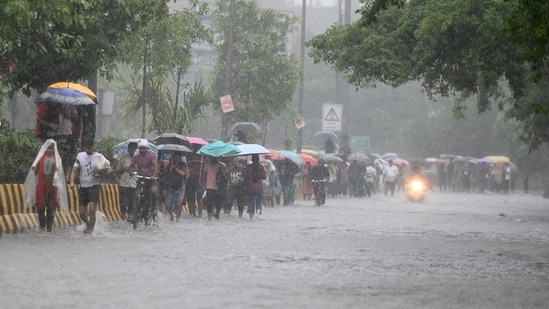
Delhi and its neighbouring districts received almost continuous rain between Wednesday and Thursday afternoon, with more rain expected on the intervening night of Thursday and Friday. Safdarjung weather station in Delhi accumulated 105mm rain in the 30 hours ending 2:30 PM on July 9. This followed 14.2 mm rainfall in the preceding 24 hours. How anomalous is this much rainfall for Delhi? Here are four charts that put this rainfall in context.
A lot of rain in Delhi, but it's not breaking records yet
- This much rain is not business-as-usual for Delhi…A total of 119.2 mm rain in 2 days and six hours at the Safdarjung station is not normal ; the station’s normal for the entire month of July is 210 mm. In other words, the station received more than half of a month’s worth of rain in just 2.25 days. India Meteorological Department’s (IMD) gridded data – it averages rainfall over boxes of two latitudes and two longitudes 0.25 degrees apart and allows one to look at daily rainfall back to 1901 – also suggests Delhi’s rain in the past three days has not been normal. The total rain in Delhi in the three days up to 08:30 AM on July 9 was 104 mm. This is 6.3 times the 1971-2020 average that IMD uses as the Long Period Average (LPA) for tracking rain performance. Should Delhi accumulate another 100 mm by the morning of July 10,it would have received 11 times the LPA for the three days ending July 10.
- …but is also neither unprecedented, nor too intenseData for the highest 24-hour rainfall recorded in each July month in the past 15 years shows that Delhi’s Safdarjung station has received 100 mm or more rain in just 24 hours in four years: July 9, 2023 (153 mm), July 21, 2013 (123.4), July 1 2022 (117.2 mm), July 27, 2021 (100 mm). Clearly, 119 mm rain at the station in 54 hours is neither too much accumulation nor an intensity Delhi has not seen in recent years.
- However, more rain by July 10 morning can make this a relatively rare eventIMD’s gridded data concurs on this assessment. The 104 mm total rain for the three days ending July 9 is ranked 95th highest since 1901 for a three-day period. To be sure, if Delhi were to average even 75 mm rain in the 24-hour period ending 08:30 AM July 10, the running three-day total for Delhi would then stand at 177.6 mm, which would be 16th highest since 1901. Should this total cross 200 mm on average for Delhi, it would be ranked among the top 10 wettest three-day periods for Delhi since 1901.
- Delhi’s neighbours have accumulated somewhat more rainTo be sure, the rain accumulation is even higher in districts near Delhi, particularly to the east. For example, a grid in Faridabad, which lies to Delhi’s south-east, got 119 mm rain in the three days ending July 9, according to IMD’s gridded data. Two grids in Meerut have got 169 mm and 178 mm rainfall in the three days ending July 9. This is because Delhi was at the western edge of the weather system that brought this spell of rain. This is also why Delhi’s eastern half got somewhat more rain that its western parts.
Unlock a world of Benefits with HT! From insightful newsletters to real-time news alerts and a personalized news feed – it's all here, just a click away! -Login Now!
Unlock a world of Benefits with HT! From insightful newsletters to real-time news alerts and a personalized news feed – it's all here, just a click away! -Login Now!
Advertisement
{{/htLoading}}{{#usCountry}}