The year end festivities see tourists travelling to the hill stations in the north, often causing traffic jams. Does this mean that this period is one of the tourism peaks in the year? It is possible to answer this question for December in general. A domestic tourism survey by the National Sample Survey Office (NSSO) conducted in 2014-15 asked households if any of its members had gone on an overnight trip -- those that aren’t regular visits, last at least
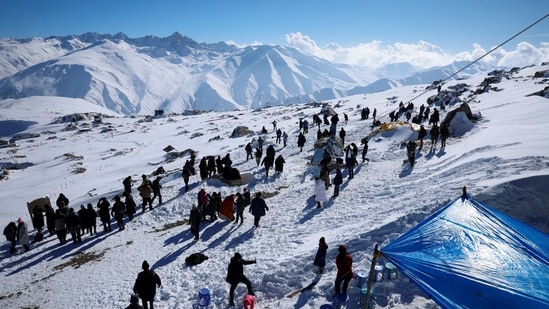
Tourists gather at Afarwat Peak, the upper reaches of Gulmarg, one of the main tourist attractions in Kashmir region. (REUTERS)
A month of commercial tourism in India
Trips for holidaying have a peak in December, but a smaller one than in summer months
The tourism survey asked respondents to classify their trips into one of seven leading purposes (the main reason for undertaking it). While two of those purposes -- holidaying, leisure and recreation (henceforth “holidaying”); and pilgrimage and religious activities – could include tourists, the survey asked for information on pilgrimages undertaken in only the 30 days preceding the survey. The information on holidaying trips was asked for the year preceding the survey conducted in the July 2014-June 2015 period. This is why the month of only the holidaying trips are worth analysing for any annual peaks. This shows that December accounted for 8.2% of holiday trips in the year, the fourth highest after May, June, and October, all three of which accounted for over 10% such trips in the year. To be sure, the share of April and August is almost the same as December’s. This means that December is indeed a popular month for holiday travel, but not as popular as the summer months that could coincide with summer vacations or the month coincident with Diwali and Dussehra celebrations. Similarly, April and August compete with December on holiday travel possibly because they are also festive months in India.
Indians could largely visit friends and relatives in holiday trips, but this is less so in December
To be sure, while the common understanding of a holiday trip may be a trip to a hill station or to the beaches, that isn’t the case for the average Indian. 60% of Indians’ holidaying trips in a year are spent with friends and relatives and only 33% in a hotel, guest house, or dharamshala (henceforth “hotels”), three places one is unlikely to stay when visiting friends and relatives. However, hotels’ proportion is 36% in December. This means that December’s share is higher when looking at hotel holiday trips than trips overall. The opposite is true for May, June, and October, although they continue to be the top three months. This suggests that December is relatively more important for touristy holiday trips.
December is also the annual peak of commercial tourism
This can be seen by looking at the proportion of holiday trips undertaken in December that the NSSO classifies as a “package trip”: trips where tourists bought a tourism product – such as transportation, accommodation, food, or sightseeing services – for the majority of the trip’s duration, even if they availed some services on their own. December has a 12.8% share in total package trips, the highest among all months, a rank that holds when looking at only trips spent in hotels. To be sure, even in December, when Indians do not travel as much as in the summer, the proportion of such package trips in overall trips is only 11.6% (26% when looking at trips with hotel stays). The trends in the subset of holiday trips undertaken with a hotel stay must also be read as indicative rather than precise, as that makes the sample size small.
Abhishek Jha is Assistant Editor-Data at Hindustan Times. He uses statistical programming to generate newsworthy insights from large datasets. He is part of the team that produces Number Theory, a daily data story feature of the paper’s print edition. Since March 2024, he has been writing Weather Bee, a weekly column for the Hindustan Times website. He is a chemical engineer by training, who specialises in stories related to weather, climate, and the environment. Jha has been at HT since 2018, where he offers data-driven perspective and analysis on politics, environment, weather, climate, economy and society. His work includes data coverage of elections in India and abroad, including the 2019 and 2024 Lok Sabha elections; the disasters and extreme weather resulting from changing climate, such as floods, droughts, heat waves, cold waves, and dwindling snow cap in the Himalayas; the factors that drive poor air quality in northern India; the changing patterns of land use; the Covid-19 pandemic and its impact on labour market conditions; the changing pattern of consumer spending seen in the new consumer spending surveys; and social norms seen in the surveys such as the National Family Health Survey.
Unlock a world of Benefits with HT! From insightful newsletters to real-time news alerts and a personalized news feed – it's all here, just a click away! -Login Now!
Unlock a world of Benefits with HT! From insightful newsletters to real-time news alerts and a personalized news feed – it's all here, just a click away! -Login Now!
Home/Editors Pick/A month of commercial tourism in India | Number Theory
{{^htLoading}}
Advertisement
{{/htLoading}}
SHARE THIS ARTICLE ON
{{#usCountry}}{{/usCountry}}
Notifications
Get breaking alerts directly from the newsroom
Notifications are on!You'll be notified when news breaks