Mirzapur, the web series shows how on-screen portrayals can transform the identity of a place by de-historicising it. Instead of being known for its impressive prehistoric heritage, it has been turned into a mafia town.
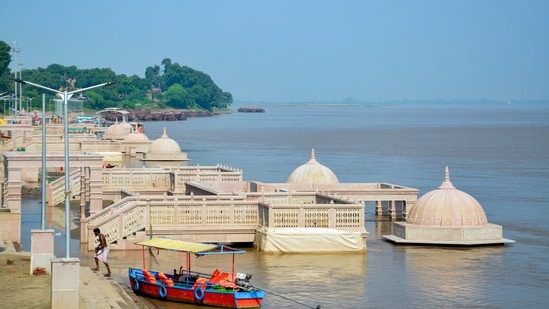
Situated in the basin of the Ganga river, which envelopes the scarp of Mirzapur on three sides, the town remains a provincial hub of pilgrimage to the Bindachal temple but and has lost its competitive edge to neighbouring Banaras. The town’s importance began
Mirzapur, the web series shows how on-screen portrayals can transform the identity of a place by de-historicising it. Instead of being known for its impressive prehistoric heritage, it has been turned into a mafia town.
Situated in the basin of the Ganga river, which envelopes the scarp of Mirzapur on three sides, the town remains a provincial hub of pilgrimage to the Bindachal temple but and has lost its competitive edge to neighbouring Banaras. The town’s importance began diminishing in the mid-19th century. It was once known for its carpet industry and, infamously, for the child labour that was prevalent.
A Pre-historic Haven
In the southern part of Mirzapur district, nestled in the Vindhyas-Kaimur range, it is still possible to view Mesolithic, Palaeolithic and Neolithic paintings made by prehistoric humans who lived in the safety of remote caves and crannies. The Sone river flows through the terrain and provides sustenance.
Archibald Carlleyle, a British archaeologist first came across Mirazapur’s pre-historic richness. In the soil inside some of these caves, microliths have been found in abundance. Those tiny implements which lack finesse are made of a quartzitic sandstone, while the smoother ones made of jasper, agate and cornelian must have required flaking them off with much pain and effort. The tools were used to strip and dress skins, cut meat, as weapons for hunting animals, other domestic chores.
Historian D L Drake Brockman writes in the Mirzapur Gazetteer 1919, “Bone implements and fragments of fossil bone belonging to very large mammalia are common in the caves, and it may be concluded that one of the chief uses of the stone knives was to scrape bone spear and arrow heads and also the shafts of arrows and spears to make them round and straight”.
A stunning discovery made in Mirzapur district relates to pre-historic tombs, whose remains were excavated by Colonel Rivett Carnac and T Cockburn in 1870s.
The Gazetteer notes about a neolithic cemetery, “The grave fully excavated was six or eight feet deep, enclosed in a stone circle about twelve feet in diameter, and contained the skeleton of an adult male over six feet in length, lying on a stone slab pointing north and south. A flat dish of “glazed” pottery was placed at the head of the skeleton, and a similar vessel lay at each corner of the tomb, which also contained a long narrow lachrymal vase of green glass about seven inches long. In a second grave opened two stone hammers and sundry flint flakes were found”.
The biggest Kaimur cave groups are the Lakhania, Panchmukhi, and Kauva Khoh Rock Shelters. The paintings depict the commonly found hunting and dance scenes and showcase both the mundane and the ordinary. But, one of the extraordinary paintings contain characters and symbols that could pre-date the Ashokan Brahmi.
Adequate evidence in the form of ruins, paintings and local oral tradition establishes the presence of various tribes such as Bhars, Cheros, Kharwars and others in the belt starting with Banaras, Mirzapur, and extending into the Kaimur jungles, which themselves stretch into present-day Madhya Pradesh, Chhattisgarh and further southwards. But it was the Bhars who were pre-eminent before they were subdued by a succession of Rajput and other Hindu dynasties and groups. Their capital is believed to have known by the name of Pampapur, whose ruins lie a few kilometres near Mirzapur.
Sculptural analysis of the statues and other elements found at the Ashtbhuja temple indicates the presence of non-Hindu divinities. M S Sherring notes in Hindu Tribes and Castes, “Some of the figures are of the aboriginal type and are readily distinguishable by their peculiar head dress and long pointed beards; while others are representations of Hindu men and women with elaborate turbans and head dress…The attitude of the Bhar figures shows them to have been still a people of dignity and importance, and in some cases, they are distinctly depicted as the superior race…”
Mirzapur in Medieval Era
The fort of Chunar is storied. So is the exquisite Chunar stone, which had been used for the massive pillars erected by emperor Ashoka was famous for its sheen and sturdiness. The fort’s ramparts overlook the Ganga and its history dates back to the early centuries of the common era. There were countless dynasties-both big and small- that have claimed to rule the fort, but they have been guests, some had a long stay and others too short to deserve a mention. The Gahadavalas, the last Hindu dynasty to rule this region had their capitals at Kannauj and Varanasi, and counted Chunar as one of their impregnable bastions. During the Sultanate period, the Chunar fort saw a succession of rulers, but none could claim it for too long.
It is during the Mughal period, starting with its founder Babur that Chunar and the region around it start appearing in historical records. For instance, Babur was told there were rhinoceroses in the vicinity of the river when he camped near Chunar; spotters were sent but returned without success.
Mughals ran the region with little trouble, however, and the fort of Chunar always features whenever there is turmoil in the region. Be it the struggle between Humayun and Sher Shah Suri or much later when Warren Hastings took refuge here. The fort provides a gallery of regimes and eras. From the mosque constructed during Aurangzeb’s time to the several tombstones erected in the memory of English men, women and children who perished here due to diseases.
British establish Mirzapur and the Carpet boom
The British quickly realised they could benefit immensely from the location of the Bindachal temple, situated at the crossroads between the south, central and Gangetic plains of Uttar Pradesh. The large forests provided timber, and the weaving tradition, which had deep roots in the region that dated back to the 12th-13th CE as an organised industry, would make Mirzapur the capital of carpet industry in the decades following the establishment of a small base in 1735.
Cotton and other textiles had been the mainstay of the local economy along with river trade, and manufacturing of brassware. The British set up carpet factories in and around Mirzapur to both create and meet the rising demand for them back home in England. Local families too followed suit but the lion’s share of the trade remained with the colonisers.
The 1919 Gazetteer records, “Carpets were made in Jaunpur and Allahabad during the time of Akbar, and it is possible that weavers from these places migrated to Mirzapur.” By the 20th century, carpet making was the main occupation in over a hundred villages, Ghosia and Madho Singh being the hubs. It further says, “3,000 weavers are settled in villages while only about 400 work in Mirzapur. It is also remarkable that twenty-three castes of Hindus and eighteen castes among Muhammadans are engaged in it. Even Brahmans and Rajputs are found among the former, while the lowest castes, such as Chamars and Pasis, are excluded.”
However, when it came to quality, Mirzapur’s carpets were regarded as being inferior to those from Persia, or Kashmir. “The quality of the Mirzapur carpets is, generally speaking, somewhat inferior, the district never having been noted for those of a superior texture. The best kind produced contains about 100 knots to the square inch, and prices vary from Rs. 3 to Rs. 12 per square yard”, noted the Gazetteer in 1919.
One Subscription.
Get 360° coverage—from daily headlines
to 100 year archives.
Archives
HT App & Website