On April 13, 1942 the Hindustan Times staff pulled off a small coup. They released, alongside the daily edition, a 104-page special issue of essays written by eminent leaders of the freedom struggle such as C Rajagopalachari, Sucheta Kripalani, Dr Mohammed Aziz Ahmed, and Dr Rajendra Prasad. The paper did so in wartime when newsprint was at a premium, sending a message of the national Indian interest despite the existence of the Defence of India Act, promulgated once Britain entered the war in 1939, which imposed regulations on “the publication of news and information” to prevent “any purpose likely to cause disaffection or alarm… or promote feelings of enmity and hatred between different classes of His Majesty’s subjects…”
When Sir Stafford Cripps, a member of the British War Cabinet, came to India in 1942 to hold discussions with the Congress and the Muslim League and enlist their support against a Japanese invasion of India, relations between the Congress and the British were icy. Gandhi dismissed the mission as deceptive and inadequate after a single meeting with the British leader. He prepared India for the final phase of his mammoth freedom struggle, known as the Quit India Movement of August 1942.
The British responded with an assault against Indian freedom fighters, killing thousands. In an attempt to place a curtain over their crackdown on satyagrahis, they imposed total censorship, and crushed the media by imposing penalties and securities. Many papers, including HT, shut down to protest the restrictions imposed on publishers. On August 18, 1942, HT’s front page carried a piece titled “14 Calcutta Papers To Close Down”. An editorial explained that “nationalist vernacular and English papers from Calcutta had decided to close down indefinitely in protest against the latest restrictions imposed on newspapers by the Government of India.”
HT remained voluntarily closed between August 19 and December 31, 1942. During those months, M Subrahmanyan, the joint editor of HT, brought out a book titled, Why Cripps Failed. On December 12, 1942, HT editor Devadas Gandhi, son of Mahatma Gandhi, wrote the foreword to this book from prison — he was serving a two-month sentence after being found guilty of contempt by the Allahabad high court. By then, HT was the most widely read paper in northern India, and its editor was the son of the Mahatma. It was bound to attract the excesses of the British.
{{/usCountry}}HT remained voluntarily closed between August 19 and December 31, 1942. During those months, M Subrahmanyan, the joint editor of HT, brought out a book titled, Why Cripps Failed. On December 12, 1942, HT editor Devadas Gandhi, son of Mahatma Gandhi, wrote the foreword to this book from prison — he was serving a two-month sentence after being found guilty of contempt by the Allahabad high court. By then, HT was the most widely read paper in northern India, and its editor was the son of the Mahatma. It was bound to attract the excesses of the British.
{{/usCountry}}Its “virtual proprietor”, GD Birla was a renaissance man. At HT, his principal objective was providing a platform for the news and views of the national movement. (In 1946, he became the chairman of HT after Pandit Madan Mohan Malaviya died). He also ventured into industry and by 1940, Birla Brothers had over 20 companies across a wide range of businesses.
In 1944, he co-authored a 100-page white paper meant for private circulation on India’s post-Independence economy. Titled The Bombay Plan, Birla co-wrote it with his businessmen peers JRD Tata, Purshottamdas Thakurdas, Kasturbhai Lalbhai and Sir Shri Ram, and technocrats Ardeshir Dalal, AD Shroff and John Mathai. Within a few weeks of its publication, Lord Wavell, Viceroy of India, welcomed it in a speech to the legislature and found in it a new approach to the solution of India’s intractable political problems.
Meanwhile, HT was growing. By 1942, the paper had bought two linotype machines and four rotary presses -- all of these were accommodated on the ground floor of the Connaught Place office into which HT moved in 1937.
Devadas began to live with his family in a flat above the newsroom. Everyone from Gandhi to Sardar Patel to C Rajagopalachari visited the HT editor’s living room, which often served as the hub of national discourse. Devadas’s children, Rajmohan, Gopal, Tara and the now-deceased Ramchandra, grew up witnessing these momentous meetings where the future of the Indian freedom struggle was often decided. “Whenever the rotary press fell silent, I would wake up,” Rajmohan Gandhi said in a piece published in HT’s 75th anniversary book.
Expectedly, when India became independent on August 15, 1947, the lead story of HT was the first chapter of India’s future.
The 22-page August 15, 1947 edition of HT carried articles from some of the most important thinkers and political activists of the era: Govind Ballabh Pant (who would become the home minister of independent India) to Woodrow Wyatt (an MP in British PM Attlee’s government) to GD Birla (Chairman of the paper’s board of directors), with specially created illustrations of freedom fighters. Where was Gandhi on this day? He was in Calcutta, fighting the forces of communal violence which had stained this historic occasion.
Gandhi’s presence in Calcutta brought a sudden calm, and scenes of fraternity which stunned the watching world. But this peace was sabotaged, and by September 1, killing and fear were again the dominant facts. A distraught Mahatma offered his life as the price of peace between Hindus and Muslims. On September 1, he began a fast unto death. His magic once again prevailed. First in stray numbers, and then in groups, people came with their leaders to the feet of the Mahatma to lay down their arms and give him the pledge of peace. They begged him to break his fast. Gandhi relented, but only after peace returned.
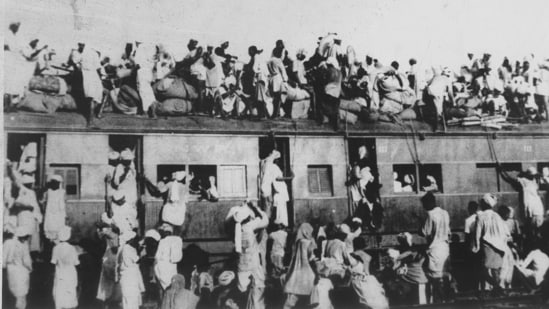
He left for Delhi on September 7, 1947 and visited the refugee camps to give solace to those who had lost everything in the brutal partition.
The symbol of peace and unity, a sage and saint for the ages, was assassinated on January 30, 1948. He fell to bullets fired by Nathuram Godse, a Hindu fanatic incensed by the Mahatma’s message of unity between religions. The Mahatma’s last words were “Hey Ram!” Gandhi died in the home of Birla, which had become a residence when he visited Delhi. His heirs, led by Nehru and Patel, were left with the responsibility of creating the framework of India from the principles they had learnt from Gandhi’s political wisdom and ideology, and from India’s ancient cultural heritage.
Gandhi’s death, on January 30, 1948 was no ordinary day for the country. It was even less so for the paper, whose editor Devadas was the Mahatma’s son. An editorial described his assassination as “the greatest crime in all history”. The paper’s obituary edition chronicled his life over several pages. The editorial team also compiled a now rare photo book titled, Memories of Bapu. One of the photographs showed Devadas holding up the bloodstained dhoti that Gandhi wore the day he died.
Gandhi’s dream came alive when, on January 26, 1950, India adopted the Constitution and became a Republic. That day, HT published a 44-page special issue in addition to the regular newspaper. Writers such as Kenneth Wheare (an Oxonian and expert on federalism) and SN Mukherjee (the chief draughtsman of the Constitution) analysed the compendious document for the readers.
The pièce de résistance, however, was a two-page article on the role that HT played in the struggle for freedom. Speaking of its fight against the oppressive rules imposed on the press, the article concluded: “In that fight, the part played by this paper (...) and all those connected with it during those troublesome years might well feel proud.”
This was not an exercise in self-congratulation, but a clear-eyed assessment of a newspaper that had come into its own — much like the newly minted Republic