Forty-five years after freedom, India seemed trapped in a swirling swamp, a socio-economic crisis that threatened to derail the nation’s progress and deny the aspirations of the post-Independence generation. A balance of payments crisis was compounded by double-digit inflation, even as violence shredded the social fabric. Rajiv Gandhi had been assassinated the previous year in a tragic echo of destiny.
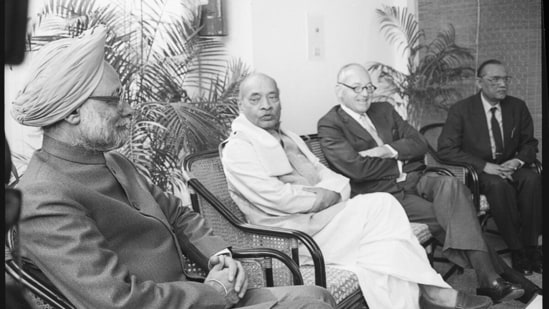
The newly elected Prime Minister PV Narasimha Rao upturned convention and chose a technocrat as the new finance minister to help pull the nation out of this morass: Dr Manmohan Singh, former Governor of the Reserve Bank of India. Singh, backed by the Prime Minister, announced an ambitious liberalisation and delicensing policy in 1992.
The great opening up was preceded by two events that continue to shape Indian politics to this day.
First, students erupted in large-scale protests after VP Singh’s coalition government announced on August 7, 1990 that the Centre would implement the Mandal Commission’s report recommending reservation for other backward class (OBC) communities in government jobs. On September 26, 1990, HT’s front page captured the tension: three lead pictures by the paper’s intrepid photographers showed police firing at protestors in Delhi’s INA Market, injured students, and a victim of the firing, with a no-frills headline “Students go on rampage in S Delhi”.
{{/usCountry}}First, students erupted in large-scale protests after VP Singh’s coalition government announced on August 7, 1990 that the Centre would implement the Mandal Commission’s report recommending reservation for other backward class (OBC) communities in government jobs. On September 26, 1990, HT’s front page captured the tension: three lead pictures by the paper’s intrepid photographers showed police firing at protestors in Delhi’s INA Market, injured students, and a victim of the firing, with a no-frills headline “Students go on rampage in S Delhi”.
{{/usCountry}}Second, in September 1990, Lal Krishna Advani, a leader of the decade-old Bharatiya Janata Party (BJP), led a Rath Yatra across five states, flanked by kar sevaks (workers) in support of a Ram Temple at the site of a derelict mosque in Ayodhya. Intermittent clashes broke out between the kar sevaks and the police in different states, and Advani was arrested. By 1991 the clamour for a Ram Temple had reached a crescendo, led by the BJP, now running a government in Uttar Pradesh. This culminated in a display of muscular Hindu nationalism when, on December 6, 1992, a 16th century mosque was brought down by kar sevaks belonging to different organisations of the Sangh Parivar.
At the same time, Kashmir plunged into militancy that led to the exodus of Kashmiri Pandits from the Valley. Over 100,000 fled as 30 separatist groups, including the Jammu Kashmir Liberation Front (JKLF) and Hizb-ul Mujahideen, unleashed venomous terrorism in their search of a separate state. “Only a herculean effort to win back the confidence of the people could possibly heal the wounds. If the militants have sprayed bullets indiscriminately, the security forces have also not lagged behind,” the HT front page story on January 24, 1990, stated.
But it was liberalisation that forced the most significant changes.
By the early ’90s, the HT office was computerised and colour photos and graphics changed the look and feel of the paper. In 1996, the company launched www.hindustantimes.com, a clear harbinger of digital news. The newsroom would become an innovator in a digital-first, and then an appfirst, approach, which meant that reliable breaking news, video stories, analysis and opinion reached readers almost instantly.
In 2000, Michael Keegan, design director of The Washington Post, helped redesign HT to meet the shifting requirements of an evolving, liberalised market. From The Hindustan Times, the paper became Hindustan Times.
The newsroom’s coverage of Delhi remained a core strength, as it led the field in coverage of two beats that came to occupy centre stage in the 1990s: civic issues and urban crime.
On July 7, 1995, five days after the charred remains of 29-year-old Naina Sahni were found inside the tandoor of an upmarket Delhi restaurant, the HT edit read, “The people can no longer take the rising crime graph in their stride. The crime reported early this week, involving the murder of a young woman and the crude attempts of the killers to eliminate all evidence by burning the body in a hotel tandoor, which resembles the plot of an Agatha Christie novel, is perhaps the most cruel episode of the kind in recent years.”
HT displayed similar persistence when law student Priyadarshini Mattoo was raped and murdered inside her Vasant Kunj home in January 1996 by Santosh Kumar Singh, the son of a senior police officer; and in April 1999, when model Jessica Lal was shot dead at a high-end bar in south Delhi after she refused to serve a drink to Manu Sharma, the son of former Union minister Venod Sharma.
Politically, the ’90s saw six Prime Ministers in Delhi as politics became as fragmented as the national mood: VP Singh, Chandra Shekhar, PV Narasimha Rao, Atal Bihari Vajpayee, HD Deve Gowda, IK Gujral. It was only in 1999 that a re-elected Vajpayee was able to complete a full five-year term.
When Vajpayee first took office in 1998, there had been four governments, including a 13-day dispensation he had led, in the preceding two years. The coalition era had become synonymous with uncertainty. Vajpayee’s most formidable contribution was ensuring stability to India and setting an example of how to manage a coalition. Equally impressive was his drive to modernise the national infrastructure and build upon economic reforms. Vajpayee’s push for the golden quadrilateral highway network, the rural roads programme, and his liberal telecom regime boosted connectivity. While Vajpayee lost the 2004 elections, his government’s economic policies helped lay the ground for a sustained period of high growth in the following years.
Vajpayee embarked upon a dramatic transformation in key aspects of national security and economic policy. The nuclear tests of 1998, and the subsequent embrace of a nuclear doctrine that was based on the “No First Use” principle, showed both India’s power and its responsible character. Pakistan responded to India’s tests, with its own decision to go nuclear, causing great unease among the Western countries. International pressure led India and Pakistan to open up channels of communication, and on February 20, 1999, Vajpayee boarded a bus to Lahore to meet the then-PM Nawaz Sharif. “From Hai Hai to Bhai Bhai” read the headline of the HT report.
Just when the two neighbours who had fought three wars seemed to be on the path of peace, Pakistan’s generals set off tensions in May 1999 by infiltrations in the Kargil region, reported to the Indian Army by local shepherds. Within weeks, full-scale war broke out, and HT reporters sent dispatches from the mountains. The coverage included human-interest stories, interviews with families of soldiers at the borders, photos of street plays on the war across cities to spread awareness. In keeping with tradition, HT also made an appeal to the readers to support India’s brave soldiers. On July 3, 1999, Hindustan Times wrote on the front page: “Brave Soldier… A Proud and Grateful Nation Salutes You... The Hindustan Times Group through their Trust have set up a benevolent fund to help the families of the valiant heroes who lost their lives for the cause of the nation.” The paper contributed ₹5 lakh and invited readers to donate generously.
This dangerous war between nuclear nations ended when India forced Pakistan to retreat from Kargil’s peaks.
With Kargil barely resolved, the spectre of renewed terrorism threatened India. In December 1999, Indian Airlines flight IC814 was hijacked by members of Harkat-ul-Mujahideen (HuM), an anti-India terrorist group operating out of Pakistan and Bangladesh at the time; the hostages were released after India freed five terrorists.
One of them was Masood Azhar, who went on to form the terrorist outfit Jaish-e-Mohammed. In December 2001, an audacious attack on Parliament brought Pakistan-sourced terrorism once again into India’s consciousness. The attempt to blow up Parliament by four suicide bombers was thwarted, but six Delhi Police personnel, two Parliament Security Service personnel, and a gardener lost their lives. “Democracy Attacked,” thundered HT on Page 1 the next day. Seven years later, on November 26, 2008, another terror attack would rip through Mumbai and leave behind a trail of bodies. By then, the world had begun to accept India not just as a victim, but as a nation that would stand in the vanguard of the international war against global terrorism and pernicious fundamentalism.