The 2014 Lok Sabha elections were marked by many firsts, the most significant being 23 million first-time voters, a majority of whom were digitally active.
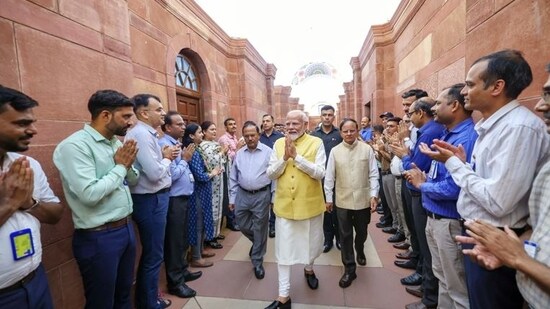
The elections were fought in the context of a slowing economy, and a spate of corruption scandals that roiled the Manmohan Singh-led United Progressive Alliance government. The stage seemed set for a change; voters reposed their faith in the Narendra Modi-led Bharatiya Janata Party’s promise of good governance, and development.
On May 20, 2014, Hindustan Times’s lead story ran with the headline, “Congress takes full unaccountability”. On May 16, the results of the Lok Sabha elections had delivered a decisive mandate, with the BJP getting 282 seats (a strike rate of 65.9%), the first straight majority for any party since 1984. The Congress was reduced to 44 seats (a strike rate of 9.4%), its worst-ever performance.
Narendra Modi, the only Indian Prime Minister to have served as a state chief minister for 12 uninterrupted years before arriving in Delhi, came to office with a deep understanding of the root problems of governance — non-delivery on schemes and policies.
Since then, by providing cash to farmers to enabling the provision of gas cylinders, from directly transferring money for construction of rural homes to water and toilets in every home, Modi has made “improving the ease of living” the core of his policies.
On a parallel policy line, Modi initiated a revolution in the national infrastructure, sought to improve the ease of doing business, and launched a concerted push to boost manufacturing through a massive state-subsidised incentive scheme to generate employment. His foreign policy positioned India as a confident power deepening ties with the US while retaining strategic autonomy, strengthening India’s relations with a neighbourhood that now extended from the Gulf to Indonesia and enhancing the “Look East” policy. India’s strategic reach was widened through partnership in Quad and creation of new naval facilities in the Andamans just north of the Malacca Strait.
{{/usCountry}}On a parallel policy line, Modi initiated a revolution in the national infrastructure, sought to improve the ease of doing business, and launched a concerted push to boost manufacturing through a massive state-subsidised incentive scheme to generate employment. His foreign policy positioned India as a confident power deepening ties with the US while retaining strategic autonomy, strengthening India’s relations with a neighbourhood that now extended from the Gulf to Indonesia and enhancing the “Look East” policy. India’s strategic reach was widened through partnership in Quad and creation of new naval facilities in the Andamans just north of the Malacca Strait.
{{/usCountry}}In 2016, Modi unlocked another digital movement which changed lives particularly in small town and rural India — the Unified Payment Interface (UPI), backed by the open APIs of IndiaStack that unlocked the economic potential of personal data at a national scale. Modi’s first push for cashless payment was aimed at the women and small shop owners of rural, small-town India. Within six years, digital payments worth ₹20,000 crore were taking place every day across the country.
On November 8, 2016, he announced a startling policy innovation in a late evening televised address to the nation, which led to financial disruption. In an effort to curtail “black money” or illicit cash from the economy, the PM abolished 1,000- and 500-rupee banknotes effective that midnight. “The Black Buck Stops Here, Says Modi,” read the HT headline the following day. “The move entails possible downside risks. Given that about 40% of India’s economy is driven by small- and medium-sized enterprises that largely run on cash transactions, the decision could have a knock-on effect on economic growth,” the report stated.
Modi’s biggest policy makeover, however, was yet to come. On July 1, 2017, HT’s headline announced it with panache: “At Midnight, Modi Rings in India’s Good & Simple Tax”, one of the most important tax reforms that unified a country of 1.3 billion people by replacing nearly 20 federal and state levies.
Then came the 2019 elections.
“In the intense, long drawn out, and often confrontational campaign ahead of the Lok Sabha elections, the most optimistic Bharatiya Janata Party (BJP) supporters borrowed a slogan first used ahead of the 2017 state elections in Uttar Pradesh: ‘Ab ki baar, teen sau paar (this time, over 300)’. On Thursday, the party did just that. It had won or was leading in 303 seats (of 542 polled). Prime Minister Narendra Modi had returned to power for a second term, and how. Modi led his party to a higher vote share (37%) as compared to 2014 as well, achieving outright political dominance in large parts of north, central, west, and east India,” read the HT front page on May 24, 2019, the day after the results to the 17th Lok Sabha elections were declared.
There were decisive changes in the internal polity as well. On August 5, 2019, in a move planned with political and legal precision, the central government led a move in the Rajya Sabha to end the special status of Jammu and Kashmir (J&K). Later that year in December, the government passed the Citizenship (Amendment) Act, or CAA, which led to protests across the country over the exclusion of Muslims from the law that aimed to provide citizenship and sanctuary to minorities from Pakistan, Bangladesh and Afghanistan — all Muslim-dominated neighbouring countries. Within days, violence rocked the Capital, and student-police clashes broke out at Aligarh Muslim University in Uttar Pradesh and Jamia Millia Islamia university in Delhi.
But soon, the government’s focus was completely taken over by the Covid pandemic. As was HT’s.
Journalists formed bio-bubbles, a limited number went to office, a majority worked from home, ready to step in if their colleagues contracted the disease. On the streets, the new drill for the reporters was that they must always stay masked and protected.
HT introduced three vital elements for its readers, even as the newsprint industry took a big hit. One, an HT Covid Dashboard. Two, the HT newsroom followed scientific breakthroughs made available by scientists from around the world. Three, the editor-in-chief Sukumar Ranganathan began a daily dispatch titled “All That You Need To Know Today” on March 19, 2020, when the first of the cases showed up in India. His column ran over the course of the pandemic, for over 350 days. It was a mix of latest science around the virus, and advised policy shifts.
The economic impact of the pandemic (a contraction of 5.78% in the 2020-21 fiscal) had an inevitable impact on the political environment. By the election season of 2023, systemic issues like entrenched unemployment, falling agricultural output and economic disparity had coalesced with newer problems like the demand for a protection net for Agniveers, central agency raids on politicians of opposition parties and the routine cancellation of competitive exams due to paper leaks, to challenge the government.
However, the ruling party’s optimism ahead of the 2024 general elections was unabated. Its campaign theme was “ab ki baar, char sau paar” (this time, we will cross 400 seats). It believed in its slogan.
On January 22, 2024, the BJP fulfilled its long-held promise to build a temple in Ayodhya, a city that Hindus believe is the birthplace of Lord Ram.
Yet, anti-incumbency tailwinds eventually helped the Opposition post its best results in a decade. To be sure, the BJP emerged as the single largest party, and the NDA won a historic third consecutive term. However, a string of significant poll losses for the BJP such as those in Ayodhya (Faizabad) and Amethi was accompanied by a revived Congress, an energised Samajwadi Party, an emboldened Trinamool Congress and a relieved Nationalist Congress Party (Sharadchandra Pawar) and Shiv Sena (Uddhav Balasaheb Thackeray), both of which had faced recent splits with a significant portion of its members aligning with the BJP.
The 2024 mandate had a message for everyone: for the NDA, continuity but with moderation; for the opposition INDIA bloc, encouragement; and for Indian democracy, an affirmation of its resilience.
Among the newsroom’s election coverage offerings was a section of the HT App that chronicled the democratic journey of India over the decades, using data animation, essays, and multimedia archival footage.
The country in 2024 is vastly different from what it was 100 years ago on almost all indicators: health, economy, business, trade, education, maternal mortality rate, and even social mores. There are more women in the formal workforce than ever before, homosexuality is no longer criminalised in India, constitutionally guaranteed reservations have effected a vast change in the lives of the most marginalised communities, and the technology revolution has transformed India into a knowledge and service hub.
For a newspaper such as HT, which has steadily built its legacy over each successive decade, such changes are equal parts challenging and exciting. Facing the future, armed with talented journalists and an organisational set-up intent on offering the “first voice” and “last word” — as the masthead, redesigned in 2020, reads — HT remains firmly grounded in its legacy. It remains the nationalist it set out to be, forever ready to build and sustain even through the leanest and most trying of times, and equipped to take on new challenges, expand and grow.
HT is the nation reflected onto itself.