
 E-Paper



Number Theory: Demand, welfare, growth — The Budget’s trilemma
.
Updated on: Jan 15, 2025, 09:07:39 IST

 Prefer HTon Google
Share via


Copy link

The National Statistical Office (NSO) released the first advance estimates for GDP for the current financial year on 7 January. When seen from a year-on-year perspective, India’s economy is expected to lose significant momentum in 2024-25. From 8.2% in 2023-24, GDP growth rate is expected to fall to 6.4% in 2024-25.
What does this mean for the Indian economy? Here is a set of arguments which suggests that reading too much into the year-on-year fall in GDP growth rate might give a misleading picture of the Indian economy’s current problems, which, to be sure, are far from insignificant.
Demand, welfare, growth — The Budget’s trilemma
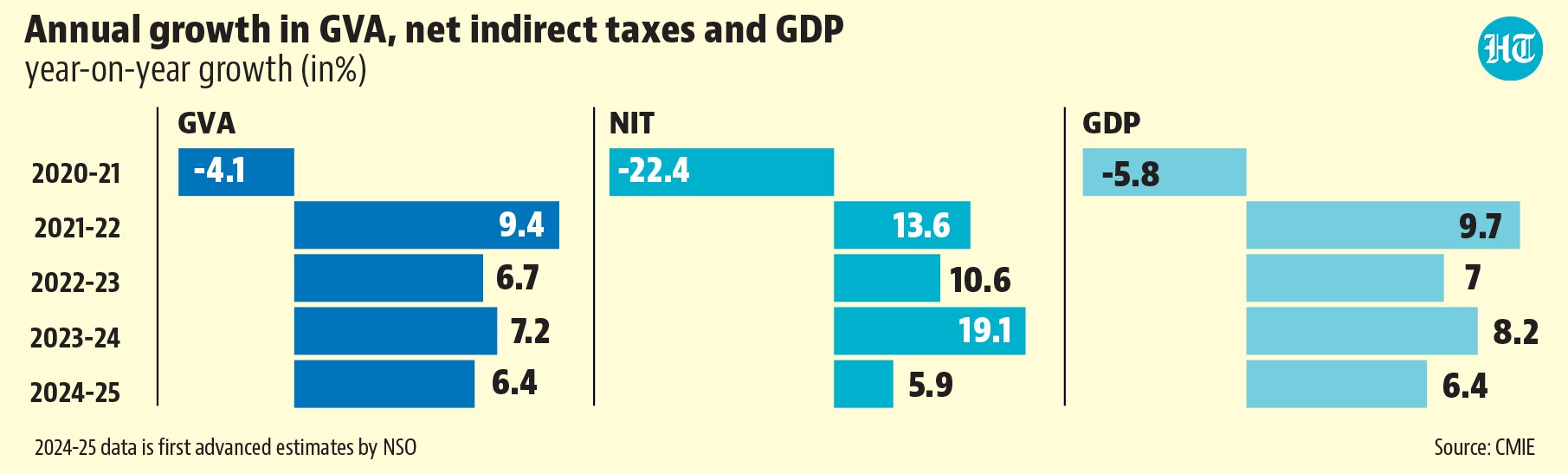
 8.2% GDP growth in 2023-24 was more fiscal consolidation than actual growthTechnically speaking, GDP is GVA plus net indirect taxes. Gross Value Added (GVA) is the sum of value added across different sectors of the economy and therefore a better measure of growth in actual production. Net indirect taxes are indirect taxes less subsidies which means that a contraction in subsidies can generate tailwinds for GDP growth. While GDP growth was 8.2% in 2023-24, GVA growth came in much lower at 7.2%. This was because net indirect taxes grew at a massive 19.1% in 2023-24, the highest this number has been since 2009-10. It was essentially a reflection of a reduction in subsidies from the peak of the pandemic with the union government’s subsidy falling even in nominal terms between 2022-23 and 2023-24. The first advance estimates have projected a GVA growth of 6.4%, same as the GDP growth number. This means that the slowdown in actual production, which is what value-added measures, over last year is lower than the one in GDP. Once again, the answer lies in growth the net indirect tax part of the equation. It is expected to come down from 19.1% in 2023-24 to 5.9% in 2024-25.
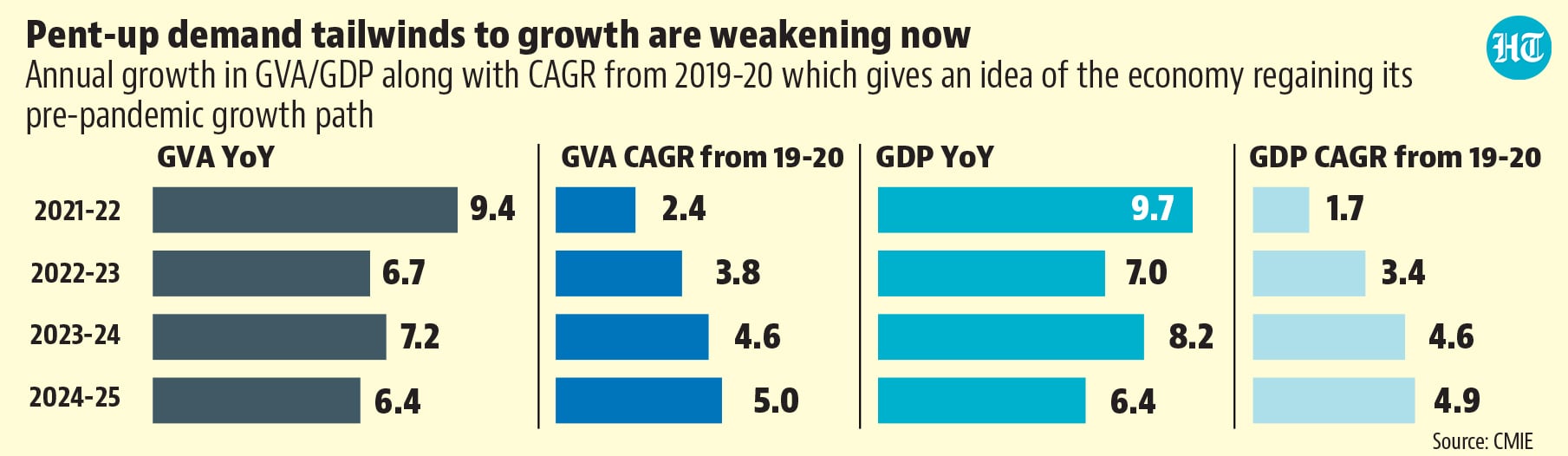
- Then, there is the need to put pent-up demand in perspectiveThe pandemic’s economic disruption – largely a function of the severe lockdown which lasted more than two months in the first quarter of 2020-21 and the longer disruption to contact intensive services – inflicted an annual contraction of 5.8% in India’s GDP in 2020-21. The contraction was 4.1% in terms of GVA. Because the contraction threw the Indian economy off its natural pre-pandemic growth path, growth numbers in subsequent years have had incrementally diminishing pent-up demand. The best way to look at this is to read year-on-year growth numbers along with compound annual growth rate (CAGR) of that year’s GDP/GVA data compared to pre-pandemic (2019-20) levels. This data speaks for itself. Barring 2023-24, a rising CAGR from pre-pandemic levels of GVA has been accompanied by a falling year-on-year growth. This is basically the dissipation of pent-up demand tailwinds. The most important and concerning point in the data is that India’s 2024-25 GVA has seen just a 5% growth compared to pre-pandemic levels. Put simply, a lot of the 7% plus growth we saw in recent years was just the economy catching up to its pre-pandemic path.
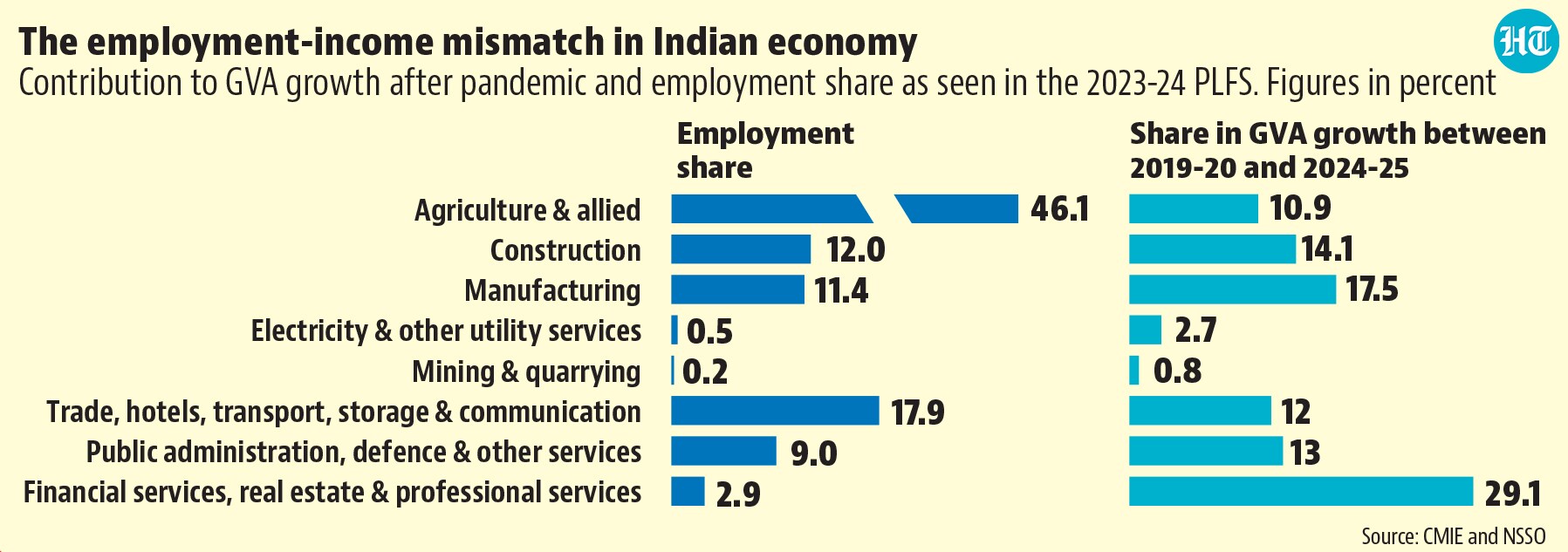
- And the recovery is skewed towards sectors which are less employment intensiveJust one sub-sector, namely, financial services, real estate & professional services, accounts for 29.1% of the growth in GVA between 2019-20 and 2024-25. Its employment share in the economy, according to latest available data (2023-24 PLFS) is just 2.9%. If one were to add the electricity, gas, water supply and other utility services, which has an employment share of just 0.5%, the cumulative addition to GVA between 2019-20 and 2024-25 becomes 31.8%. This basically means that only almost one-third of the growth in GVA post-pandemic has come from sectors which employ just 3.4% of the workers in the economy. While this income-employment asymmetry is more a structural problem for the Indian economy than a post-pandemic phenomenon, it highlights the fact that a large part of economic growth actually does little to boost mass demand. This also explains why a substantial part of the population is so keen on provision of various kinds of welfare benefits during elections. Such benefits offer a much-needed cushion to their consumption spending. The problem is, this cushion is dependent on the revenue cushion from the low-employment but high-value sectors. This is exactly what makes India’s political economy extremely complicated. And this is what the coming budget will have to deal with.


Unlock a world of Benefits with HT! From insightful newsletters to real-time news alerts and a personalized news feed – it's all here, just a click away! -Login Now!


