An electronic travel aid for the visually challenged, an intervertebral disc tissue using silk biotechnology and an e-health kit for rural paramedics. As many as 400 innovative projects - the result of hard work and bright ideas - were showcased by IIT Delhi students at the annual IIT Delhi Open House last week.
Elaborating on his project that could work wonders for patients with back problems/injuries, Sumit Murab, a PhD scholar at the department of textile technology, says: “Millions of elderly persons around the world are suffering from lower back pain, due to intervertebral disc (IVD) degeneration. This results in problems such as disability and symptomatic pain. The current surgical treatments involve removal of disc and fusion of two vertebra or insertion of metallic implants, which hinder the patient’s movement and pose a threat of post-operative trauma to the patients.
“We have developed an injectable hydrogel system of N-acetyl-glucosamine (GlcNAc) loaded silk hollow spheres embedded in silk hydrogel for therapeutic release and enhanced mechanical strength. Controlled release of GlcNAc holds potential for the treatment of degenerative disc diseases. To the best of our knowledge, this is the first system demonstrating the effect of controlled release of medically relevant dose of GlcNAc,” says Murab.
Another innovative device, developed by students of the computer science and engineering department, is called SmartCane. “It is an electronic travel aid which fits on the top fold of a smart cane stock used by visually-challenged persons. It overcomes its limitations by detecting obstacles. For safe mobility, it is important that such obstacles are detected early. The cane has other uses. It doubles as a spatial awareness device and can detect presence/absence of objects in the surroundings. It can detect objects in the range of three metres. It vibrates at different intensities and informs the user about the presence of objects in its path. These vibrations convey the distance information and thus enable the user to negotiate the obstacles from a safe distance. With simple orientation and training, any visually-challenged person can benefit from this,” says Kunal Kwatra, one of the students working on this project.
{{/usCountry}}Another innovative device, developed by students of the computer science and engineering department, is called SmartCane. “It is an electronic travel aid which fits on the top fold of a smart cane stock used by visually-challenged persons. It overcomes its limitations by detecting obstacles. For safe mobility, it is important that such obstacles are detected early. The cane has other uses. It doubles as a spatial awareness device and can detect presence/absence of objects in the surroundings. It can detect objects in the range of three metres. It vibrates at different intensities and informs the user about the presence of objects in its path. These vibrations convey the distance information and thus enable the user to negotiate the obstacles from a safe distance. With simple orientation and training, any visually-challenged person can benefit from this,” says Kunal Kwatra, one of the students working on this project.
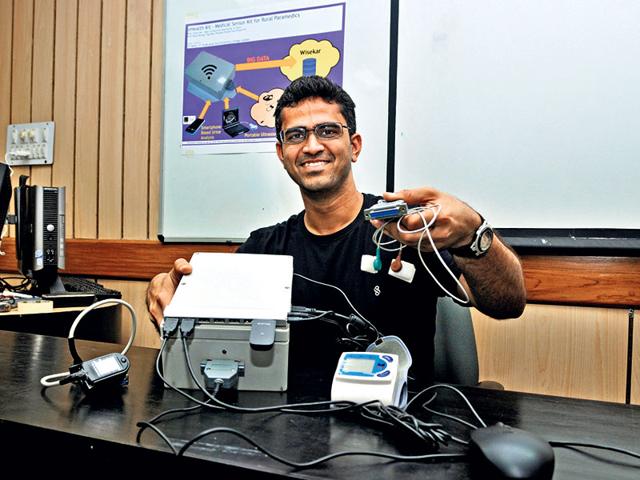
{{/usCountry}}Another revolutionary project is an e-health kit which has been developed as a simple easy-to-use medical diagnostic backpack for paramedics-on-cycles to carry into villages and allow them to collect medical data, then use available communication networks (2G/3G/WiFi) to flow into a cloud database called WiSeKAr. This data can then be used for medical profiling.“We integrate a pulse oximeter, electronic blood pressure monitor, air flow sensor for pulmonary capacity/chronic obstructive pulmonary disease (detection, blood sugar level monitor for diabetes screening, ECG, a portable ultrasound system and a smartphone-based urine analysis kit into one convenient solar-powered package with an intuitive user interface. The data collected in our database (WiSeKAr) is available for big data analysis. With the use of the e-health kit, medical profiling becomes possible. Trends such as diet-induced deficiencies and diseases can be picked up in communities and the spread of diseases can be detected,” says Professor Subrat Kar of the department of electrical engineering, who is part of the project.
Kar says that the significance of this equipment is that it truly takes only a paramedic with this equipment in a backpack and travelling on a two-wheeler/bicycle to collect several vital medical parameters from the heart of India’s villages. “Our other partners in this project are IIT Hyderabad and University College London, the DST in India and the EPSRC in UK,” he adds.
Not only does the e-health kit allow registration of authentic medical data, it follows trends like spread of diseases, occurrence of diet-linked deficiencies professor subrat kar, department of electrical engineering, IIT delhi