A few events in the past week have hinted at intense factionalism within the ruling Bharatiya Janata Party (BJP): Two prominent Lingayat leaders, Jagadish Shettar and Laxman Savadi, who left after the party denied them tickets and have since joined Congress, blamed BJP national general secretary B L Santosh, who has come from Rashtriya Swayamsevak Sangh (RSS), accusing him of manoeuvres to sideline the old guard.
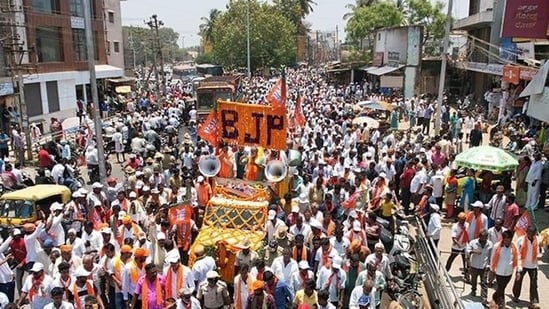
In the past week, some commentators in Kannada newspapers also wrote that the BJP
A few events in the past week have hinted at intense factionalism within the ruling Bharatiya Janata Party (BJP): Two prominent Lingayat leaders, Jagadish Shettar and Laxman Savadi, who left after the party denied them tickets and have since joined Congress, blamed BJP national general secretary B L Santosh, who has come from Rashtriya Swayamsevak Sangh (RSS), accusing him of manoeuvres to sideline the old guard.
In the past week, some commentators in Kannada newspapers also wrote that the BJP may install a Brahmin chief minister if the party wins a majority or comes close to forming a government in the May 10 elections.
The opposition played this up as a Lingayat versus Brahmin conflict within the BJP. Janata Dal (Secular) leader H D Kumaraswamy said that a Peshwa Brahmin would be the BJP CM if the party won, hinting at Santosh. “Lingayat leaders in BJP are challenging the Brahmin lobby,” said Karnataka chief president D K Shivakumar last week, as the BJP started a whisper campaign in Central and North Karnataka that a Lingayat CM candidate will be declared soon. Both these regions are Lingayat-dominated. The caste forms about 17% of the state’s population and in Karnataka, the BJP is known as a party of Lingayats — the community has helped the party win previous state elections.
The BJP is yet to declare its CM candidate, and Karnataka has so far had two Brahmin chief ministers – R Gundu Rao from the Congress, in 1980 and Ramakrishna Hegde of the Janata Party, in 1983.
The BJP denied a ticket to Shettar, 68, who has been a former chief minister and state BJP chief, from the Hubbali-Dharwad assembly constituency, and gave the ticket instead to another Lingayat leader, Mahesh Tenginkai. However, Tenginkai, who is the state BJP general secretary, is considered a protégé of Santosh.
Brahmins constitute about 4% of the state’s population of 70 million and the BJP gave tickets to 13 Brahmins as compared to eight in 2018. The Congress has given tickets to seven Brahmins. To be sure, Brahmins are an important vote bank in the state for the BJP, even though the party has never nominated a CM from this community. The BJP chief ministers have been from dominant communities, Lingayat and Vokkaliga.
Shettar, who is contesting from the same seat on a Congress ticket, had worked closely with BS Yediyurappa to build the Lingayat vote base of the party. He blamed Santosh for sidelining all veterans in the party including Yediyurappa to become the chief minister. “It was his (Santosh) plan to remove Yediyurappa (as state chief minister in July 2021),” he said on April 21.
Savadi said that he received a call from Santosh informing him about the BJP’s decision not to field him hours before the tickets were announced on April 11. The BJP decided to give the ticket to Congress turncoat Mahesh Kumathalli, who had defeated Savadi from Athani in northern Karnataka, in 2018. Savadi was nominated to the legislative council and was seeking a ticket from Athani again. He is now the Congress candidate in Athani.
On April 21, former deputy chief minister H S Eshwarappa, a Kuruba (caste of former chief minister and Congress leader Siddharamaiah), also said that he got a call from Santosh asking him to retire from electoral politics. He also got a call from Prime Minister Narendra Modi thanking him for his work. However, the request of a five-time MLA to give a ticket to his son KE Kantesh, was not accepted and the party nominated Channabasappa, a leader considered close to Santosh.
As it became evident from the BJP candidate list that many of Santosh’s loyalists have got tickets, all Lingayat law-makers from the state, including chief minister Basvaraj Bommai and former chief minister B S Yediyuruppa, met last week and decided to ask the party high command to declare a Lingayat chief minister.
“We will ask the party high command to declare a Lingayat as the chief minister candidate to infuse confidence among the community,” Bommai said after the meeting.
Political commentators in Karnataka said it has never happened before that the CM has participated in a meeting of community-specific MLAs and urged the party high command to declare a CM candidate who belongs to the community. Experts said that this was aimed at targeting the rise of Santosh and his close confidante and Parliamentary affairs minister, Prahlad Joshi, a Deshastha Brahmin from Dharwad.
“The rise of Brahmins in Karnataka BJP is hurting the old guard, especially Lingayats, who have a strong hold over the party. The noises after ticket distribution shows all is now well within the BJP,” said political commentator Sandeep Shastri.
At least four CM candidates are either no longer in the party or have retired from electoral politics. Yediyurappa “retired” from electoral politics in July 2022 having ascended the throne thrice and crossing the age of 75. Shettar and former deputy chief minister Savadi, have joined the Congress and Eshwarappa announced his retirement from electoral politics.
Another former deputy chief minister R Ashok, a Vokkaliga, has been fielded from two constituencies. A defeat outside his pocket borough will be seen as a sign of his limited popularity. Five-time MLA V Somanna, a Lingayat, has also been fielded from two seats, much against his wishes. A defeat could leave a mark.
All these developments may well be the BJP’s strategy of replacing older generation leaders with younger ones. The party has handed over 62 tickets to newcomers. But, in politics, every move is thought to have another motive. Many BJP leaders hold Santosh and Joshi responsible for this possible sidelining, even though Santosh, in an interaction with Deccan Herald, said that the decision of ticket distribution was a collective one.
To be sure, Santosh, who rarely interacts with the media, is a quiet leader and rarely reacts to political controversies. Joshi has refused to react to these claims.
One Subscription.
Get 360° coverage—from daily headlines
to 100 year archives.
Archives
HT App & Website