Union home minister Amit Shah on Sunday accused the previous Samajwadi Party (SP) government of engaging in appeasement politics in Uttar Pradesh. He also claimed that the then government used to discriminate on power distribution along religious lines.
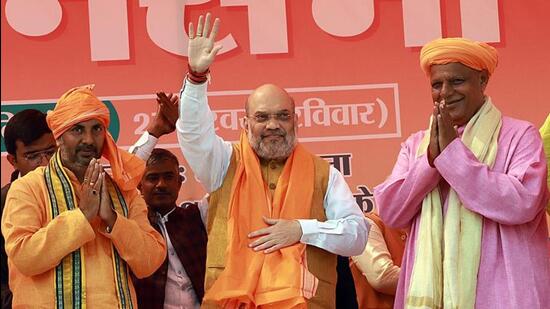
“There used to be power during Taazia and Moharram, but none during Parshuram Jayanti, Ram Jayanti and Krishna Janmotsav,” Amit Shah said, addressing public meetings in eastern UP.
“Mujhe batayo ye theek hai kya (tell me, if this was, ok?),” he asked as the crowd waved their hands indicating their disapproval.
Amit Shah spoke in Phephna, Bansdeeh (Ballia), Farenda (Maharajganj) and Nautanwa (Maharajganj).
Amit Shah’s take on discriminatory power supply during the SP rule is part of the BJP plan to target the Samajwadi Party and to show it as a party that engaged in appeasement politics.
Another example that party leaders like Amit Shah have been often quoting in the UP campaign is about Yogi Adityanath’s government having cleansed eastern UP of both ‘macchhar aur mafia (mosquitoes and mafia)’.
“Tell me where are Azam Khan, Mukhtar Ansari or Atiq Ahmad these days. Behind bars, right? Now, tell me if SP comes to power, will these remain in jail. You want them in jail or do you want them out on bail?” Shah has been stating in each of his rallies and asserting that it is important that BJP is voted to power again to keep criminals at bay. In the west UP campaign earlier, Amit Shah had been striking the Samajwadi Party with the NIZAM jibe and had explained that NIZAM meant rule in Urdu. He then had proceeded to explain that the abbreviation stood for Naseemuddin Siddiqui, Azam Khan, Mukhtar Ansari and Atiq Ahmad.
{{/usCountry}}“Tell me where are Azam Khan, Mukhtar Ansari or Atiq Ahmad these days. Behind bars, right? Now, tell me if SP comes to power, will these remain in jail. You want them in jail or do you want them out on bail?” Shah has been stating in each of his rallies and asserting that it is important that BJP is voted to power again to keep criminals at bay. In the west UP campaign earlier, Amit Shah had been striking the Samajwadi Party with the NIZAM jibe and had explained that NIZAM meant rule in Urdu. He then had proceeded to explain that the abbreviation stood for Naseemuddin Siddiqui, Azam Khan, Mukhtar Ansari and Atiq Ahmad.
{{/usCountry}}“What can I do if they happen to be Muslims?” chief minister Yogi Adityanath had said recently in an interview with a news channel when asked about the Opposition charge that the BJP was targeting Muslims alone.
Political experts were quick to notice that the BJP is aiming to avoid voting along caste lines in eastern UP and thus examples, such as the ones that Amit Shah or other BJP leaders have been making during the campaign, are subtly aimed at ensuring that BJP voters vote as one, not along caste lines.
In the 2017 UP polls, Prime Minister Narendra Modi, too, had flagged the issue. “If a village receives funds for graveyard, then it should also get for cremation grounds, too. If you provide uninterrupted power supply on Eid, then you should also do it for Holi,” Modi had said during the 2017 UP campaign.
This time, chief minister Yogi Adityanath has been targeting the SP, stating that during its rule all that the Samajwadi Party government did was to construct boundary walls of Muslim graveyards and Shah has focused on discrimination on religious lines under the SP rule.
Modi, on the other hand, has focused on recounting anecdotes from the two Hindu epics of Ramayana and the Mahabharata to subtly make the point about ancient India not believing in caste divide. He even coined a slogan that said welfare of the poor alone was his government’s solitary goal.
“Jaati dharm se upar uthkar badhaya hai samman, sabse pehle, garib kalyan (have risen above caste and religion, welfare of the poor is the priority),” he said in his rallies in eastern UP on Sunday.
Towards this end, Modi even recounted how his government’s free ration scheme had benefitted 15 crore people in UP and proceeded to give a breakup of the beneficiaries, too.
“Of these 15 crore, nine crore are backwards, three crore Dalits and an equal number of poor from the general category,” Modi said in Deoria on Sunday to highlight how his government’s benefits are intended for the poor across all castes.
Drawing heavily from Hindu religious texts and scriptures, he recalled how Lord Krishna was supported by the poor and commoners, when he raised the Govardhan mountain to protect the people from rain god Indra’s wrath. “Lord Ram eating tasted berries from Shabri or raising a force of forest dwellers to take on the mighty Ravan are all in our scriptures that should have helped guide our politicians to focus on the poor,” Modi said, adding that the Hindu religious texts showcased equality.
“Lord Ram’s transition from a prince to a lord was complete only after he ate Shabri’s tasted berries and met Nishadraj,” Modi added. The BJP has inked a pre-poll pact with the Nishad Party as well as Apna Dal (Sonelal), both OBC- based parties.
“The BJP doesn’t believe in caste politics. So, whether it is the PM or the union home minister, both stated facts. As all Hindus would know how Lord Ram and Lord Krishna, while essaying their role on earth, gave the message of equality of all. It is also a fact that during SP rule, there used to be blatant discrimination on religious and caste lines,” a BJP functionary said.