
 E-Paper



In West Bengal, battle for Matua vote heats up
The Matua population is considered to have the power to swing elections in as many as 30 assembly seats and have a significant impact on another 50

 Prefer HTon Google


The calm that surrounds Thakurbari, the pilgrimage site for the Matua community, a scheduled caste group, in West Bengal’s Bongaon, masks the power struggle at play here.
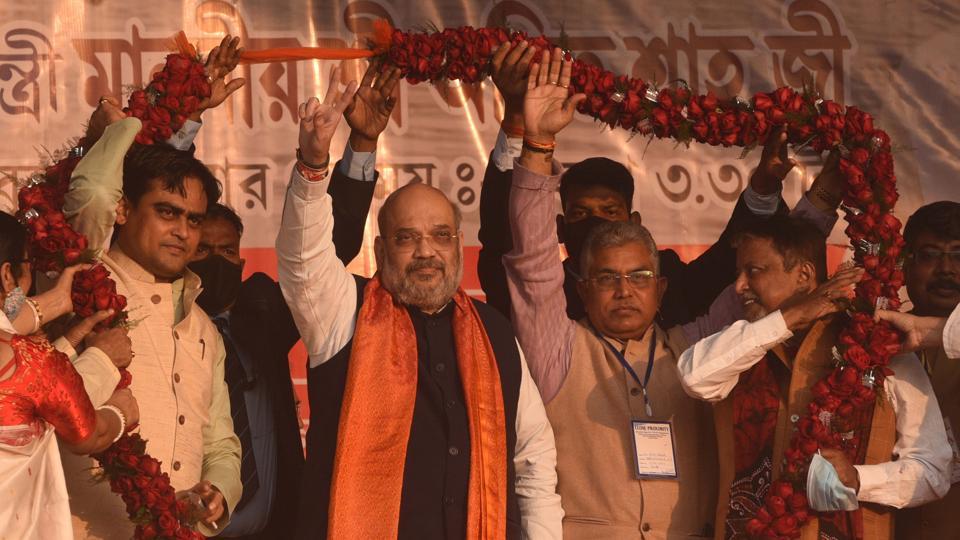
Part of the 24 North Parganas, Bongaon sub division, like the other Matua strongholds of Nadia, Coochbehar, Dinajpur and Burdwan, among others, is a battle ground for the Matua votes and at the centre of a struggle for control between the ruling Trinamool Congress and the Bharatiya Janata Party (BJP).
The Matua population is estimated at 50 million, of which about 30 million are in West Bengal alone and 15 million are listed as voters. Tracing their roots to 19th century undivided Bengal, they are considered to have the power to swing elections in as many as 30 assembly seats and can have a significant impact on another 50.
The political and electoral tussle
Since the 2019 Lok Sabha polls, both the BJP and the Trinamool Congress (TMC) have outdone each other to woo the Matuas ahead of the elections to pick a new 294-seat assembly that will begin in the state on March 27.
Also Read | Don’t vote for BJP, you won’t be able to follow your ‘dharma’: Mamata Banerjee
In 2019, the BJP managed to get a foothold in the 24 North Parganas, which is part of the southern region of the state and a TMC bastion. “In North Parganas, there are over 33 assembly constituencies and the TMC won 27 of these in 2016. In 2019 Lok Sabha polls, it lost 12 assembly segments to the BJP, including the four assembly seats in the Bongaon Lok Sabha. This happened because of the support we got from the Matuas,” said a BJP leader.
The BJP leader quoted above said the party wrested control of Barrackpore and Bongaon Lok Sabha seats, after getting the support of the Matuas on the basis of the promise of a Citizenship (Amendment) Act or CAA, which promised citizenship to Hindus, Sikhs, Parsis, Buddhists and Jains coming from Pakistan, Bangladesh and Afghanistan, and credited Mukul Roy for victories in these seats.
The CAA was passed in Parliament but is yet to be implemented on the ground. Union home minister Amit Shah on a visit to Thakurbari in February had assured that the process has only been delayed because of the pandemic and that the party would not renege on its promise to give the Matuas their long standing due—a paper to certify their Indian nationality.
The TMC, on its part, has also been on an overdrive to appease the voters. In the run up to the 2019 elections, chief minister Mamata Banerjee not only visited Bongaon but also announced an allocation of ₹10 crore for the Matua development board apart from sanctioning a university.
Citizenship and votes
The quest to control the Matua vote, however, largely hinges on the issue of identity and rights. While the BJP is keen to ensure that the discourse stays on the issue of the Matuas being neglected and overlooked till the CAA came to their rescue, the TMC has turned the tables by questioning how those who have election cards and been part of the election process for years be sold the idea of an identity they already have.
Also Read | TMC to EC: Remove Suvendu Adhikari’s name from Nandigram’ electoral roll
Paritosh Saha, a TMC candidate from Bagdhah assembly constituency in Bongaon that has over 40% Matua votes, said the BJP has been misleading the community on the issue. “We are going door-to-door to campaign and are telling people that they are already citizens of this country and don’t need any certificate,” he said.
The sentiment is echoed by a resident of village Helencha in Bagdhah, Bikas Biswas, who is also the working secretary of the All India Matua Samaj. “What will they (BJP) give me. I already have the PAN card, election ID and Aadhaar,” he said. And taking a dig at the BJP bringing up the issue of unfinished promises of jobs and more money in bank accounts. “Have they provided the promised ₹15 lakh? Can the BJP give us jobs?” he asked referring to the problem of unemployment among the Matuas.
BJP MLA from the area, Dullal Bar, offered a counter. He said apart from the issue of establishing their identity as citizens of India, and improving their living standards, the BJP wants to politically empower the Matuas.
“The TMC talks about empowering the Matuas. But how many community leaders find important positions in the party or the government? The TMC could not even appoint an SC or an ST representative to look after departments that draft policies for these groups. We are going to change that. The Matuas will be the decision-makers and stakeholders,” he said. Bar is also the state president of the BJP’s SC Morcha.
In Ranihati, also a Matua stronghold, a community leader not wishing to be identified said while the political parties are fighting to claim the Matuas as their own, little has been done on the ground to ensure justice. “To begin with, the land pattas (ownership) that we were promised have not been delivered even after 70 years. There are many voices within the community that are advocating voting for candidates instead of a party because we have been let down by all,” the person said.
“There are graduates who are forced to drive totos (battery operated rickshaws). Some have no option but to take up labour jobs. There’s no industry to offer jobs. These are issues that political parties should focus on,” said Anil Biswas, a resident of Ranihaiti, when asked what Matua want from political parties.
The intra-community dynamics
While most political watchers consider the Matuas as a monolith that tends to follow the instructions of their leaders, Biswajit Chakravarty, an academic at the Rabindra Bharati University in Kolkata, said it is a folly to think the community votes as a single bloc.
“There is a tendency to overestimate their role in shaping electoral outcome. Most parties think they heed the call of their leaders on voting. But my findings show that they are divided too,” he said.
A few community elders agree that there are deep divisions in the once tightly knit structure and admitted that with fissures within the community and the Thakur clan, it is unlikely that any party will benefit from the consolidated Matua vote.
Matuas leaders said the community’s political assertion began with PR Thakur, the grandson of Hari Chand Thakur, who founded the sect, taking control of the Matua Federation somewhere around 1930. His wife and the matriarch of the community, the now deceased Binapani Devi or Boroma, had initially supported the Trinamool ahead of the 2009 Lok Sabha elections and the community was credited to have swung the elections in favour of TMC in 2011 assembly elections.
The same year, her son, Manjul Krishna, became a minister for refugee rehabilitation in the Mamata Banerjee cabinet, and another son, Kapil Krishna, was elected to the Lok Sabha. The family feud, according to the local residents, started when the sitting MP Shantanu Thakur (Manjul’s son) contested in the 2019 elections against his aunt Mamata Bala Thakur.
“The political parties have wedged differences in the Thakur clan. After the passing away of Boroma, differences have widened and the clan is bitterly divided,” said a resident of Thakurnagar on condition of anonymity.


