Film historians often argue that the 1950s and 60s was the golden age of Indian cinema, when filmmakers experimented with genres, subjects, and socio-political issues freely and without sacrificing mainstream commercial aspirations. The period gave rise to several desi film genres that remain prevalent today. A similar case could be made for the period between the late 90s and early 2010s for ‘children’s films’ in India. During that 15-17-year period, major filmmakers and stars experimented with mainstream films aimed at children. Be it animation, fantasy, or even coming-of-age, kids were spoilt for choice when it came to Hindi films made for them.
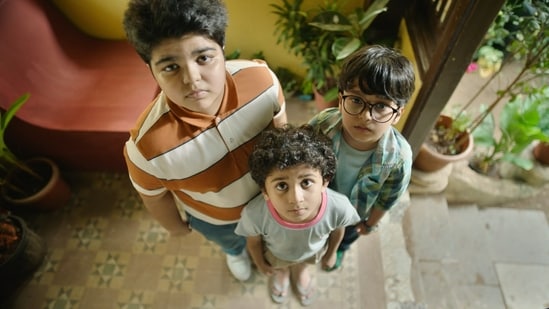
Around the turn of the millennium, Hindi cinema saw a big, positive change in how films meant for children were mounted, made, and marketed. Mainstream stars, actors, and producers increasingly began to venture into the space. And this continued for over a decade. Vishal Bhardwaj began his career with Makdee and Blue Umbrella. Anurag Kashyap followed Black Friday with Return of Hanuman. Both Yash Raj Films and Dharma Productions backed multiple children’s films. And then there were the non-star-led films that still left their mark, from Stanley Ka Dabba to Jajantaram Mamantaram.
That is in stark contrast to how the situation is today. The big stars no longer work in children's films. The animation industry has found mythology to be the only gateway for kids, and independent slice-of-life films have diminished in number. So much so that when the trailer of Little Thomas - a film with an 8-year-old in the lead - dropped, the words used to describe it were ‘rare’ and ‘niche’. What changed, then? Hindustan Times spoke to stakeholders - filmmakers, writers, and producers - who have made such films before to decode where Bollywood’s children’s films vanished.
‘Children’s films kaunsa chalti hain’
The biggest change in the last decade of Indian cinema has been the focus on box-office ‘surety’ as a parameter for making films. ‘Risk averse’ is the term writers and directors use to describe financiers and producers today. Kaushal Oza wrote and directed Little Thomas, an upcoming film about a youngster trying to persuade his parents to give him a sibling. The filmmaker says he had to run pillar to post to pitch the film before he found a backer. “I wrote this film and started making it because I liked the story. I didn’t think of it as any particular genre, just an accessible film that could be low-budget. But when I started putting this out. I realised people are seeing it as a children’s film because they need a reference point. They said, ‘Children’s film kaunsi chalti hai (Which children’s film is successful).’,” he says.
{{/usCountry}}The biggest change in the last decade of Indian cinema has been the focus on box-office ‘surety’ as a parameter for making films. ‘Risk averse’ is the term writers and directors use to describe financiers and producers today. Kaushal Oza wrote and directed Little Thomas, an upcoming film about a youngster trying to persuade his parents to give him a sibling. The filmmaker says he had to run pillar to post to pitch the film before he found a backer. “I wrote this film and started making it because I liked the story. I didn’t think of it as any particular genre, just an accessible film that could be low-budget. But when I started putting this out. I realised people are seeing it as a children’s film because they need a reference point. They said, ‘Children’s film kaunsi chalti hai (Which children’s film is successful).’,” he says.
{{/usCountry}}Film producer Ranjan Singh, who has backed Little Thomas and began his career with Taare Zameen Par, says the market for children’s films exists, as evidenced by the fact that three of the top 10 highest-grossing films of the year globally are children’s films. He argues, “PVR has a sub-section for kids, with about 80-90 theatres across India dedicated to children. 90% of the films played there throughout the year are Hollywood films, because they know how big a market it is.”
‘But kids today watch Singham and Pushpa’
Industry insiders say that while Hollywood has created a blueprint for kids’ films to succeed, India has lumped children - as audience members - with adults. The films meant for children are now often those that are meant primarily for their parents or older siblings. Filmmaker Sonam Nair, who made her debut with the heartwarming teen comedy Gippi in 2013, recounts an incident from a recent outing to watch singer Mika Singh perform. “There were two kids who kept dancing, and they kept asking for a song. That was the Pushpa title track. He performed that, and these two kids did the full Pushpa step. That is the change. The kids want to watch Pushpa,” she says.
Kaushal Oza echoes this, recalling a conversation he had with writer Jaideep Sahni while he was making Little Thomas. “He said I was up for a challenge. He said, ‘Idhar bache Singham dekhte hain, Taarak Mehta dekhte hain (Here, kids watch Singham and Taarak Mehta), which may not even be age-appropriate. Your fight is with these titles’.”
The lost advantage of the Children’s Film Commission
Anurag Kashyap may not be the first name that springs to mind when you talk of children’s films, but for years, he was the director of India’s most successful animated film. His 2007 film Return of Hanuman was a cable TV hit, even if it did not do well in theatres. Kashyap attributes the changed scenario to a lack of institutional support. “We had a big advantage earlier because we had the Children’s Film Commission, which was headed by renowned actors and filmmakers. It was almost mandated for the industry to keep making films that catered to children. That is gone now. The irony is that we live in a time when the administration wants all films to be for children. Even adult films are cut so that they can be watched by children. But they should not be children’s films,” says the filmmaker.
The Children's Film Society, India (CFSI) was a government-backed organisation that produced and distributed cinema for children. Formed in 1955, it was headed by illustrious names such as Sai Paranjpye (twice), Nafisa Ali, Nandita Das, and Amol Gupte over the years. In 2022, it was merged with the National Film Development Corporation (NFDC).
The star problem?
In the golden age of kids’ films in India, the biggest stars often lent their weight to films marketed for children. Aamir Khan lent his star power to Taare Zameen Par, and Amitabh Bachchan did the same for Bhoothnath. Shah Rukh Khan had a cameo in the latter. And then there was Hrithik Roshan, who brought the superhero genre to kids with Koi Mil Gaya and Krrish. The emphasis on stars has meant that producers are only willing to back kids’ films today if a big name is attached. Anurag Kashyap jokes, “If we want to make Home Alone, for instance, the three villains need to be stars.”
But Ranjan Singh says a way to bypass that still exists. “If you feel a film has only limited business potential, then you make it on a low budget,” he argues. “Economics is always involved because making movies takes a lot of money. But if you are settled on a story, then you find a way to make it.”
Mythological films have almost completely dominated the space for children’s films in India, be it live-action (HanuMan) or animated (Mahavatar Narsimha). Beyond that, titles like Little Thomas are few and far between. But writers and filmmakers hope the frequency will only increase.
As Anushka Shah, producer of Little Thomas, puts it: “On distribution, the system is built around opening-weekend star power and evening shows. A children's film needs the opposite: morning and afternoon slots, school-holiday timing, word of mouth that builds over weeks. On the whole, we think the challenges are well worth it because, in the long run, fighting the good fight creates better-quality cinema for everyone.”
Get more updates from Bollywood, Taylor Swift, Hollywood, Music and Web Series along with Latest Entertainment News at Hindustan Times.
Get more updates from Bollywood, Taylor Swift, Hollywood, Music and Web Series along with Latest Entertainment News at Hindustan Times.