India’s northern plains are expected to get a colder winter than normal because of the La Nina effect, and experience a longer than usual spell of toxic air as stubble-burning may continue till early December, according to weather and pollution experts.
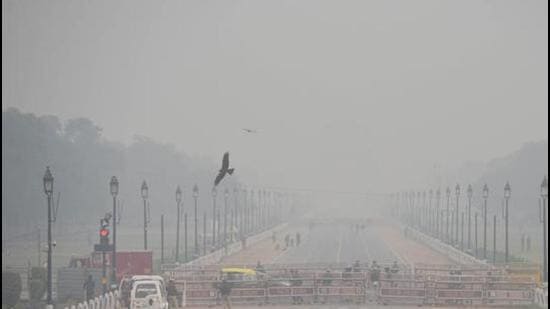
Rise in air pollution levels is directly related to local weather conditions, such as wind speed and ground temperature, with farm fires contributing to the pollution load. Good wind speed coupled with higher ground temperature helps in quicker dispersal
India’s northern plains are expected to get a colder winter than normal because of the La Nina effect, and experience a longer than usual spell of toxic air as stubble-burning may continue till early December, according to weather and pollution experts.
Rise in air pollution levels is directly related to local weather conditions, such as wind speed and ground temperature, with farm fires contributing to the pollution load. Good wind speed coupled with higher ground temperature helps in quicker dispersal of pollutants from ambient air. Pollution levels in Delhi and other areas in northern plains reached “severe” levels on Diwali night, bringing the season’s first smog.
A Climate Trends analysis on Friday said that air pollution in the northern plains may linger for longer than normal even as La Nina, a complex weather pattern caused by variations in ocean temperatures in the equatorial band of the Pacific Ocean, is likely to cause intense winter conditions in the northern plains, especially the Indo-Gangetic Plains (IGP) for a second year in a row.
According to the India Meteorological Department, La Nina was reason for a surge in monsoon rains this year.
“With second consecutive La Nina, north-west India is gearing up for intense chilly weather this season. Meteorologists have been forecasting record low temperatures across northern plans this year, with November and December expected to be colder than usual,” the Climate Trends analysis said, adding that the temperatures are expected to drop to 3 degree Celsius in some northern areas in January and February.
G P Sharma, president- Meteorology and Climate Change, Skymet Weather, said there was high probability of second back to back La Nina that can cause an intense cold wave from December 2021 to February 2022. “With El Nino-Southern Oscillation (ENSO) getting colder than earlier estimates, the confidence in this forecast has grown off late,” he said, but added that the winter weather is affected by several other factors.
Also Read | Dry weather likely ahead in Chandigarh: IMD
IMD director general Mrutyunjay Mohapatra on Wednesday said that La Nina conditions are likely to prevail over Indian Ocean till March and expected a colder winter this time. He added that IMD would come up with a detailed winter forecast by November-end.
Although data from the Indian Agriculture Research Institute shows that crop residue burning recorded in six states across India including Punjab and Haryana till November 4 was half of the same period in 2020, a delay in harvest season due to extended monsoon rains could prolong the farm fires to December, said Tanushree Ganguly of Council for Energy, Environment and Water.
This could, in turn, contribute to high local pollution load. Farm fires this year started late because of delay in paddy harvest in six paddy cultivating states of Punjab, Haryana, Uttar Pradesh, Madhya Pradesh, Rajasthan, the climate trends said.
In any case, the relationship between colder winters and high pollution level in the region is well known. The dip in temperature slows down the wind speed, causes inversion that leads to haze setting in, and the colder ground pulls pollutants towards it. Inversion is when cold air gets trapped under a layer of warm air and cannot rise, leading to pollutants getting trapped near the ground level.
“In a nutshell, all else remaining constant, cooler conditions inhibit vertical mixing within the atmosphere. Therefore, possibilities are higher for poor air quality,” said Dr V Vinoj, assistant professor, School of Earth Ocean and Climate Sciences, Indian Institute of Technology, Bhubaneswar.
Prof S N Tripathi, head of department (civil engineering) at IIT Kanpur and member of the steering committee of the National Clean Air Programme of the Environment Ministry added that intense winters would mean more haze which would lead to increased trapping of pollutants available over the surface.
“All these conditions would result in a vicious smog circle, wherein we would not see clearance for some days,” he said, adding that present forecasts raise the possibility of longer fog period this winter.
...
One Subscription.
Get 360° coverage—from daily headlines
to 100 year archives.
Archives
HT App & Website