A single dollar transformed the legal destiny of an island measuring 150 acres in Canada's Bay of Fundy. The Bowdoin Biological Station's 1936 Annual Report records that J. Sterling Rockefeller and his wife, Paula, transferred Kent's Island to the president and trustees of Bowdoin College on January 30, 1936.
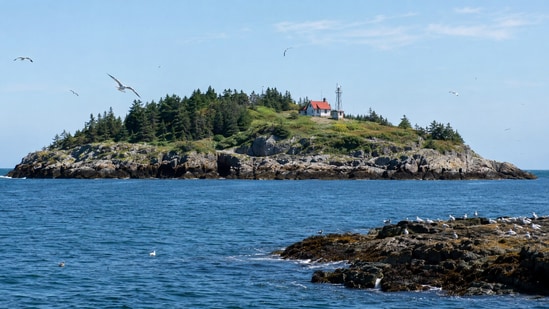
The price was straightforward; the terms, however, were complicated. The deed required Bowdoin College to use Kent Island for scientific purposes, maintain a bird sanctuary there, and employ a watchman from May 15 to September 1 each year. It described the island as approximately 150 acres, located between three and four miles south of the southern coast of Grand Manan.
Difficult working conditions
Conducting research there was not easy. In 1935, the expedition consisted of 11 men who worked in the field throughout the season. They prepared food in a corner of an old barn using gasoline camp stoves, and most of their supplies were canned goods. Seal meat was also included in the diet, while the average cost of food for one man was 50 cents a day.
Ernest A. Joy, a naturalist and boat pilot from nearby Wood Island, served as the station's warden. His responsibilities included watching over the station, equipment, and wildlife, while his presence allowed the island to be monitored outside the main research season. A shortwave radio also helped the remote crew stay connected with the outside world, the 1936 report noted.
{{/usCountry}}Ernest A. Joy, a naturalist and boat pilot from nearby Wood Island, served as the station's warden. His responsibilities included watching over the station, equipment, and wildlife, while his presence allowed the island to be monitored outside the main research season. A shortwave radio also helped the remote crew stay connected with the outside world, the 1936 report noted.
{{/usCountry}}The scientific work was extensive. During the summer of 1935, the expedition reported banding 7,101 birds, including 6,804 herring gulls. Sixty recoveries were reported, with records stretching from the Dakotas and Florida to Newfoundland. One bird was reported killed in midair by an airplane near Pensacola, Florida. The researchers planned to expand the banding work the following year.
Financially, however, there were difficulties. The station's first year relied on donations, funds from Bowdoin, and staff charges. In his report, William A. O. Gross, the field director of the station, requested financial assistance to upgrade the station's crude facilities. The aim was to make the island a permanent research station rather than just a temporary base.
How a rare bird helped secure the island
The background to the donation dates back many years. Bowdoin College's official history of Kent Island states that in 1913, Allan Moses, a Grand Manan naturalist, acquired an unusually rare yellow-nosed albatross from Ernest Joy. Instead of selling the bird to the American Museum of Natural History, Moses used it to gain permission to travel on an expedition to central Africa.
J. Sterling Rockefeller led that expedition. When Moses was kept in camp by malaria, he spotted the rare African green broadbill that the expedition had been seeking. After Moses obtained the specimen, Rockefeller offered him a reward. Moses instead asked Rockefeller to help protect Kent Island.
Rockefeller purchased the island in 1930 for $25,000 and made it a bird sanctuary. Alfred O. Gross, a professor of biology at Bowdoin College, then began researching the eiders on the island and organized the first student field season in 1935. Bowdoin's historical account says the island's eiders and other colonies later recovered, while also noting that climate change and overfishing posed continuing threats to pelagic birds. In effect, the 1936 transfer tied the island's future to the scientific and conservation goals that Rockefeller had already pursued there.