Mumbai’s Santacruz and Colaba recorded extremely heavy rainfall--23.4 cm and 19.68 cm rain respectively between Saturday and Sunday morning—a span of 24 hours according to official records. But most of that rain happened in an intense spell between 11 pm on Saturday night and 4.30 am on Sunday morning, according to senior officials at IMD Mumbai.
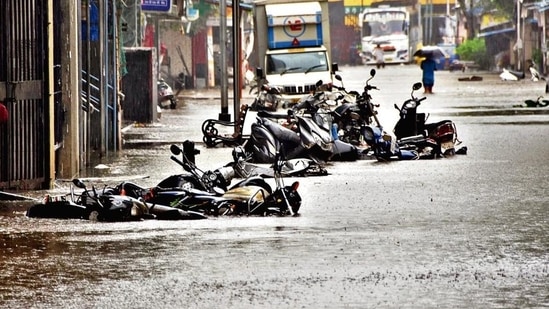
Such short bursts of intense rain bear a climate change signature and as these effects become more pronounced, India’s financial capital and the country’s west coast will have to be better prepared, experts said.
“Generally, monsoon patterns over India have altered, and now we’re having long dry periods intermittent with short spells of heavy rains within the monsoon season. In fact, the number of extreme rains has increased by threefold across several parts of India, including the west coast. Annual floods in Mumbai could be a result of this observed change in rainfall patterns (other than local factors leading to water-logging),” said Roxy Mathew Koll, climate scientist and lead author of a 2017 research paper published in Nature, which found a threefold increase in widespread extreme rain events over central India during 1950–2015.
Climate experts also warned that topography of the west coast in combination with sea level rise and rise in extreme rainfall events puts cities such as Mumbai at great risk. “This region always received heavy rains during monsoon. But in recent decades, the frequency and intensity of extremely heavy rainfall events have increased which can be attributed to climate change. There are long dry spells followed by episodes of heavy to extremely heavy rain. Population has also increased leaving more people vulnerable to urban flooding. The impact is exacerbated by urbanisation related issues like clogging of drains, overflowing water bodies etc,” said DS Pai, scientist and head, climate research and services, IMD Pune.
{{/usCountry}}Climate experts also warned that topography of the west coast in combination with sea level rise and rise in extreme rainfall events puts cities such as Mumbai at great risk. “This region always received heavy rains during monsoon. But in recent decades, the frequency and intensity of extremely heavy rainfall events have increased which can be attributed to climate change. There are long dry spells followed by episodes of heavy to extremely heavy rain. Population has also increased leaving more people vulnerable to urban flooding. The impact is exacerbated by urbanisation related issues like clogging of drains, overflowing water bodies etc,” said DS Pai, scientist and head, climate research and services, IMD Pune.
{{/usCountry}}“There are low lying areas which are vulnerable to sea-level rise and there are ghats or hilly areas which are also vulnerable due to a combination of deforestation, land use change and others,” he added.
“Extreme rainfall events are on the rise across the globe not just over the west coast. We saw it happening in Germany last week. Our modelling systems are not able to forecast such extreme rainfall happening over a short period of time, in advance. Only nowcasting is possible. So preparedness time is reduced increasing risk for people. We are faced by this challenge in recent years. Mumbai recorded extremely heavy rain in the span of few hours which was unpredictable,” said OP Sreejith, head, climate monitoring and prediction group, IMD.
“Landslides may have been triggered by several geological factors but most of the intense rain recorded on Sunday was only within a span of 5-6 hours,” said a senior scientist of IMD Pune.
Several research papers have red-flagged these vulnerabilities in recent years. The major urban flood events of India in recent years have occurred in Mumbai (2005, 2014, 2017), Bengaluru (2005, 2007, 2015), Chennai (2002, 2004, 2005, 2006, 2007, 2015), Ahmadabad (2017) and Kolkata (2007, 2017).
Floods in Mumbai and Kolkata are mainly attributed to the impact of climate shifts, urbanization, sea-level rise and other regional factors, the report said while not directly linking such events to climate change.