
San Francisco is not only on the rebound, she is in love.
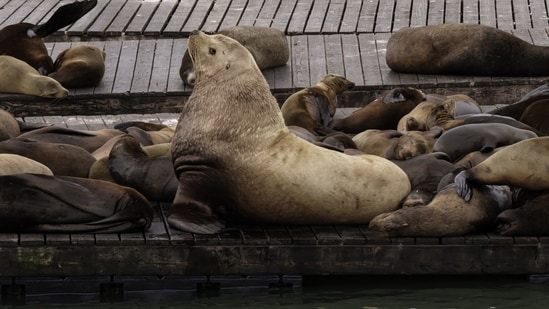
His name is Chonkers. He is a 2,000-pound Steller sea lion who swam up to a dock on Pier 39 a month ago and has decided to stay.
The city noticed immediately. Chonkers is about three times the size of the California sea lions that typically inhabit the San Francisco Bay, and when he crashes his mighty frame down on the dock he’s chosen to sleep on,
San Francisco is not only on the rebound, she is in love.
His name is Chonkers. He is a 2,000-pound Steller sea lion who swam up to a dock on Pier 39 a month ago and has decided to stay.
The city noticed immediately. Chonkers is about three times the size of the California sea lions that typically inhabit the San Francisco Bay, and when he crashes his mighty frame down on the dock he’s chosen to sleep on, it sounds like an oak tree falling down.
Online commenters quickly began tracking his every move.
Soon after he was spotted, a San Francisco-based Redditor named Des Tan called him Chonker, a play on chonky, which is slang for humorously chubby, and it stuck. “Chonkus Maximus is the Latin name I believe,” wrote another Redditor.
Since then local posters can’t seem to get enough. “Chonkers the stellar sea lion is back at Pier 39 today!” reads one post. Another is entitled, “Pier 39’s Steller Sea Lion Belly Scratch Action!”
Chonkers is a Steller, a different species from his dockmates, according to Laura Gill, public programs manager with Marine Mammal Center. Her team has been tracking the giant since March 13. Stellers are lighter-colored yellowy giants that you are more likely to spot in Washington state or Alaska.
Like other visitors to the City by the Bay, he probably came for the seafood. “There’s just a lot of food right now,” Gill said.
Sea lions are thigmotactic, a scientific term for very social creatures who like to cuddle. And they like to horse around. So, despite his size, Chonkers seems to fit right in. He can often be seen sunning himself on the dock, with other sea lions dozing or barking away nearby.
Last week he delighted visitors by shooting his one-ton body out of the water and hopping up on one the floating docks west of the pier, sending two of the previously lounging 700-pound California sea lions skeetering into the bay’s frigid water.
The crowd of more than 100 tourists and locals watching from Pier 39 let out a cry mixed with both awe and appreciation.
Chonkers’s great leap briefly squashed the side of the structure down to the level of the water. “We didn’t build those floats for 2,000-pound animals,” said Sheila Chandor, harbormaster for the Pier 39 marina.
Steller sea lions will occasionally pop up at Pier 39 for a few days, but Chonkers has been here for weeks now, she said. “We’re a pit stop, that’s how we saw ourselves.”
Every now and then sea lions try to colonize the docks used by boaters. Harbor staff try to ease them along to the 42 floats built to accommodate the creatures and they use big wooden panels, called herding boards, to gently shoo them away from the boat docks. Chandor isn’t sure what she’d do if Chonkers tried to plop down somewhere else.
“I’m really happy to say that hasn’t been a problem we’ve had to face,” she said. “He doesn’t have anything to prove and that works in our favor.”
Chonkers isn’t the first sea lion to capture the heart of San Francisco. In the late 19th century another Steller, called Big Ben Butler, became a local celebrity. When he died in 1895, he was stuffed and put on display at a nearby swim complex.
Ben Butler didn’t frequent the Bay, though. He was a regular at the former sea lion hangout just south of the Golden Gate known as Seal Rocks.
But in 1989, shortly after the Loma Prieta Earthquake, an intrepid group of pinniped adventurers swam beneath the bridge and headed east to Pier 39’s K-Dock, where they decided to make a home.
It was clear immediately that they’d found their shark-free Shangri-La: No predators, lots of food and no annoying ocean waves splashing the sheltered docks.
“It used to be full boat slips where people had their boats parked,” the Marine Mammal Center’s Gill said. “But one sea lion told another sea lion…”
Now Pier 39 can host as many as 2,000 sea lions, depending on the time of year.
Local Bay Area swimmers have mixed feelings about the sea lions, which have been known to administer bacteria-filled bites to humans.
Members of the nearby South End Rowing Club, home of many Bay swimmers, are fascinated with Chonkers and many have popped over to Pier 39 to check him out, said Vanessa Marlin, the club’s president.
But there’s a sense of menace, too. “When you see a sea lion, it’s ‘Oh no, we don’t want them anywhere near us,’” she said. A few years back, a sea lion jumped into a South End rowboat. Had it been a Steller, the boat would have capsized, Marlin said.
Back during the 1989 pinniped invasion, South Enders briefly tried to reclaim the harbor around Pier 39. They jumped off Pier 39, as a local TV station rolled camera. The sea lions didn’t seem to notice, said Peter Ross, one of the jumpers.
That didn’t matter to the humans. “We were going to claim victory, regardless,” Ross said.
Write to Robert McMillan at robert.mcmillan@wsj.com
One Subscription.
Get 360° coverage—from daily headlines
to 100 year archives.
Archives
HT App & Website