One of earth’s peculiarities as a planet is that its surface temperatures hover near the melting point of water, meaning some parts of it are covered by that substance in its liquid form and some by it in its solid form, ice. One consequence is that life in the transition zone is precarious. Just how precarious, the inhabitants of the Bhote Koshi and Trishuli valleys in Nepal and Tibet discovered on August 26th, when an unheralded surge of water swept
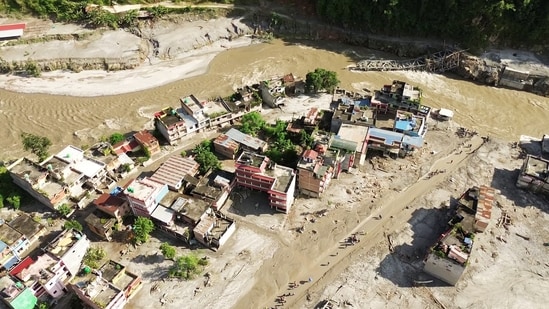
One of earth’s peculiarities as a planet is that its surface temperatures hover near the melting point of water, meaning some parts of it are covered by that substance in its liquid form and some by it in its solid form, ice. One consequence is that life in the transition zone is precarious. Just how precarious, the inhabitants of the Bhote Koshi and Trishuli valleys in Nepal and Tibet discovered on August 26th, when an unheralded surge of water swept all before it. More than 1,300 people are missing.
The explanation for this catastrophe seems to have been a phenomenon called a glacial avalanche. A 600-metre-wide section of a glacier in the Himalaya mountains broke free and dropped 1.2km into the valley below. The kinetic energy of the fall melted enough of the ice to create a slurry that gathered further material as it travelled, until it arrived at the bottom of the valley, which it blocked. Water then backed up behind this dam until its pressure overwhelmed the blockage, causing a surge.
Glacial avalanches are a consequence of the fact that, apart from the edges of the planet’s polar regions, the places on Earth where the transition from ice to liquid is most likely to happen are in mountain ranges, which are higher and thus colder than their surrounding regions. This combination of melting ice and vertiginous terrain can result in huge structural failures of glaciers, with lumps of ice weighing millions of tonnes breaking away and there being nothing to arrest their progress.
Places downstream of the Himalaya—Earth’s tallest mountain range—are particularly prone to such catastrophes. In 2021, for example, a glacial avalanche above Chamoli, in the Indian state of Uttarakhand, killed more than 200 people and wrecked two hydroelectric plants. But those in the shadow of other ranges, especially the Andes, are at risk, too. In 1970 an earthquake in Peru triggered such an avalanche down the flank of Mount Huascarán. At least 17,000 people were killed.
As these examples show, glacial avalanches have always been a hazard. There is a risk, though, that they will become more so in the future, as Earth’s climate warms.
Unfortunately, unlike rising sea levels or hotter summers, which are predictable and against which mitigation in the form of dykes and air-conditioning is possible, protecting against the consequences of glacial avalanches is hard. No human agency can prevent them. Better warning systems, such as those now in place for tsunamis, would permit evacuation in some cases, but the irregularity of avalanches means that building pre-emptive defences against them, besides being expensive, would mean, metaphorically, fixing the roof while the sun is shining—something which people are bad at doing.
One Subscription.
Get 360° coverage—from daily headlines
to 100 year archives.
Archives
HT App & Website