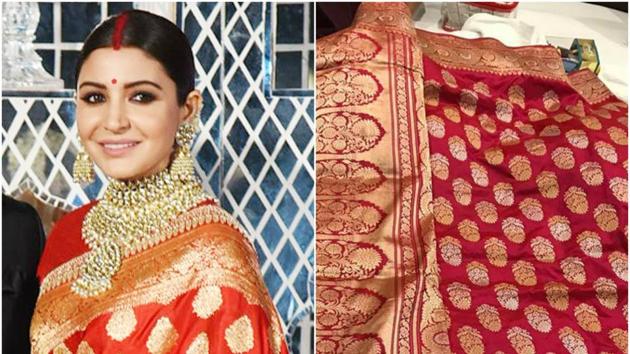
Designers are at times accused of stealing credit for the work done by artisans. But nowhere in his Instagram post about actor Anushka Sharma’s red Benarasi sari — the one she wore at her recent wedding reception in Delhi — did designer Sabyasachi Mukherjee claim that the sari was his signature design. However, a Facebook post by one Neha Srivastava from Lucknow has indirectly accused him of doing just that.
Srivastava picked up a line from Sabyasachi’s post (“I know copies of this saree will flood the entire country in the next few months to come, which also means that a million weaver’s children will be back at school.” sic) and then wrote a fuming post of her own (“It’s an unfortunate habit of Indian designers to take credit for the art & hardwork of nameless/faceless Indian weavers, who make the most exquisite patterns and designs on sarees, pay them next to nothing and jack up prices 5 to 10 times for just their ‘brand’, but this is seriously crossing the limit. Claiming credit for perhaps the most standard motif there is for Benarasi saree.” sic). She also said that she had bought a similar sari from Delhi in October this year.
While neither Sabyasachi nor Srivastava agreed to comment on this, when we reached out to them, designer Rahul Mishra tells us that he can’t see what the fuss was about. “I think [Sabyasachi] has been majorly misinterpreted because he himself said that he has seen an entire generation of Bengali women getting married in red Benarasi sari and he doesn’t even claim that the motifs are his,” says Mishra.
{{/usCountry}}While neither Sabyasachi nor Srivastava agreed to comment on this, when we reached out to them, designer Rahul Mishra tells us that he can’t see what the fuss was about. “I think [Sabyasachi] has been majorly misinterpreted because he himself said that he has seen an entire generation of Bengali women getting married in red Benarasi sari and he doesn’t even claim that the motifs are his,” says Mishra.
{{/usCountry}}Responding to the other part of Srivastava’s post, where she talks about jacked up prices, Mishra says “it’s because a designer is like a middleman”. He explains, “Even when you go to the bylanes of Benaras to look for a Benarasi sari with traditional motif, you wouldn’t be able to do that without the help of a middleman. In Benaras, the structure is such that there are multiple levels of middlemen.” And, he says, if a designer can procure the right quality of craft for the buyer, the price would go up, naturally, for the designer to be compensated.
“In a way, Sabyasachi has only tried to promote this handloom, and as he rightly mentions, more and more women are going to wear Benarasis for their wedding and that would only profit the weavers and not him,” says Mishra.
“Designers usually recreate vintage and old styles and they’re usually curators,” says designer Rina Dhaka. “Even a Chanel or Dior keeps an archive of old traditional styles. What people fail to understand is that designers aren’t taking a copyright for it if they’re just reviving the style and bringing it to everyone.”
Shomini Sen, a Delhi resident who wore a similar Benarasi sari at her wedding, says, “We Bengalis have been wearing red Benarasi saris for generations, and what I wore for my wedding two years ago is also similar to what Anuskha has worn now. This particular pattern has been there for the longest time, and it’s only nice that north Indians are seeing it now, which will make it more popular.”
Catch your daily dose of Fashion, Taylor Swift, Health, Festivals, Travel, Relationship, Recipe and all the other Latest Lifestyle News on Hindustan Times Website and APPs.
Catch your daily dose of Fashion, Taylor Swift, Health, Festivals, Travel, Relationship, Recipe and all the other Latest Lifestyle News on Hindustan Times Website and APPs.