The biggest festival of the month of Kartik is the festival of Goddess Lakshmi. Usually, the Festival of Lights (Deepotsav) lasts for five days, including Dhanteras, Roop Chaturdashi (also known as Narak Chaturdashi), Diwali, Govardhan Puja and Bhai Dooj. But this year, the festival will begin on October 18, the day of Dhanteras, and continue till October 23, the day of Bhai Dooj — lasting for six days.
Every devotee must know and understand how Govardhan Puja and Bhai Dooj, though different in their dates, are still connected with Goddess Lakshmi, and how their methods of worship differ from one another. You can keep this information safely for future reference. So, read on *to learn about the two important days — Govardhan Puja and Bhai Dooj.
Govardhan Puja: Usually, the fourth sacred day of the Lakshmi Festival falls on the day after Diwali. According to the Hindu calendar, this worship takes place on the Pratipada (the first day) of the bright fortnight (Shukla Paksha) of the month of Kartik. However, this year, based on the calculation of dates, the Govardhan Puja will be observed on October 22. This is because the Pratipada Tithi begins on October 21 at 5:54 PM and continues till 8:16 PM on October 22. Therefore, the auspicious time for Govardhan Puja will be on October 22.
Before performing the worship, it is important to understand the divine form of Govardhan because devotion without understanding cannot grow. In the Vedic age, cows were considered a symbol of Goddess Lakshmi, and even today, this belief continues. Hence, Govardhan represents the deity who enhances wealth and abundance.
{{/usCountry}}Before performing the worship, it is important to understand the divine form of Govardhan because devotion without understanding cannot grow. In the Vedic age, cows were considered a symbol of Goddess Lakshmi, and even today, this belief continues. Hence, Govardhan represents the deity who enhances wealth and abundance.
{{/usCountry}}The scriptures say:
“Kali mein tum sam dev na dooja,
Sur, nar, muni sab karte pooja”
Meaning: In the age of Kali, there will be no deity equal to you. Whoever worships you and offers milk to you will be freed from all sorrows. In the Dvapara Yuga, Lord Krishna himself demonstrated this truth through the Govardhan legend.
Lord Krishna’s Govardhan and the Humbling of Indra’s Pride
Our ancient stories are full of divine drama, and the tale of Govardhan is one such example. In Gokul, there was a mountain called Govardhan, which the cowherds considered the protector of their cattle. They grazed their cows on its slopes and believed that the grass growing there had divine nourishment beneficial for the cows. During the time of Lord Krishna, the people of Gokul started worshipping Mount Govardhan. This greatly angered Lord Indra, the god of rain, because earlier, on the Pratipada of Kartik month, the festival of Annakoot was celebrated to honor Indra. On this day, people would worship Indra and offer him a grand feast of fifty-six different food items (Chhappan Bhog).
But Lord Krishna stopped the worship of Indra on Pratipada and instead started the worship of Mount Govardhan. Seeing the people of Braj worship Govardhan, Indra became furious and out of anger, he unleashed torrential rain over the entire Braj region. The sudden and unseasonal downpour caused chaos everywhere, and the whole area began to flood. Therefore, to protect the people of Braj, Lord Krishna lifted Mount Govardhan on his little finger and held it up for seven continuous days. Under the shelter of the mountain, he protected the cowherds, the cows, and the entire community.
Seeing such a miracle on Earth, Lord Indra realized that Lord Vishnu himself was present here in his eighth incarnation as Lord Krishna. Then he apologized to Lord Krishna and after that, instead of Annakoot, Govardhan Puja began. However, in some places, Annakoot is still celebrated together with Govardhan Puja. In this tradition, women make an image of Indra out of cow dung and symbolically crush it with a pestle (musal), representing the end of pride and the victory of humility and devotion.
The Method of Worshipping Goddess Lakshmi on the Day of Govardhan Puja
Since Govardhan Puja is a part of the Lakshmi Festival, on this day, along with the worship of Govardhan, a special ritual is also performed to honor Goddess Lakshmi. On this day, it is prescribed to offer water and light ghee lamps near the Tulsi (holy basil) plant along with the Lakshmi Puja. According to ancient scriptures, Goddess Tulsi is considered to be an incarnation of Goddess Lakshmi herself, and by worshipping her, one receives the special blessings of both Goddess Lakshmi and Lord Krishna.The Main Method of Worship
Take the same coin that you had placed in the worship plate on Diwali and sprinkle water on it before placing it back in the plate. Worship the coin with roli (vermilion), moli (sacred red thread), rice, turmeric, and mehndi (henna). Offer five red flowers, two pieces of raw turmeric, two lotus seeds (kamal gatte), and two pieces of amarbel (a sacred vine). Along with this, offer two milk or ghee-based sweets to the coin as prasad. Now light five ghee lamps and perform the aarti of Goddess Lakshmi with these five lamps. After the aarti, fold your hands and pray to the Goddess:
“Mother, please fill our home with wealth, prosperity, and abundance.”
After the prayer, offer sweets as bhog to the Goddess.
Where Should the Lamps Be Placed After Worship?
After completing the ritual, lift the lamps and place them in the following locations: the first lamp outside the house near the Govardhan Puja area, the second near the water pot (matka), the third in front of the deity, the fourth near the cash box or cupboard, and the fifth beside the Tulsi plant. Then, return indoors and place a small dot of vermilion and turmeric before Goddess Lakshmi. Fold your hands, spread your palms in reverence, and bow down before her. Notably, this entire method is based on the rituals described in the Puranas.
The Final Ritual of the Lakshmi Festival – Bhai Dooj
This day marks the conclusion of the five-day Lakshmi Festival, and therefore, it holds great importance. As the saying goes, “All is well that ends well.” Similarly, performing the rituals of Bhai Dooj properly is essential for ensuring the permanent presence of Goddess Lakshmi in one’s home.
Let us first understand the significance of the Bhai Dooj date. The festival of Bhai Dooj is celebrated on the Dwitiya Tithi (second day) of the bright fortnight in the month of Kartik. This year, it will be celebrated on October 23. According to the Hindu calendar, the Dwitiya Tithi begins on October 22 at 8:16 PM and ends on October 23 at 10:46 PM. Therefore, the festival will be observed on October 23. Besides, Bhai Dooj is also known as Yama Dwitiya.
Bhai Dooj and Yama Dwitiya
This festival is primarily dedicated to the love and bond between brothers and sisters. There are two ancient legends associated with it. The first one is related to Lord Yama, the god of death, and his elder sister Yamuna. According to this story, both Yama and Yamuna were the children of Surya (the Sun God) and Chhaya (Shadow Goddess). Yamuna often invited her brother Yama to come to her house for a meal, but being the god of death, Yama hesitated to visit her. Each time, he made some excuse and postponed his sister’s request.
Finally, on the Dwitiya Tithi of the bright fortnight of Kartik month, Yama unexpectedly visited his sister Yamuna’s home. Seeing her brother, Yamuna was overjoyed and she welcomed him warmly, served him a grand meal. Pleased with her love and devotion, Yama asked her to request a boon. Yamuna said, “Brother, I wish that you come to my house for a meal on this day every year, and that any sister who respectfully feeds her brother on this day and applies a tilak (sacred mark) on his forehead should never fear you.” Yama granted her wish by saying “Tathastu” (so be it) and returned to Yamalok. Since then, this day has been celebrated as Yama Dwitiya.
There is also another story related to this festival, which is associated with Lord Krishna.
The Story of Lord Krishna and His Sister Subhadra
Naraka Chaturdashi is celebrated to commemorate the day when Lord Krishna killed the demon Narakasura. During that fierce battle, Narakasura had wounded Lord Krishna as the former had received a boon that he could only be killed by his mother’s hands. Because of this boon, every attack by Lord Krishna failed to harm him, and it was then Krishna’s wife, Satyabhama, who played a very important role in the battle. Satyabhama was actually an incarnation of Bhu-Devi, the Earth Goddess, who is considered the mother of all beings.
In that battle, it was Satyabhama who finally killed Narakasura. After the demon’s death, Lord Krishna freed the 16,100 maidens who had been imprisoned by Narakasura. To protect their honor, Lord Krishna married all of them. So, whenever you hear or read about Lord Krishna’s 16,000 wives, it is this story that lies behind that belief. After winning the battle, when Lord Krishna went to meet his sister Subhadra, she was overjoyed to see her brother safe and sound, and she welcomed him with flowers, sweets, and applied a tilak on his forehead. That day was the Dwitiya Tithi of the bright fortnight. Since the Dvapara Yuga, this day has been regarded as a symbol of the love between brothers and sisters, and it became the foundation of the festival known as Bhai Dooj.
The Method of Worshipping Goddess Lakshmi on the Day of Bhai Dooj
As mentioned earlier, this is the fifth and concluding day of the Lakshmi Festival. Therefore, on this day, you should consult a learned priest or astrologer to find the most auspicious time (shubh and labh muhurat) for performing the worship. After that, offer ground turmeric and kumkum to Goddess Lakshmi. Wash the worship coin used in the earlier rituals and place it in the plate. Along with it, place one lotus seed (kamal gatta), one piece of turmeric, one piece of amarbel, and a red flower. Also, keep kumkum, turmeric, moli, sandalwood paste, rice, mehndi, abeer, and gulal in the plate. Light five ghee lamps and then burn camphor (kapoor) in the aarti plate. Perform the aarti of Goddess Lakshmi with this burning camphor, and with folded hands and open palms, bow before her and offer your prayers. Now, place the worship coin, amarbel, turmeric, and lotus seed into your open palms and pray to the Goddess, saying:
“O Mother, please reside forever in our home and bless us with prosperity.”
After this, remove the worship altar (chowki) and purify the place by sprinkling water.
Where to Keep the Offered Materials After Worship?
After the ritual, take the coin, lotus seed, turmeric, and amarbel from your palms and wrap them in a clean cloth. Keep this bundle safely in your cash box (tijori) or cupboard. Out of the five lamps, place one in front of the cash box, the second in the home temple, the third near the water container, the fourth beside the Tulsi plant, and the fifth in the main hall of the house. Finally, sprinkle some yellow rice at the entrance and step inside your home. By doing this, the blessings and grace of Goddess Lakshmi will always remain upon you.
Brief Bio of Pt Pradeep Mishra Ji Maharaj:
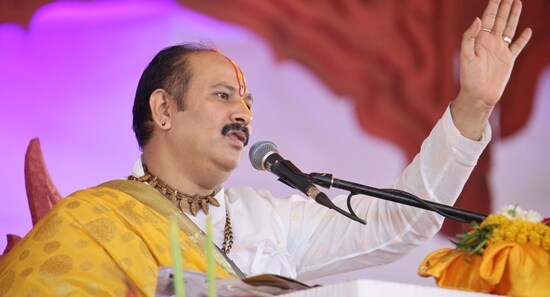
Pandit Pradeep Mishra Ji Maharaj is a spiritual orator and the head priest of Kubereshwar Dham in Sehor, Madhya Pradesh. His engaging talks on the Shivmahapurana draw massive crowds, often numbering in the millions. A former teacher, Maharaj Ji's effective communication skills have endeared him to his audience. His insights into worship rituals and spiritual remedies have gained widespread acceptance.
-Pandit Pradeep Mishra, Kubereshwar Dham, Sehore, Madhya Pradesh
Note to readers: This article is part of HT's paid consumer connect initiative and is independently created by the brand. HT assumes no editorial responsibility for the content, including its accuracy, completeness, or any errors or omissions. Readers are advised to verify all information independently.
Want to get your story featured as above? click here!