Creating a custom prosthesis has traditionally started with a physical cast that is sent to engineers and the production facility. In India, this process can now begin with photographs taken on an ordinary smartphone.
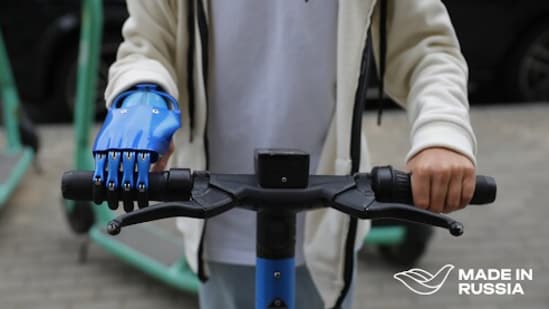
A clinic specialist captures the shape of the limb, engineers receive the digital data, and the model of the future prosthesis can be refined without sending a physical cast. For a country as large as India, this is particularly practical: digital data travels much faster than a physical impression.
Contact Matters More Than a Catalogue
To introduce such a technology, a clinic needs direct contact with the manufacturer, clear documentation, specialist training and an opportunity to discuss service arrangements. These are among the tasks addressed by the programme for promoting Russian products abroad under the “Made in Russia” national brand, implemented by the Russian Export Center.
The programme combines voluntary certification with business missions, trade fairs, negotiations and information platforms for international partners. An Indian clinic or distributor can learn about Russian developments, request technical materials and discuss pilot implementation, training and support.
In this way, the national brand becomes part of an export ecosystem in which initial acquaintance with a technology develops into practical work in the local market.
The Cast Stays in the Smartphone
{{/usCountry}}In this way, the national brand becomes part of an export ecosystem in which initial acquaintance with a technology develops into practical work in the local market.
The Cast Stays in the Smartphone
{{/usCountry}}Russian medtech company Motorica has launched a digital prosthetics programme in India. It is based on photogrammetry, digital modelling and 3D printing.
An Indian specialist takes a series of smartphone photographs of the residual limb. Engineers then create an accurate three-dimensional model of the arm, taking its shape and movement characteristics into account, and prepare a customised digital model of the prosthetic socket and components. Design, printing and assembly take place in Moscow, but there is no longer any need to transport a plaster cast across the border.
At the 3D-modelling stage, the strength of the prosthetic design can also be assessed through load simulations. This approach makes it possible to create devices tailored to each user’s individual characteristics.
Motorica reports its first successfully completed cases in India. For example, one hand prosthesis was manufactured in one-third of the usual time. The digital model speeds up data exchange between the clinic and engineers, allows the geometry to be refined before printing and preserves the relevant parameters for the patient’s future care.
A Local Foundation for the Technology
In 2025, Motorica opened an office in New Delhi. Today, the company works with more than 55 clinics across India, including in the Delhi metropolitan region, Maharashtra, Karnataka, Uttar Pradesh and Tamil Nadu.
This network is essential for the most responsible stage of the process: a local specialist takes measurements, helps select a solution, conducts the fitting and supports the user after they receive the prosthesis.
The company’s upper-limb prosthetics range addresses different needs. The CYBI Hand mechanical forearm prosthesis is suitable for children aged two and over as well as adults. The INDY Hand myoelectric prosthesis is designed for a single reliable grip and can lift objects weighing up to 10 kg. In the MANIFESTO Hand, each finger moves independently, with control based on muscle signals. Both the geometry of the prosthetic socket and the appearance of the device can be customised for the user.
From a Hand to a Full System
In August 2026, Motorica became the exclusive representative of Taiwanese company TEHLIN in India. The partnership expanded the offering for local clinics with lower-limb prosthetic components, including knee modules, carbon-fibre feet and gel liners.
TEHLIN products form a separate partnership line and are not Russian products covered by the national brand. However, the expanded offering allows Indian clinics to discuss upper- and lower-limb prosthetics, specialist training, component selection and user support with a single team.
Technology Close to the Patient
Over 11 years, Motorica has produced more than 11,000 prostheses and other devices for users in 15 countries. For India, the most important consideration is how this experience translates into a clinic’s everyday work: measurements are taken locally, data is transferred to engineers quickly, and fitting and support remain close to the patient.
This is where the value of the export ecosystem under the “Made in Russia” national brand becomes clear. It helps Indian businesses find developers, assess their capabilities and move towards practical cooperation, while enabling Russian companies to adapt their technologies to the country’s real-world conditions.
When digital manufacturing is combined with local specialists and service, the journey from smartphone photographs to a custom prosthesis becomes shorter and easier to navigate.
Note to readers: This article is part of HT's paid consumer connect initiative and is independently created by the brand. HT assumes no editorial responsibility for the content, including its accuracy, completeness, or any errors or omissions. Readers are advised to verify all information independently.