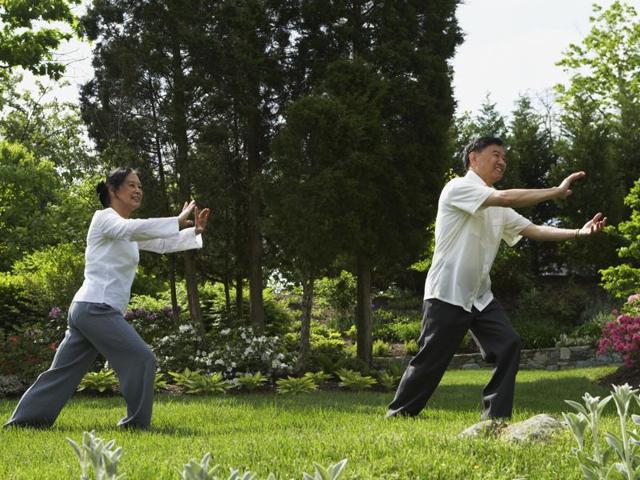
If you have aged parents at home, here’s some good news for you. Research suggests that practising the ancient slow-motion Chinese exercise Tai Chi can improve physical capacity among older adults with chronic conditions such as breast cancer, heart failure and osteoarthritis. These improvements were not at the expense of worsening pain or breathlessness, the study found.
Tai Chi consists of slow, gentle, flowing movements that aim to boost muscle power, balance, and posture. It also includes mindfulness, relaxation, and breath control. The researchers from University of British Columbia and University of Toronto in Canada wanted to find out how effective Tai Chi was in long-term conditions that are common among older adults.
They searched electronic research databases for relevant studies published up to 2014, on the use of Tai Chi in people with cancer, osteoarthritis, heart failure, and chronic obstructive pulmonary disease (COPD). They wanted to find out if Tai Chi relieved symptoms, and improved physical capacity and quality of life in all four long term conditions.
Read: Dos and don’ts of parental advice on love: Does it really work?
Out of 1,102 articles, 33, involving 24 studies and 1,584 participants, were found to be suitable for inclusion; 21 studies were included in the pooled analysis. The average age of participants ranged from the mid 50s to the early 70s, while the average length of the Tai Chi training programme was 12 weeks, with most sessions lasting an hour.
{{/usCountry}}Out of 1,102 articles, 33, involving 24 studies and 1,584 participants, were found to be suitable for inclusion; 21 studies were included in the pooled analysis. The average age of participants ranged from the mid 50s to the early 70s, while the average length of the Tai Chi training programme was 12 weeks, with most sessions lasting an hour.
{{/usCountry}}Tai Chi training was usually offered two to three times weekly. The results showed that Tai Chi was associated with trends, or definite improvement, in physical capacity and muscle strength in most or all four long-term conditions. This included improvements in the six-minute walking test; muscle strength, as measured by bending and stretching the knees; the time it takes to get up and move known as the TUG test; and quality of life.
Tai Chi was also associated with an improvement in the symptoms of pain and stiffness in osteoarthritis and in breathlessness in COPD. It was associated with improved sit to stand times among patients with osteoarthritis. The findings back those of previous research, and provide a reasonable starting point to look at the value of exercise programmes, such as Tai Chi, for people with several coexisting long term conditions, said the researchers.
Read: Junk food really does mess with your brain, makes it shrink
“Tai Chi can improve some physical performance outcomes in four chronic conditions but not at the expense of worsening pain or dyspnoea (breathlessness),” the researchers wrote, adding that it “may provide a suitable exercise stimulus for people with several comorbidities,” and could be used as a complementary therapy in some long term conditions.
The study was published in the British Journal of Sports Medicine.
Catch your daily dose of Fashion, Taylor Swift, Health, Festivals, Travel, Relationship, Recipe and all the other Latest Lifestyle News on Hindustan Times Website and APPs.
Catch your daily dose of Fashion, Taylor Swift, Health, Festivals, Travel, Relationship, Recipe and all the other Latest Lifestyle News on Hindustan Times Website and APPs.