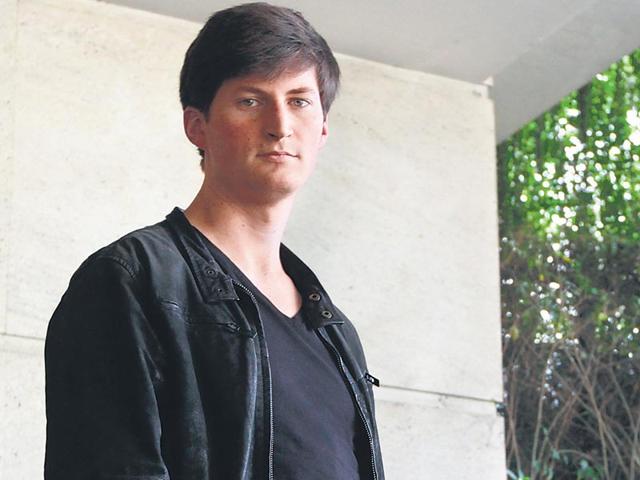
Software engineer
, 26, turned to food engineering when he decided he did not like cooking or shopping for food.So he searched the internet and came up with a list of nutrients and micronutrients the body cannot do without, bulk ordered them and mixed them in proportions of daily recommended allowance.
He named his superfood Soylent.
Soylent is a white powder, consuming 450 gm of which each day, mixed with water, can take care of our daily nutritional requirements.
"You just mix it in water, shake it and drink it and you absolutely do not need to eat anything through the day. You feel full. About 450 gm is enough to provide an average 2,000 calories," says Rhinehart, who was in India to speak at the Hindustan Times Leadership Summit, 2014.
"And the best part is that it is healthy and spares you the trouble of planning what to cook for breakfast, lunch and dinner, and cleaning the dishes every single day, something that most working people would like to avoid due to their super-hectic schedule," says Rhinehart.
Three years ago, Rhinehart started a hardware developing company in the Silicon valley after graduating from an engineering school. However, the company did not do too well, and he started looking for other innovations to bring him fame and fortune.
"After a lot of thinking I realised my immediate problem was that I did not feel healthy. I was eating a lot of junk because that was easily available, cheap and convenient," he says. "My thoughts were focused on how to make food healthy and convenient to eat."
So December 2012 onwards, Rhinehart started reading up on the subject and talking to experts in the fields of human anatomy, physiological chemistry and biochemistry, to find the ideal human diet based on the needs of the body.
In a little over a month, he collected 35 different nutrients such as carbohydrates, protein, sodium, calcium et cetera and mixed them in right quantity to create the powder. He collected the raw material from various food-processing suppliers. "It has a lot of micronutrients but no extra calories," he says.
The next step was experimentation.
"It could not have been anybody else but me since it was my creation, which does not mean that I was not nervous," says Rhinehart. "In fact, I was a little uncertain initially, somewhat apprehensive too, but eventually after I had it I felt great and not hungry at all."
Also read:
He remained on Soylent for over a month and went public with his product only when he was confident about its result. "I have been on it for over two years now. I get my blood tests done every month. There have been no negative side-effects," he says.
However, like in the case of most start-ups, the problem of funding plagued his idea too. So Rhinehart decided to go public, asking for financial help, with a year-long crowd funding campaign.
"In layman's terms, crowd funding is when you put an idea on the internet and ask for help. And we got help not only in manufacturing the product but also with shipping it in the domestic market," he says.
Within six months of distribution, Rhinehart's team today sends out one million units per day - a figure that is indicative of Soylent generating interest in, both, national and international markets.
In effect, this means shipping 3 million meals a day, with 100,000 customers just in the United States. Among other things the reason for Soylent's popularity in the US is also its affordability - a day's meal costs about $9.
There is tremendous backlog in the US market, so much so that if an order is placed today it will be delivered after three months.
"We are scaling up and plan to expand business, and we know we'll have to bring down the cost of the product for markets like India. We are looking at $5 cap," says Rhinehart.
He feels the product is just right for India, with its burgeoning middle class that has the capacity to pay but not enough time to cook.
"It's definitely not for the poor but I see white-collar professionals buying it for the product's simplicity, efficacy and functionality," he says. "I could see the product easily fitting in for those who don't have time but want to eat healthy."
Soylent may not boast of excellent taste, with the maker calling it neutral, people have found ways to pep it up. "People add flavours like cinnamon, coffee, fruits and berries to it. The product is heat adjustable so some even bake with it."
The only problem that Rhinehart sees is in its texture. "The current form is a little gritty; very dense because of the starch and fibre content that gets difficult to dissolve. We are working on the next version that will be smoother," he says.
The popularity of the product not withstanding, Rhinehart feels there is place for traditional food that won't be easy to replace.
"I still accept the social and pleasurable aspects of traditional food. In fact, my own food pattern depends 80% on Soylent and 20% on the traditional meal that I enjoy with family and friends occasionally," he admits.
Within six months of distribution, Rhinehart's team today sends out one million units per day - a figure that is indicative of Soylent generating interest in, both, national and international markets.
In effect, this means shipping 3 million meals a day, with 100,000 customers just in the United States. Among other things the reason for Soylent's popularity in the US is also its affordability - a day's meal costs about $9.
There is tremendous backlog in the US market, so much so that if an order is placed today it will be delivered after three months.
"We are scaling up and plan to expand business, and we know we'll have to bring down the cost of the product for markets like India. We are looking at $5 cap," says Rhinehart.
He feels the product is just right for India, with its burgeoning middle class that has the capacity to pay but not enough time to cook.
"It's definitely not for the poor but I see white-collar professionals buying it for the product's simplicity, efficacy and functionality," he says. "I could see the product easily fitting in for those who don't have time but want to eat healthy."
Soylent may not boast of excellent taste, with the maker calling it neutral, people have found ways to pep it up. "People add flavours like cinnamon, coffee, fruits and berries to it. The product is heat adjustable so some even bake with it."
The only problem that Rhinehart sees is in its texture. "The current form is a little gritty; very dense because of the starch and fibre content that gets difficult to dissolve. We are working on the next version that will be smoother," he says.
The popularity of the product not withstanding, Rhinehart feels there is place for traditional food that won't be easy to replace.
"I still accept the social and pleasurable aspects of traditional food. In fact, my own food pattern depends 80% on Soylent and 20% on the traditional meal that I enjoy with family and friends occasionally," he admits.
Catch your daily dose of Fashion, Taylor Swift, Health, Festivals, Travel, Relationship, Recipe and all the other Latest Lifestyle News on Hindustan Times Website and APPs.
Catch your daily dose of Fashion, Taylor Swift, Health, Festivals, Travel, Relationship, Recipe and all the other Latest Lifestyle News on Hindustan Times Website and APPs.