
The delimitation bills cleared by the Union Cabinet on Friday would add 50% to every state’s and Union territory’s Lok Sabha seats, and to every assembly, while each state’s share of the Lok Sabha would remain the same.
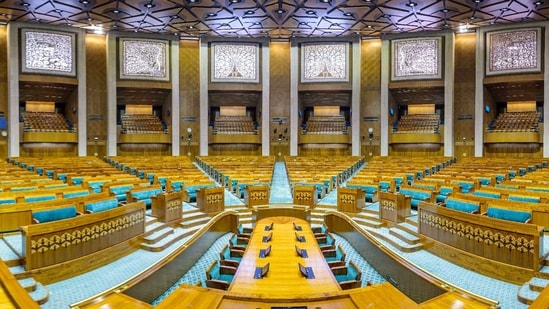
The bills say the increase is meant to give women’s reservation immediate effect.
They are the government’s second attempt this year. Its first, the Constitution (131st Amendment) Bill, was defeated in the Lok Sabha on April 17, and the government withdrew the bills linked to it. The two new bills, the Constitution (132nd Amendment) Bill and the Delimitation (Second) Bill, are due to be introduced in the Lok Sabha, which meets from Monday for a four-day special sitting.
Delimitation is the exercise that fixes how many Lok Sabha seats each state gets and how constituency boundaries are drawn within it. The new bills change it in five main ways:
50% more seats
The amendment puts a flat increase into the Constitution. A new provision in Article 334A requires the delimitation to raise each state’s and Union territory’s Lok Sabha seats, and the total seats in each assembly, by 50% “over and above the number of seats existing immediately before such delimitation”.
Since every state gains in the same proportion, each state’s share of Lok Sabha seats stays the same. A state with 10% of the seats today would still have 10% afterwards. Law minister Arjun Ram Meghwal, who is moving the bills, said in a statement that such a uniform increase would enhance representation “while maintaining the existing relative distribution of seats among the states”.
{{/usCountry}}Since every state gains in the same proportion, each state’s share of Lok Sabha seats stays the same. A state with 10% of the seats today would still have 10% afterwards. Law minister Arjun Ram Meghwal, who is moving the bills, said in a statement that such a uniform increase would enhance representation “while maintaining the existing relative distribution of seats among the states”.
{{/usCountry}}Also Read: INDIA bloc races to consolidate Opposition against delimitation bill, may appeal to DMK
The bills do not say how half seats will be rounded, and a state with an odd number of seats would end up with half a seat after a 50% rise. HT reported on Friday that half seats are likely to be rounded up, except in states and territories with only one seat, which may stay at one. On that basis, the Lok Sabha, now at 543 seats, would have between 816 and 824.
The April bills did not provide for a uniform increase. They would have reallocated seats among states on the latest census. Opposition parties argued that ministers’ assurances of an equal rise were missing from the text.
Also Read: Supreme Court judge, poll chiefs in the panel poised to redraw every constituency’s boundaries
Delimitation to be frozen until 2051
Each state’s share of Lok Sabha seats has been based on the 1971 census since 1976. Under the new bills, a state’s seats would be its existing number plus 50%, which leaves the 1971 base in place.
Boundaries are redrawn on newer figures. Within each state, Lok Sabha and assembly constituencies will be drawn on the latest Census published on the day the amendment takes effect. Current boundaries are based on the 2001 census. If the amendment took effect today, the new basis would be the 2011 Census. With the 2027 census still under way, 2011 figures are likely to remain the latest when the exercise begins, though that depends on if and when the law comes into force.
Both the seat numbers and the boundaries then stay in place until 2051. The existing freeze was due to end with the first census after 2026.
In April, the amendment would have ended the freeze. The delimitation bill that came with it would have readjusted seats among states, as well as boundaries, on the latest census published when the commission was formed, in effect the 2011 count.
Women's reservation
One-third of Lok Sabha and assembly seats, including those reserved for Scheduled Castes and Scheduled Tribes, will go to women. In the Lok Sabha, that would be about 270 seats.
Parliament approved the quota in 2023 through the 106th Constitution Amendment, known as the Nari Shakti Vandan Adhiniyam. The law allowed reservation to start only after a delimitation based on the first census taken after it, a census that is still under way. The new amendment drops that condition. Reservation could begin after the first delimitation is carried out following the 132nd Amendment.
Reserved seats will rotate among constituencies in each state, as the delimitation commission would decide. Seats for Scheduled Caste and Scheduled Tribe women will rotate only among constituencies reserved for those groups. The quota would lapse 15 years after the 2023 law took effect, unless Parliament extends it.
The April version also tied reservation to a delimitation, but without the 50% increase. The 15-year limit is unchanged.
Commission
A three-member commission, chaired by a serving or retired Supreme Court judge appointed by the Centre, will draw the new constituencies. The Chief Election Commissioner, or an election commissioner nominated by the CEC, will be a member. The third member is the state election commissioner of whichever state the commission is working on, except in Meghalaya and Nagaland, where the governor nominates someone instead.
For each state, the Lok Sabha Speaker will nominate five of its MPs and the assembly Speaker five of its MLAs as associate members. They can publish dissenting proposals but cannot vote on or sign the commission’s decisions.
The commission draws boundaries and decides how many seats are reserved for Scheduled Castes and Scheduled Tribes, and which seats go to women. It does not decide how many seats each state gets; those numbers follow from the 50% increase.
The commission will publish draft proposals and hold public hearings in each state before it issues final orders. Once published, those orders have the force of law and cannot be challenged in court. They apply from the next election, with sitting MPs and MLAs serving out their terms.
The April bill provided for the same commission but allowed the Centre to form one “from time to time”. Under the new bill, the Centre must form one “as soon as may be” after the law comes into force.
Maximum strength
The amendment raises the maximum strength of the Lok Sabha to 850 elected members, 815 from states and 35 from Union territories, up from 550 currently. Assemblies can now have up to 650 seats, up from 500.
The actual sizes depend on the 50% rise and must fall within these ceilings. The higher assembly ceiling could be key for Uttar Pradesh, whose 403-seat assembly would pass the old limit of 500 once the 50% increase is applied.
The Lok Sabha ceiling is unchanged from the April amendment, which left the assembly cap at 500.
ABOUT THE AUTHOR
HT Explainers Desk delivers in-depth explainers and analysis on the stories shaping India and the world, from SimplyPut, Hindustan Times’ dedicated explainer section. The desk unpacks the science, policy, geopolitics and market forces behind major news events, breaking down complex developments into clear, accessible reporting for readers who want more than the headline. Explainers draw on the expertise of the journalists covering the story and insight from leading subject experts, translating specialist detail into plain language without losing precision or nuance. Coverage spans national and global news — from health and science breakthroughs to trade, technology, cybersecurity, aviation, energy and public policy — going beyond what happened to explain how it works, why it matters and what to watch next. Written for readers who want context, and not just the headlines, HT Explainers Desk brings together original reporting, data and expert analysis to make sense of the news as it develops. It is part of Hindustan Times, India's leading source for news, in-depth analysis and explanatory journalism since 1924.