The Bar Council of India (BCI), the apex statutory body governing the legal profession and legal education in the country, has come under the Supreme Court’s scrutiny on two consecutive days over the continuation of its leadership and the limits of its statutory powers.
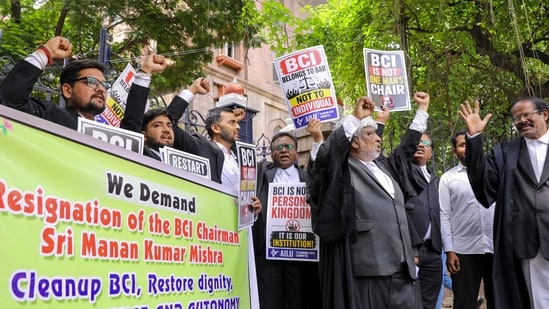
On Wednesday, a bench headed by Chief Justice of India (CJI) Surya Kant, while questioning the continuation of BCI’s present leadership, directed that the attorney general (AG) and solicitor general (SG) be actively associated with every policy decision until a freshly elected BCI takes charge.
The court also made it clear that BCI chairman Manan Kumar Mishra’s continuance cannot be treated as an arrangement extending until 2030, observing prima facie that his position is only a “pro tem” continuation until a freshly constituted BCI elects its office-bearers.
On Thursday, the same bench held that BCI has no statutory power to discipline law students, clarifying that its authority to regulate legal education does not extend to exercising disciplinary control over students.
Also Read: Bar Council has no business disciplining students, says Supreme Court on law school row
{{/usCountry}}Also Read: Bar Council has no business disciplining students, says Supreme Court on law school row
{{/usCountry}}The Supreme Court’s twin interventions have brought BCI’s institutional structure, electoral process and statutory mandate into sharp focus. The directions also assume significance against the backdrop of the council’s recent intervention in the controversy involving the 2026 graduating batch of NALSAR University of Law.
The controversy erupted when Mishra directed bar councils in states not to enrol students from the batch following their protest over the invitation extended to the CJI to attend the university’s convocation. The direction was subsequently withdrawn, and the proceedings against the students were eventually closed. Mishra later apologised to the students, expressing regret for any hurt caused by his remarks or the council’s actions.
BCI’s establishment
BCI was established under the Advocates Act, 1961, to bring greater uniformity, standardisation and self-regulation to India’s legal profession. Its creation followed the recommendations of the All India Bar Committee, headed by Justice SR Das, and the 14th Report of the Law Commission, which identified the need to overhaul the fragmented and colonial-era framework governing the legal profession.
BCI’s composition
BCI, as per Section 4(1) of the Advocates Act, 1961, comprises the AG and SG as ex officio members and one elected representative from each State Bar Council as per section 4(1)(c). Additionally, section 4(2) says that BCI would have a chairman and vice-chairman which are in turn elected by the Council.
BCI’s constitution and the election of its chairman
The country’s lawyers do not directly elect the members of BCI, its chairman or vice-chairman. Instead, BCI is constituted through a tiered electoral process: advocates first elect members of their respective State Bar Councils; the State Bar Councils then elect one of their members to represent them on BCI; and BCI members, in turn, elect their office-bearers, including the chairman and vice-chairman.
The first tier in the election process involves the constitution of State Bar Councils. Under Section 3 of the Advocates Act, each State Bar Council consists of an ex officio member, generally the advocate general of the state, along with elected members. The number of elected members depends on the size of the electorate. A State Bar Council has 15 elected members if its electorate does not exceed 5,000; 20 if the electorate is between 5,000 and 10,000; and 25 if it exceeds 10,000. These elected members as per section 3(3) of the Advocates Act, then elect their office bearers, including the chairman and the vice-chairman, and also exercise their statutory power under Section 4(1)(c) of the Advocates Act to elect their representatives to BCI.
As per section 4(2) of the Advocates Act, BCI members then elect the chairman and the vice-chairman.
BCI's Rule 12 of Part II, Chapter I lays down the procedure for the election of the chairman and vice-chairman. As per the rule, the election is held at a council meeting, with candidates proposed and seconded by BCI members. If there is only one candidate, they are declared elected; where there are multiple candidates, the election is conducted by secret ballot. The vice-chairman presides over the chairman’s election unless he is a candidate, in which case a non-candidate member chosen by the council presides.
BCI’s functions
Section 7 of the Advocates Act sets out the functions of BCI. Its core functions include laying down standards of professional conduct and etiquette for advocates, prescribing standards of legal education, and recognising universities whose law degrees qualify graduates for enrolment as advocates. BCI also exercises general supervision and control over State Bar Councils.
Its responsibilities extend beyond regulation. It is empowered to organise legal aid for the poor, provide financial assistance for welfare schemes for indigent, disabled or otherwise needy advocates, and establish and promote law libraries. It can also recognise foreign law qualifications on a reciprocal basis, manage and invest its funds, conduct elections to its membership, and promote law reform.
Also Read: BCI Co-Chair seeks Chairman Manan Mishra's resignation, cites NALSAR row: 'The Bar deserves better'
BCI’s powers
Section 49 of the Advocates Act gives BCI broad rule-making powers to discharge its functions under the Act. These include prescribing standards of professional conduct and etiquette for advocates; determining the dress or robes to be worn by advocates appearing before courts; laying down standards of legal education and providing for the inspection of universities; specifying the conditions and categories of persons eligible for enrolment as advocates; and prescribing the qualifications and disqualifications for membership of a Bar Council.
The Supreme Court’s recent interventions underscore the need for greater institutional accountability, transparency and adherence to the statutory limits governing BCI.
Speaking to Hindustan Times, Ved Prakash Sharma, advocate, co-chairman of the Bar Council of India and former vice-chairman, welcomed the Supreme Court’s directions on tighter oversight of BCI, as well as its observations on the limits of the council’s statutory powers.
On the court’s direction that the attorney general and solicitor general be actively associated with BCI’s policy decisions, Sharma said both are already BCI's ex officio members under the Advocates Act and, therefore, their involvement in the council’s decision-making process is not a new arrangement.
“The Advocates Act is very clear that the attorney general and solicitor general are ex officio members of BCI. They are already part of the council and will be consulted in its decision-making, including on policy matters. The Supreme Court has only emphasised their role; they have not been brought into the BCI from outside,” he said.
On the Supreme Court’s observation that BCI has no statutory power to discipline law students, Sharma said the council’s regulatory jurisdiction begins once a law graduate is enrolled as an advocate.
“BCI’s regulatory power starts after a law graduate becomes an advocate, so the Supreme Court’s observation is correct. The letter written by the BCI chairman to the vice-chancellor of NALSAR was withdrawn within hours. After discussions among the members, it was decided that the letter should not have been issued, as BCI has no authority to regulate the conduct of law students. That is a matter for the university’s vice-chancellor and administration,” he said.