The flydubai Dubai-Tel Aviv flight, in which the co-pilot allegedly stabbed the captain before passengers and crew took control, approached the speed of sound as it dove around 14,000 feet in about half a minute over Saudi Arabia, Bloomberg reported on Wednesday.
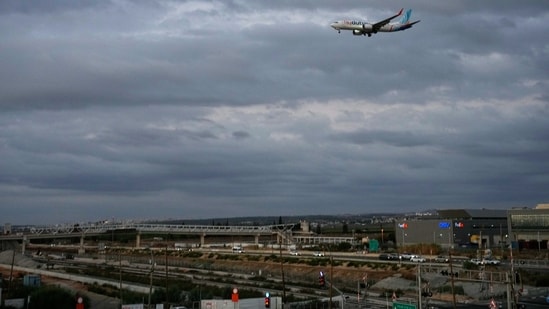
Flight tracking data available publicly cannot confirm how close it came to the speed of sound, which on its own depends on atmospheric composition and temperature at a specific point of time. But a dive that drastic is likely to have been turbulent and strained a commercial passenger plane's structure and operations.
A look at what we know happened on Wednesday, before the Boeing 737 Max 8 landed in Saudi Arabia's Tabuk with a damaged rudder, and the science behind such incidents:
What happens when airliner nears speed of sound?
Airliners run into the effects of the speed of sound well before they reach it, beginning from the wing. At high altitude, a jet's speed is expressed as a Mach number, the ratio of its true airspeed to the speed of sound, according to the US Federal Aviation Administration's (FAA) Airplane Flying Handbook. Mach 1 is the speed of sound.
{{/usCountry}}Airliners run into the effects of the speed of sound well before they reach it, beginning from the wing. At high altitude, a jet's speed is expressed as a Mach number, the ratio of its true airspeed to the speed of sound, according to the US Federal Aviation Administration's (FAA) Airplane Flying Handbook. Mach 1 is the speed of sound.
{{/usCountry}}Jets designed for subsonic flight are limited to some Mach number below the speed of sound because of shock waves, the FAA handbook says.
A wing generates lift by speeding up the air flowing over its curved upper surface, so parts of that airflow reach the speed of sound before the plane does. A shock wave forms where that fast-moving air abruptly slows to below the speed of sound. As the plane flies faster, the shock grows stronger and moves back along the wing, until the airflow behind it breaks away from the surface, according to the FAA.
Airliners have two speed limits that pilots must not exceed. The first is a maximum operating speed, or VMO, which governs at lower altitudes, and the other is maximum operating Mach number, or MMO, which governs higher up, where colder air lowers the speed of sound.
Beyond the MMO limit, that separated airflow can cause severe buffeting and possible loss of control, the handbook says. A shift in lift can also push the plane's nose down, a tendency pilots call "Mach tuck". If it goes too far, the pilot may not have enough control left to stop the plane entering a steep dive.
What does a steep dive do to an airliner?
An example in the FAA handbook gives a descent rate of 3,000 feet a minute for a jet at idle power, flying at 300 knots.
FZ1073 lost roughly 14,000 feet in about half a minute, according to Bloomberg. The exact rate will only emerge from analysis of the flight data.
A dive also changes the g-forces acting on the aircraft. A sudden push of the nose downwards can take it briefly below zero g. At zero g, objects float, and below it, loose objects float towards the ceiling, according to a report by the US National Transportation Safety Board (NTSB). And pulling out of the dive then raises the g-force, pressing down on a structure already strained by speed.
Tails are especially exposed, because large or repeated movements of the rudder or elevators at high speed can load them beyond their design strength. AP reported that most of FZ1073's rudder was torn from its tail during the descent. Analysts suspect the dive may have led to the damage, but only a thorough investigation can confirm that.
Also read: Near-catastrophe on flight 1073 exposes gaping hole in Dubai’s aviation security | The Economist
How much can airliners withstand?
US rules require each new airliner to have a design dive speed above its operating limits. This figure is worked out from a hypothetical adverse situation, in which the plane is tipped 7.5 degrees nose-down from cruise and left for 20 seconds before the pilot pulls out, according to the FAA. The aircraft must be free of flutter at every speed up to that dive speed. Flutter is a violent, self-reinforcing vibration of wings or tail surfaces, and new designs must be flight-tested for it up to the dive speed.
FAA rules also require an airliner's structure to withstand at least 2.5g, and minus 1g, at normal speeds without permanent damage. The negative-g requirement shrinks to zero at the design dive speed. Designers must then add a 50% safety margin on top of those limits, which the structure must survive for at least three seconds.
Europe's aviation regulator, Easa, has equivalent rules.
During an Australian Transport Safety Bureau inquiry into a 2017 incident involving a Qantas 737 near Canberra, Boeing told investigators it was considering adding guidance to its 737 training manual, which said that "airplanes have been flight tested beyond VMO/MMO to ensure smooth pilot inputs will return the airplane to the normal flight envelope".
HT Immersive: Minute by minute: The stabbing, turbulence aboard flydubai FZ1073
Have airliners survived dives like this before?
Three cases investigated by the NTSB show a range of outcomes.
- China Airlines 006, 1985: The Boeing 747SP rolled and dived from about 41,000 feet to 9,500 feet over the Pacific. Its recorder logged peaks of 4.8g and 5.1g, and large sections of both horizontal tail surfaces tore away. The NTSB said reliable recorded data showed the plane had not exceeded its maximum operating speed, and the damage was due to aerodynamic overload during the descent and recovery. It touched down safely in San Francisco, and two of the 274 people on board were seriously injured.
- EgyptAir 990, 1999: After the relief first officer's control inputs, the Boeing 767 dived from 33,000 feet. It passed its maximum operating speed of Mach 0.86 at about 30,800 feet and peaked at Mach 0.99 at about 22,200 feet, beyond the Mach 0.91 the NTSB described as its never-exceed airspeed. The aircraft crashed into the Atlantic, killing all 217 people on board. Egypt's civil aviation authority disputed the NTSB's findings.
- American Airlines 587, 2001: The Airbus A300's vertical tail fin and rudder broke away shortly after take-off from New York. The NTSB found the fin failed under loads beyond its design strength, created by the first officer's "unnecessary and excessive rudder pedal inputs". All 260 people on board and five people on the ground were killed.
What happens next?
Ultimately, the flight data recorder will hold more information, including the jet's speed through the air, the g-forces and the positions of the controls. Investigators are likely to use those readings to establish what happened during the dive.