
 E-Paper



Flydubai cockpit attack: The emergency codes, locked doors and hijackings that shaped flight security rules
Israel says a co-pilot stabbed his captain and tried to crash a Dubai-Tel Aviv flight. The motive is unknown. Here is how cockpit security works.

 Prefer HTon Google


A flydubai flight carrying 174 people from Dubai to Tel Aviv made an emergency landing in Tabuk, Saudi Arabia, on Wednesday after its co-pilot stabbed the captain and, according to Israeli officials, tried to crash the aircraft. Passengers and crew overpowered him in the cockpit, and a second pair of flydubai pilots travelling on the flight brought the Boeing 737 Max 8 down safely, Israeli officials told Reuters.
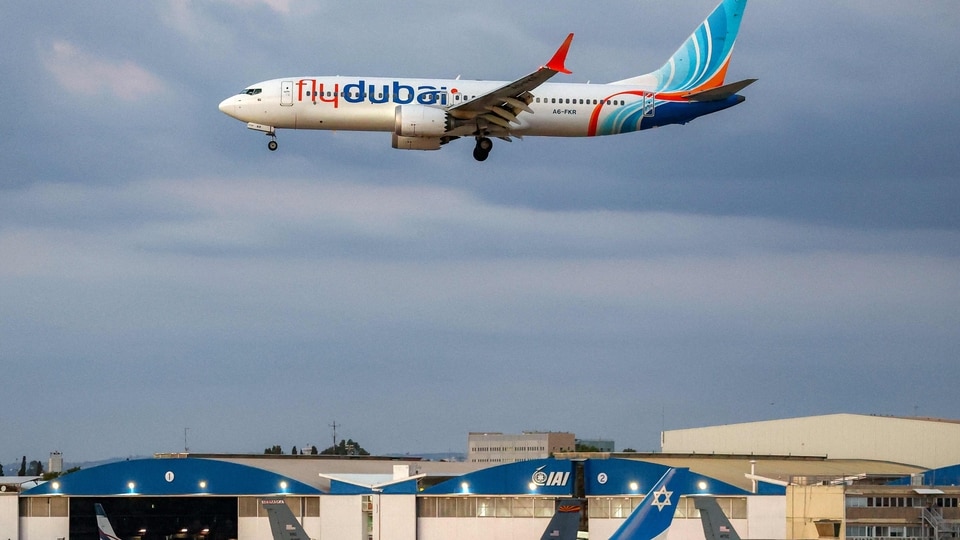
Israeli Prime Minister Benjamin Netanyahu called it "a highly severe security incident".
The episode has drawn attention to safeguards most passengers never see: the codes pilots use to signal danger, the reinforced door that seals the cockpit, and the checks on who is allowed to fly a commercial jet. Most of those rules were written after earlier attacks on aircraft, including the 9/11 US terror attacks and the 1999 hijacking of an Indian Airlines flight to Kandahar.
Investigators have not said why the co-pilot, whose identity has not been made public, attacked his colleague. Flydubai said "the underlying reasons and motives behind this event are unknown and remain subject to a formal investigation" and warned against "premature speculation". Israeli officials, speaking to Reuters on condition of anonymity, said their assessment was that it was an attempted terror attack, and defence minister Israel Katz called it "an attempted jihadist terror attack", though he did not say what he based that on. Asked by Fox News whether Iran was involved, Netanyahu said: “It's too early to say.”
What happened on board?
The trouble began about two-and-a-half hours after the aircraft left Dubai. The jet dropped sharply, with Israeli officials and data from the flight-tracking website Flightradar24 showing that it fell nearly 14,000 feet (4,267m) in less than 30 seconds, Reuters reported.
Passengers and a crew member forced their way into the cockpit and restrained the co-pilot, and the second pair of flydubai pilots took over the controls.
Prince Sultan bin Abdulaziz International Airport in Tabuk said the aircraft made a distress call at 8.44am local time and landed at 9.45am. Most of the plane's rudder had been ripped off the tail during the descent, AP reported. The airport said both pilots were taken to hospital. Saudi authorities arrested the co-pilot and were questioning him, Netanyahu said.
How does the cockpit door work?
Before the September 11, 2001, attacks in the US, in which 19 hijackers took control of four airliners and nearly 3,000 people were killed, cockpit doors on American airliners were lightweight and could be forced. In January 2002, the Federal Aviation Administration (FAA) ordered operators of more than 6,000 aircraft to install reinforced doors by April 9, 2003. The rule also required the doors to stay locked, with locks that open only from inside the cockpit, and barred crew members not assigned to the cockpit from carrying keys to it.
The International Civil Aviation Organization (ICAO), the United Nations body that sets global aviation standards, has required since November 2003 that passenger aircraft weighing more than 45,500kg, or with more than 60 seats, carry a cockpit door "designed to resist penetration by small arms fire and grenade shrapnel".
Its standards also require the door to resist forced entry and to lock and unlock from either pilot's seat. The door must stay locked from the moment the outer doors close after boarding until they open again, except when authorised people need to pass through, and pilots must be able to see the whole area outside it.
Pilots open them from inside. Cabin crew outside can request entry through a keypad, and on many airliners, the door unlocks after a short delay if the pilots do not respond, unless a pilot inside presses a switch to deny access.
The US has added a second layer. Under a rule the FAA finalised in June 2023, new passenger aircraft built for US airlines must carry a physical secondary barrier, a gate that closes off the area in front of the cockpit whenever the door is opened in flight. The FAA said the barrier should hold back an attacker until the open door "can be closed and locked". The rule applies to aircraft built from two years after it took effect, and older aircraft do not have to be retrofitted.
Accounts of how the FZ1073 door came open differed. A spokesperson for Netanyahu told Reuters that the captain, Smit Machchhar – an Indian national from Mumbai – managed to click the release that opened the cockpit door, allowing passengers and crew to overpower the co-pilot on Wednesday.
Passengers who went in found the co-pilot bashing at the control panel, the spokesperson said. "Despite being stabbed and seriously injured, he (Machchhar) fought back, resisted, opened the cockpit door, and enabled passengers and crew to overpower the attacker," Netanyahu wrote on X.
Yaniv Hayoun, a passenger Netanyahu identified as a plumber, said he was among those who pushed their way into the cockpit. "The door apparently wasn't locked, and we managed to open it. What made it difficult for us was the (other) pilot himself. He had been stabbed and was on the other side of the door," Hayoun said.
The weapon has not been confirmed either. Netanyahu told Fox News the attacker might have hit the captain with an axe. Airlines are generally required to keep a crash axe in the cockpit so the crew can break through a window to escape or open a panel to reach a fire, AP noted.
Regulators acknowledge that the locked door carries risks of its own. In a safety bulletin issued in May this year, Europe's aviation regulator, the European Union Aviation Safety Agency (EASA), cited research that said reinforced doors, while essential for preventing attacks, "may introduce specific safety risks in certain scenarios, particularly in cases of pilot incapacitation".
What signals did the crew send?
Every airliner carries a transponder, a device that broadcasts a four-digit code to air traffic controllers. Under procedures set by the International Civil Aviation Organization (ICAO), the United Nations body that writes global aviation standards, three codes are reserved for trouble: 7700 for a general emergency, 7600 for a radio failure and 7500 for what ICAO calls unlawful interference. The code lets a crew raise an alarm without saying a word, which can help if a hostile person is in the cockpit.
Flight FZ1073 transmitted a general emergency signal and then an unlawful interference code, Flightradar24 data showed. ICAO's term covers hijacking and other acts that endanger the safety of a flight, and a 7500 code sets off security procedures on the ground.
On Wednesday, when the flydubai flight issued the signals, Israel scrambled warplanes because it feared a hijacking.
The crew also called for help over the radio. A person who heard the flight's communications with air traffic control told AP, on the condition of anonymity, that the pilot's voice was trembling as he called "mayday", said a hijacking was under way and asked for ambulances.
The motive of Wednesday's incident isn't clear yet.
How did hijackings shape these rules?
Hijackings in the region in 1960s and 1970s prompted some of the measures. In July 1968, members of the Popular Front for the Liberation of Palestine hijacked an El Al flight from Rome to Tel Aviv and forced it to land in Algiers. Israel later put armed security officers on El Al flights.
Israel has not had a hijacking in decades and maintains some of the strictest airport security in the world, including on flights bound for the country, AP reported.
The US began screening every airline passenger and their carry-on bags in January 1973, after a run of hijackings of American aircraft.
India's defining case came at the end of the last century. On December 24, 1999, five armed men hijacked Indian Airlines flight IC-814 soon after it left Kathmandu for Delhi. Over the following days the aircraft was flown to Amritsar, Lahore and Dubai before ending up in Kandahar in Taliban-ruled Afghanistan. One passenger, Rupin Katyal, was killed. The crisis ended on December 31 after India released three jailed militants, among them Masood Azhar, who later founded Jaish-e-Mohammed.
Parliament passed the Anti-Hijacking Act in 2016, replacing a 1982 law and allowing death penalty where a hijacking leads to the death of a hostage, a security officer or any other person not involved in the offence.
What did Germanwings change?
On March 24, 2015, the co-pilot of Germanwings flight 9525, flying from Barcelona to Düsseldorf, locked the captain out after he stepped out of the cockpit and flew the Airbus A320 into the French Alps, killing all 150 people on board. France's air accident investigation agency, the BEA, found the co-pilot had been suffering from a mental illness his employer did not know about.
Three days after the crash, EASA recommended that airlines keep two authorised people in the cockpit at all times, typically by having a cabin crew member step in whenever a pilot leaves. It relaxed that advice in 2016 and left the decision to each airline's risk assessment. In May this year, it reversed course and reinstated two people in the cockpit as its preferred approach, though the recommendation is not binding.
EASA said the policy had not introduced risks that outweighed the danger of a pilot being locked out, pointed to countries where it is mandatory, including the US, China and Japan, and said the aim was to stop a pilot left alone from losing control of the aircraft if he became incapacitated.
Since February 2021, European rules have required airlines to give pilots a psychological assessment before they start flying passengers for the airline, to test crews for alcohol and drugs, and to offer peer-support programmes.
Who is allowed to fly an airliner?
The captain is the pilot-in-command, with final authority over the aircraft, and the first officer, or co-pilot, is second in command. The two share the flying. Under ICAO standards, both must hold a licence and pass regular medical examinations that include mental fitness, and airline staff with access to secure areas undergo background checks.
On Wednesday, the second pair of flydubai pilots on FZ1073 proved decisive. Airlines routinely carry crew who are not operating the flight as passengers, to position them for duty elsewhere, a practice known in the industry as deadheading.
Israel now plans checks of its own. "Every pilot that is going to be flying into Israel, we are going to know the pilots' identities, know who they are, and do some type of security check," Doron Spielman, a spokesperson for Netanyahu, told Reuters. Israel has not published details of how those checks will work.
What happens next?
Investigators have yet to say what checks the co-pilot passed before he was cleared to fly, what weapon he used and how it reached the cockpit, and how airlines might guard a cockpit against a threat that is already inside it.
The investigation is expected to draw on the cockpit voice recorder and the flight data recorder, which store sounds from the flight deck and the aircraft's key flight readings, Bloomberg noted.
Under ICAO rules, the country where a serious incident occurs normally leads the safety investigation, though it may delegate the task. The UAE’s General Civil Aviation Authority (GCAA) has said its investigation teams, working with the relevant authorities, are examining the causes and circumstances of the incident, including its operational and security aspects. A safety investigation of this kind runs separately from any criminal inquiry. Netanyahu said the UAE’s president had agreed that Israel would join the questioning of the suspect and told Fox News that Israel would be “following and possibly also participating in this investigation”.


