A three-member panel of the Election Commission of India passed an interim order on Thursday barring both rival camps of the All India Trinamool Congress from using the party's name and its reserved 'flowers and grass' symbol. The EC decision came ahead of the October 6 bypolls in West Bengal and Assam.
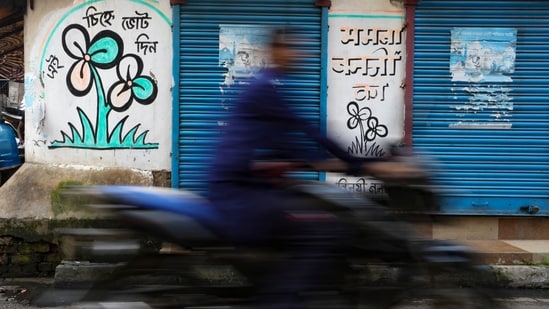
The panel, comprising Chief Election Commissioner Gyanesh Kumar and election commissioners Vivek Joshi and Sukhbir Singh Sandhu, held that "there are two rival groups in the All India Trinamool Congress, one led by former chief minister Mamata Banerjee and the other led by Arup Roy and each group is now claiming to be the party".
After both camps filed their choices, EC allotted them their temporary identities on Friday. Mamata Banerjee's faction will take the name Mamata All India Trinamool Congress on a football player symbol, and the Ritabrata Banerjee camp, Democratic Trinamool Congress on an envelope symbol.
The party split
The Mamata Banerjee-led TMC lost the West Bengal assembly election to the Bharatiya Janata Party (BJP) earlier this year, ending 15 years in office. The defeat set off a revolt within the party.
On June 3, 58 rebel MLAs elected Ritabrata Banerjee, whom the party had expelled, as Leader of the Opposition in place of Mamata Banerjee's nominee, Sovandeb Chattopadhyay, and secured recognition from the state assembly speaker. Banerjee's Trinamool expelled Ritabrata Banerjee and MLA Sandipan Saha for what it called anti-party activities. The Mamata camp has since lost 62 of the party's 80 MLAs.
{{/usCountry}}On June 3, 58 rebel MLAs elected Ritabrata Banerjee, whom the party had expelled, as Leader of the Opposition in place of Mamata Banerjee's nominee, Sovandeb Chattopadhyay, and secured recognition from the state assembly speaker. Banerjee's Trinamool expelled Ritabrata Banerjee and MLA Sandipan Saha for what it called anti-party activities. The Mamata camp has since lost 62 of the party's 80 MLAs.
{{/usCountry}}On June 14, the revolt reached Parliament. Twenty of the party's 28 Lok Sabha MPs, led by senior leader Kakoli Ghosh Dastidar, wrote to Speaker Om Birla saying they had merged with the little-known NCPI (Nationalist Citizens Party of India). They said they would function as a separate bloc backing the BJP-led National Democratic Alliance.
Also read: 'Vote theft, govt theft, now party theft': Rahul Gandhi, Kejriwal slam EC over TMC symbol freeze
The question EC has to answer
While EC has allotted temporary symbols, it will eventually need to decide on the claims by the two factions.
The rival claims are centred on an argument about TMC's rulebook. The rebels contend that TMC's National Working Committee (NWC) lost its authority because its three-year term under Article 20 of the party constitution expired on February 11, 2025, and was never renewed. On that reasoning, they convened a special session on June 22, at which delegates unanimously elected Arup Roy as chairperson of a new NWC.
Mamata Banerjee's camp rejected that account. She had written to EC two days earlier, on June 20, notifying it of her own reconstituted committee and office-bearers. Her reply called the rival claim "fundamentally flawed, illegal and not substantiated by the party constitution", and a party representative told EC that the June 22 meeting, held at a Kolkata hotel, was "a mere ex-post facto creation of a paper trail".
Also read: Lokpal finds no merit in allegations against rebel TMC MP Arup Chakraborty
The rule
The dispute falls under Paragraph 15 of the Election Symbols (Reservation and Allotment) Order, 1968, the clause that EC invokes when two factions of a recognised party claim the same name and mark.
The test it applies comes from the Supreme Court's 1971 ruling in the Sadiq Ali case, which grew out of the 1969 split in the Congress.
EC works through three questions in sequence. It first asks whether either faction has repudiated the party’s stated aims and objectives, then turns to the party's own constitution, and finally counts numerical strength across the two wings: the elected legislators and the organisational structure.
In the 1969 case, neither Congress faction had abandoned the party’s stated aims, which made the first test redundant, and the constitutional test was of little help because each group had expelled members of the other. So, EC settled it on numbers.
Upholding that approach in 1971, the Supreme Court held that majority and numerical strength was a relevant and valuable test, and that an election symbol is not the property of the party that uses it.
On Thursday, EC said a Paragraph 15 determination follows a detailed hearing of "all the available facts and circumstances", and that it did not have time to complete those proceedings before the bypolls, so its interim arrangement was to be followed until the dispute is decided.
Four disputes, one method
Known as the two-wing test, for the legislative and organisational wings it counts, it is the formula EC has fallen back on in such disputes for half-a-century.
EC applied the two-wing test to the Samajwadi Party in January 2017, days before Uttar Pradesh voted, after a public falling out between then chief minister Akhilesh Yadav and his father, party founder Mulayam Singh Yadav. Both claimed the bicycle. Akhilesh's camp filed affidavits from 205 of 228 MLAs along with majorities among MPs, MLCs and convention delegates, while his father's side filed no comparable documentation of its own.
A 42-page EC order gave Akhilesh the symbol, holding that his faction enjoyed "overwhelming majority support, both among the organisational and legislative wing of the party". Mulayam Singh Yadav's counsel had argued there was no split in the party at all and that the symbol should have stayed with him whatever the numbers showed.
A dispute of similar shape broke out in the AIADMK within months of former Tamil Nadu chief minister J Jayalalithaa's death in December 2016, pitting O Panneerselvam against VK Sasikala. EC froze the two leaves symbol in March 2017 for a Tamil Nadu bypoll. Panneerselvam and then chief minister Edappadi Palaniswami merged their camps that August, isolating the Sasikala camp. An 83-page order by EC in 2017 found that the merged group commanded majority support in both the organisational and legislative wings.
The next two disputes came from Maharashtra. Eknath Shinde took a majority of Shiv Sena MLAs into a coalition with the BJP in 2022, and the EC froze the bow and arrow symbol for a bypoll in Andheri East, giving the Uddhav Thackeray camp a flaming torch and the Shinde camp two swords and a shield.
Ruling on the underlying claim in February 2023, EC found the organisational-wing test inconclusive and fell back on legislative numbers, which gave Shinde’s faction the Shiv Sena name and the symbol.
Then, Ajit Pawar took a majority of Nationalist Congress Party (NCP) legislators into the same government in July 2023, and the next February, EC awarded Ajit's faction the party's name and its clock symbol. While doing so, EC cited a "test of aims and objectives of the party constitution", a "test of the party constitution" and a "test of majority".
The Supreme Court later allowed Ajit Pawar's group to keep the clock symbol with a disclaimer that the matter remained sub judice, and let Sharad Pawar's faction contest as Nationalist Congress Party–Sharadchandra Pawar under a new symbol.
The Shiv Sena case is still running and has reached the Supreme Court, where it was heard on Thursday.
What happens next
Ritabrata Banerjee, welcoming Thursday's EC decision, said that "within a democracy, there is no place for dictatorship" and that the EC had shown "there is no room for dynastic politics".
"A political party is not a private limited company, nor can there be an heir to a political party. This has been proven," he was quoted as saying by news agency PTI.
Senior Trinamool leader Kunal Ghosh, of the Mamata camp, asserted that supporters see the former CM as the party's political face. Mamata's Trinamool has since decided to opt out of the Nandigram bypoll race, and instead, support the Congress candidate.
As for the dispute over the ‘real’ Trinamool Congress, EC will next hold hearings, and likely weigh the rival constitutions, the validity of the June 20 and June 22 meetings, and the strength each side commands. Whichever faction loses can challenge the decision legally.
(With inputs from Himanshi Sharma)