E-Paper



Shiv Sena dispute: Supreme Court calls for clear criteria to determine 'real' party when factions stake claim
In a key observation, the Supreme Court asserted that disputes over political party majorities require more than counting legislators, citing Shiv Sena split.

 Prefer HTon Google


The Supreme Court on Wednesday observed that there must be clearly defined criteria to determine the majority in a political party when rival factions stake claim to its name and election symbol, indicating that such disputes cannot be resolved solely on the basis of the numerical strength of legislators.
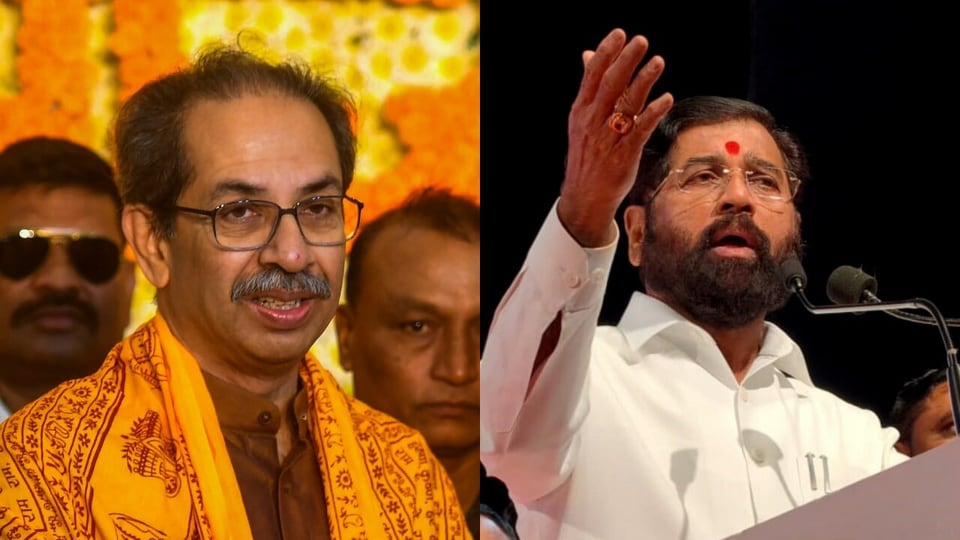
A bench comprising Chief Justice of India Surya Kant and justices Joymalya Bagchi and V Mohana made the observations while hearing the challenge by the Uddhav Thackeray-led faction against the Election Commission’s February 2023 decision recognising the Eknath Shinde-led faction as the “real Shiv Sena” and allotting it the party’s bow-and-arrow symbol. The bench indicated that the concept of “majority” in a political party required a more nuanced examination than merely counting legislators.
“There should be defined criteria. If there are defined criteria, to a large extent such situations can be prevented,” it observed.
Also Read | 'There could be only one Shiv Sena': Uddhav Thackeray amid row over MPs' switch to Shinde camp
The court further said that a political party’s constitution could itself prescribe how the party is constituted and how a majority within it is to be determined.
“The Constitution of the party will prescribe how the party is constituted and how a majority within that party is to be determined,” remarked the bench, while adding that one faction may rely on elected representatives whereas another may point to office-bearers, primary members and organisational wings.
“There has to be some formula under the Election Commission’s guidelines, the party Constitution or a statute to determine how a majority is to be assessed,” it emphasised. The observations are significant because the Election Commission is currently engaged in deciding the “real” Trinamool Congress (TMC).
And the observations assume significance because the Election Commission, while deciding the Shiv Sena dispute, ultimately relied on the numerical majority enjoyed by the Shinde faction in the legislature after finding the first two tests under the 1971 Sadiq Ali judgment inconclusive.
Also Read | Shiv Sena vs Sena (UBT) on foundation day: Shinde, Thackeray spar as rebel MPs stay away
Senior advocate Kapil Sibal, appearing for the Thackeray faction, argued that the Election Commission had fundamentally erred by treating the legislative majority as decisive while ignoring the party’s organisational structure and constitution.
Referring to the Shiv Sena’s 2013 and 2018 constitutions, Sibal argued, “From 2014 till 2022, no one ever questioned the validity of the party constitution or Uddhav Thackeray’s authority as Paksh Pramukh. The Election Commission, the Speaker and constitutional authorities all recognised the leadership under that constitution.”
The bench remarked, “So, your argument is that the Election Commission was asking the wrong question,” the bench remarked.
The bench also reiterated the distinction between a political party and its legislative wing, a principle emphasised by the Constitution bench in its May 2023 judgment in the Shiv Sena dispute.
Also Read | Meetings, invitation, missing numbers: Uddhav's Shiv Sena headed for another split in Maharashtra?
“The control of the political party subsists over the legislature party. Any valid decision of the political party has to prevail over the will even of the majority of the legislature party,” it observed.
Sibal agreed, submitting that allowing legislators alone to determine the identity of a political party would undermine representative democracy.
The bench noted that representative democracy also required some space for elected representatives to take political decisions.