Britain had set June 1948 as its exit deadline from India. Instead, the Union Jack came down 10 months earlier, on August 15, 1947 — a date the last viceroy, Lord Louis Mountbatten, appears to have picked on impulse to fold his own wartime triumph into the birth of a new nation.
By early 1947, British rule in India was unravelling. And the British proposal on transfer of power, called the Cabinet Mission Plan of 1946, had failed to broker an agreement between the Congress and the Muslim League. Muhammad Ali Jinnah's call for Direct Action Day on August 16, 1946 — a mobilisation to press the League's demand for a separate Pakistan — set off communal violence in Calcutta that spread to Noakhali in eastern Bengal (now in Bangladesh), then to Bihar and, by March 1947, parts of Punjab.
Viceroy Lord Wavell, at odds with London, had been pressing Prime Minister Clement Attlee for a firm exit date to prevent the situation from spiralling further.
His contingency proposal — the so-called Breakdown Plan, for a phased British withdrawal — was rejected by the colonial rulers' India and Burma Committee in early January 1947, and Attlee's government decided instead that a new viceroy was needed. On February 20, 1947, Attlee told the House of Commons that Britain would transfer power into responsible Indian hands "by a date not later than June 1948", and appointed Lord Louis Mountbatten to negotiate the terms of transfer, according to UK parliamentary records.
Mountbatten arrived in Delhi on March 22, 1947, carrying instructions from London to complete the handover, and was sworn in as viceroy two days later by chief justice Sir Patrick Spens. The Raj was gone within five months.
{{/usCountry}}Mountbatten arrived in Delhi on March 22, 1947, carrying instructions from London to complete the handover, and was sworn in as viceroy two days later by chief justice Sir Patrick Spens. The Raj was gone within five months.
{{/usCountry}}Also read: Full Vande Mataram to ring out from Red Fort for 1st time on Independence Day
The June 3 plan
After weeks of negotiations with the Congress and the League, Mountbatten unveiled his blueprint for Partition on June 3, 1947. The Mountbatten Plan set out the creation of India and Pakistan, the division of Punjab and Bengal, and a referendum in the North-West Frontier Province to decide which country it would join. Both parties accepted it.
Crucially, the June 3 plan pulled the transfer of power forward by more than 10 months from the June 1948 target.
Indian history textbooks cite a cluster of overlapping reasons for the compression. Mountbatten believed prolonging British authority would only make the subcontinent harder to control. The Congress and the League, both exhausted by negotiation, were largely aligned on wanting an early handover. And a swift break, Mountbatten calculated, would leave less room for either side to reopen settled questions or for the violence to spread further while administrative separation was still being worked out.
Independence Day: HT full coverage
A date close to Mountbatten
Mountbatten decided on August 15 somewhat impulsively at a press conference when asked to name a date, according to his own later accounts, most famously recorded in Larry Collins and Dominique Lapierre's Freedom at Midnight.
"The date I chose came out of the blue. I chose it in reply to a question," he later recalled. "I was determined to show I was master of the whole event… I hadn't worked it out exactly then — I thought it had to be about August or September and I then went out to the 15th August. Why? Because it was the second anniversary of Japan's surrender."
That anniversary — August 15, 1945 — was VJ Day, when Emperor Hirohito's radio broadcast announced Japan's surrender to the Allies in the Second World War. Mountbatten, who was then the first Supreme Allied Commander of the South East Asia Command, treated it as one of the crowning hours of his war. (The formal Japanese surrender in his own theatre came later, in Singapore in September 1945.)
Choosing the same date for the founding of India and Pakistan appears to have let him tie the memory of that victory to the making of two new nations.
Also read: 'Separatism In Kashmir, Punjab, Assam…': In 1990 Independence Day speech, Then-PM VP Singh's warning
A midnight compromise
But Mountbatten's decision ran into an unexpected hurdle. Indian astrologers and some political leaders held that August 15 was inauspicious by the Hindu calendar.
In his 16th personal report to King George VI, dated August 8, 1947 — later collected in the official Transfer of Power documentary record edited by Nicholas Mansergh — the viceroy wrote: "The astrologers are being rather tiresome since both the 13th and the 15th have been declared inauspicious days, whereas the 14th is auspicious."
He also suggested he had not been warned that he ought to consult astrologers before fixing a date for the transfer.
Freedom at Midnight records that an astrologer wrote to Mountbatten, pleading with him not to grant independence on August 15, warning that any floods, famine or massacres to follow would be blamed on a nation born under a curse. The original letter, however, has not been traced to Mountbatten's archived correspondence, and Collins and Lapierre remain the most notable source.
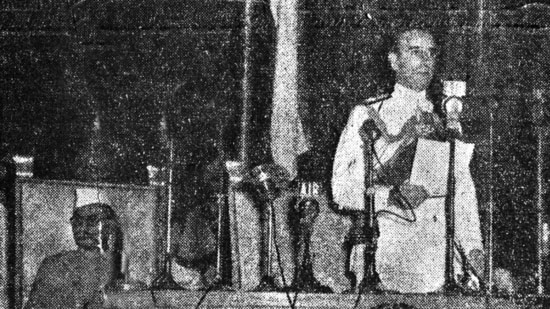
The compromise Mountbatten reached would keep the date but shift the moment. India would technically become independent at the stroke of midnight between August 14 and 15. That is why the Constituent Assembly convened close to midnight on August 14, 1947, and Jawaharlal Nehru delivered his "Tryst with Destiny" speech just before the hour struck.