The Rajya Sabha on Monday passed the Bankers' Books Evidence Bill, 2026, replacing a 135-year-old British-era statute with a legal framework that treats electronic, digital, virtual and cloud-stored bank records as admissible and enforceable evidence in court.
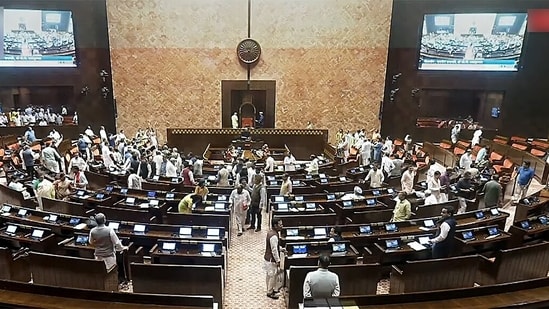
The Bill, moved by the finance ministry, has now cleared both Houses of Parliament. It was introduced in the Lok Sabha on August 3 and passed on August 5.
The law it replaces — the Bankers' Books Evidence Act of 1891 — was drafted for a world of physical ledgers. The first screen would not be invented for another six years, and the electronic revolution was still decades away at the time.
The Act, which has since been amended several times as India stepped into freedom and modernity, was never built for cloud-based, electronic, digital or other storage formats.
What changes for the courtroom
{{/usCountry}}The Act, which has since been amended several times as India stepped into freedom and modernity, was never built for cloud-based, electronic, digital or other storage formats.
What changes for the courtroom
{{/usCountry}}Consider a case over a disputed transaction in your bank account. The bank needs to prove what its records show without physically carrying an entire ledger into court.
Under the 1891 Act, a bank officer would obtain a certified paper copy of the relevant page, sign it and produce it as proof. But over a century later, most banks do not keep paper ledgers at all. The transactions sit on computer systems and servers, often at locations far from the branch.
The 2026 Bill ensures courts accept electronic, digital, virtual and cloud-stored records — collectively referred to as a "copy" — as proof.
The key clauses
Section 6 is the fulcrum of the Bill. It establishes the legitimacy of digital records as evidence and preemptively closes off grounds that could be used to withhold such information.
The section states that the “admissibility of an electronic or digital record of a banker’s book in evidence, shall not be denied on the ground that it is an electronic or digital record and such record shall, subject to the conditions specified in Section 7, be admissible, valid and legally enforceable, as other evidence”.
Also Read | Day after Modi-Sukhbir meeting, Shiromani Akali Dal supports women’s quota, delimitation bills
Section 7 lists the conditions an electronic record must meet: the copy must have come from a device in regular use for that activity during the relevant period; the system must have been functioning properly throughout, or any malfunction must not have affected the record's accuracy; the copy's content must match the data entered into the system; only authorised personnel must have made entries, with proper safeguards; and no unauthorised changes must have occurred.
The certification test
The Bill sets clear guardrails to ensure authenticity. The copy must be true and accurate, prepared from relevant records, with no unauthorised changes to the underlying data. The system must not have been tampered with, and the data must be safely and accurately transferred to storage media.
Every certified copy still needs a certificate to accompany it. For physical records, the certificate must confirm that it is a true copy from the bank's regular books and that the original remains with the bank. For digital records, the certificate must confirm that the copy was produced by a computer system. Both must be dated and signed — manually or digitally — by an authorised bank officer.
Also Read | No direction by the chair to HM to come to House, only observation: Rijiju
The 1891 Act carried a single, simple certificate format, since only paper records existed at the time. The 2026 Bill splits this into two separate regimes: one for physical records, another for digital.
When bank officers can be summoned
Section 8 protects bank officers from being dragged into other people's court cases merely to prove records — unless a court has a specific, written reason to doubt those records, or the bank has failed to comply with a prior order.
The 1891 Act carried a similar condition but did not spell out the meaning of “special cause”. It read: “No officer of a bank shall in any legal proceeding to which the bank is not a party be compellable to produce any banker's book the contents of which can be proved under this Act, or to appear as a witness to prove the matters, transactions and accounts therein recorded, unless by order of the Court or a Judge made for special cause”.
Also Read | BJP MP to propose bills seeking age checks for children, curbs on AI deepfakes
The 2026 Bill fills that gap
According to legislative research group PRS, the Bill treats special cause as any of three situations: where the accuracy or genuineness of an entry or information is doubtful; where an event has occurred which suggests that the regularity or ordinary nature of record-keeping is interrupted; or where the bank does not comply with any court order regarding inspection of books.
A wider net
The 2026 Bill also lets the Centre extend the law, by notification, to any entity or class of entities operating in the financial sector — beyond banks and post office savings banks — subject to conditions it specifies.
PRS notes that the government may specify conditions, exceptions, or modifications when it extends the Bill's provisions to a new class of entity. In practice, that gives the Centre wide latitude to decide who is drawn in, on what terms, and with what carve-outs.
Some experts have said this could potentially stretch the legislation’s ambit to non-banking financial companies (NBFCs) and payment aggregators such as UPI-linked services — crucial cogs in India's modern financial apparatus.
The Bill will come into effect once it secures the President's assent and the Centre issues a gazette notification.