Dark matter is called dark because it cannot be seen. Scientists believe it must be there because nothing else adequately explains many of the things we observe in the universe. But no one has detected dark matter itself, far less seen it.
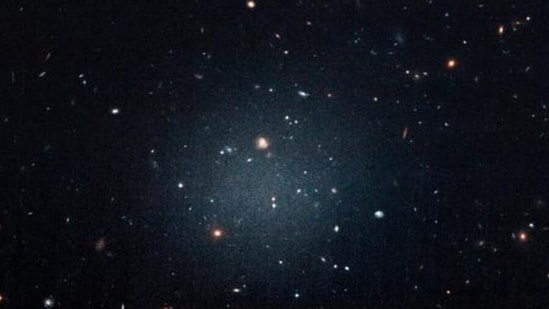
Until now — or maybe not. In an experiment a mile underground in a South Dakota research facility, scientists have detected signs of what may have been an interaction between ordinary matter and a dark-matter particle. They are cautious about committing themselves: it is a single event, and does not prove conclusively that dark matter was involved.
The uncertainty aside, the findings are exciting. The researchers believe this may be the first hint of a direct detection, if it is that. Until now, evidence for dark matter has come from observing its apparent gravitational effects — how galaxies, stars and other structures in the universe behave.
What is dark matter?
Scientists have believed in the existence of dark matter for almost a century now. The concept was first proposed in 1933 by Swiss astronomer Fritz Zwicky. Studying a galaxy cluster, he observed that the individual galaxies were moving at speeds that could not be explained by visible mass. Hence, he proposed, some “dark matter” must account for the missing mass and its gravitational effects.
Over the decades, the idea became mainstream as scientists tied various other observations to the likely presence of dark matter. There is gravitational lensing, for instance: when astronomers measure the bending of light in galaxy clusters, the results point to a mass that is much higher than the mass of the visible matter. Other observations that cannot be explained by ordinary matter include the pattern of tiny temperature fluctuations in the early universe, and the way galaxies and clusters have formed and are distributed.
{{/usCountry}}Over the decades, the idea became mainstream as scientists tied various other observations to the likely presence of dark matter. There is gravitational lensing, for instance: when astronomers measure the bending of light in galaxy clusters, the results point to a mass that is much higher than the mass of the visible matter. Other observations that cannot be explained by ordinary matter include the pattern of tiny temperature fluctuations in the early universe, and the way galaxies and clusters have formed and are distributed.
{{/usCountry}}“Dark matter has been a longstanding puzzle — either we don’t understand gravity on distances beyond the solar system or there’s missing stuff. In our galaxy, you need some additional source of matter to explain the orbiting speed of the stars. We can’t see this matter but we see the effects of it; this is what we call dark matter,” particle physicist Sam Eriksen of the University of Bristol told HT. He is the lead author of a study describing the findings of the recent experiment.
Today, ordinary matter — everything that we see — is believed to represent only about 15% of all matter. Everything else is believed to be dark matter. But it does not emit or reflect light, and is invisible to us.
If you cannot see it, the only way to detect dark matter is to look for signals it leaves on visible matter. That is what the recent experiment sought to find, and possibly did.
The experiment
Interaction between ordinary matter and dark matter is very rare.
At the Sanford Underground Research Facility in South Dakota, the experiment, called LUX-ZEPLIN or LZ, sought to capture one of those interactions. Specifically, it looks for signs of an interaction between xenon atoms and a “weakly interacting massive particle” (WIMP), one of the proposed candidates among dark-matter particles.
“There are many hypothesised dark matter particles, WIMPs, axions, etc… But none have been observed. The LZ experiment primarily searches for WIMPs, and in the latest work, we observed a single event which appears how we’d expect a WIMP to,” Eriksen said.
The detector is a large cylindrical vessel containing 10 tonnes of liquid xenon. The element in its liquid form is dense, providing several advantages for such experiments. “We use xenon because it’s incredibly dense so there’s a higher probability for dark matter to hit an atom. Even so, we only expect a few occurrences a year, or less,” said Eriksen , whose paper has been submitted to the journal Physical Review Letters.
“When any particle interacts with the xenon, we see flashes of light. In fact, we see two flashes of light,” he said. First, the interaction produces immediate photons — particles of light — at the interaction site. The interaction also liberates free electrons, which produce a much larger secondary signal.
“The properties of these flashes allow us to determine what kind of particle collided with the xenon as well as the energy and position of the interaction. WIMPs are expected to be very distinct from other particles. What we’ve seen is an interaction that doesn’t look like any background,” Eriksen said.
The researchers described the detection in an announcement at a scientific conference in Japan on Tuesday.
“We can’t draw definitive conclusions and we can’t rule out that this isn’t some rare process that looks the same. But it could be the first hint of a dark matter observation,” Eriksen said.
Not yet a discovery
Although the interaction appeared to indicate the involvement of a WIMP, the researchers do not claim the actual detection of dark matter. The observation does not meet the statistical threshold necessary to make such a claim.
“Importantly, as it’s just a single event, we are not claiming that it is dark matter,” Eriksen said.
“We considered many different things that could have caused this event, including neutrinos, neutrons and unique gamma-ray interactions. However, none of these can explain the event we’ve observed,” he said.
“There could still be processes that result in WIMP-like signals, and we’re putting this result out to get feedback from the scientific community. Ultimately, it’s a single event, and we’ll only be able to confirm this observation with more data, which will hopefully contain more events,” he said.
The researchers are working to rule out other explanations.