Jensen Huang’s resignation as Nvidia’s chief executive, after reports of his affair with a woman US authorities suspect of being a Chinese spy, leaves the dominant maker of artificial intelligence (AI) chips without the founder who has run it since 1993, and the wider AI industry without the man who helped bankroll its expansion.
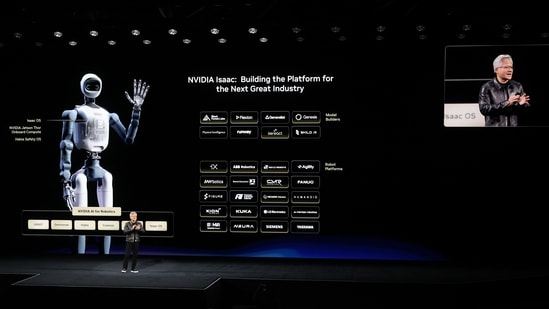
Nvidia said on Thursday that Huang “has resigned as President, Chief Executive Officer, and a member of the Board, effective immediately”. Chief financial officer Colette Kress will serve as interim chief executive while the board searches for a permanent successor, and Harvey Jones, a former chief executive of chip design software firm Synopsys, becomes the board's first-ever chair. Nvidia's shares fell 10.3% in premarket trading, putting its market value on course to drop below $4 trillion for the first time since July 2025, Reuters reported.
Huang, 63, acknowledged on November 8 that he had been unfaithful to his wife, after reports of his relationship with Alice Huang, a former executive at Singapore-based data-centre company Megaspeed International whom US authorities have concluded was a Chinese intelligence asset. The two are not related, and Beijing has denied she is a spy. On November 11, The New York Times reported that Huang had also had a relationship with a senior Nvidia executive who reported to him.
Who runs Nvidia now, and who could
Kress joined Nvidia as finance chief in 2013 after nearly 25 years in finance roles at companies including Cisco and Microsoft, AFP reported, and she will remain chief financial officer while serving as interim chief executive. Her public role was largely limited to Nvidia's numbers, with Huang handling most of the company's dealings with the financial community, according to Bloomberg.
{{/usCountry}}Kress joined Nvidia as finance chief in 2013 after nearly 25 years in finance roles at companies including Cisco and Microsoft, AFP reported, and she will remain chief financial officer while serving as interim chief executive. Her public role was largely limited to Nvidia's numbers, with Huang handling most of the company's dealings with the financial community, according to Bloomberg.
{{/usCountry}}“Colette Kress is well respected by investors and should be able to guide NVIDIA through this challenging period. The task is daunting, as NVIDIA has been founder-led since inception and Mr. Huang concentrated much of the decision making," Gil Luria, managing director at investment bank DA Davidson, told Reuters.
Jones, who has been on Nvidia's board since 1993, said in a statement: “The Board has full confidence in Colette and the leadership team, and we expect the company's operations, customer commitments and product roadmap to continue without interruption.”
The board will consider internal and external candidates for the permanent job. Huang repeatedly avoided naming a successor, AFP reported.
Analysts see two likely internal candidates, engineer Ian Buck, who runs the business serving Nvidia's data-centre customers, and Kress, though neither has Huang's public profile. People in the industry have also mentioned outside executives, among them AMD chief executive Lisa Su, Arm's Rene Haas and Micron's Sanjay Mehrotra.
Huang, Nvidia's fourth-largest investor with a stake of about 3.61%, leaves the board as well.
What will be hard to replace?
As many as 60 leaders reported directly to Huang, and every Nvidia employee wrote a list of their five most important tasks, which he read through to make sure the company knew what to focus on, Bloomberg reported.
"The risk is not that Nvidia suddenly loses its technology roadmap ... that roadmap is largely visible for the next several years. The risk is execution. Jensen has been the chief conductor of an extraordinarily complex system," Michael Feldman, portfolio manager at ClearBridge Investments, told Reuters.
Shay Boloor, chief market strategist at Futurum Equities, worries about the longer run. "My bigger concern is next decade, because Jensen isn't simply Nvidia's CEO but he's the person who has consistently identified where computing is going before customers even realise," he said.
Investors said the quality of Nvidia's products was unlikely to change, Reuters reported. Its graphics processing units (GPUs), first built to render 3D images in video games, have become the backbone of AI systems.
“Nvidia's core asset is its advanced GPUs, which still have no real substitute in the market,” Anna Wu, founder of Floodlines Research, told Reuters. "The AI trade rests on that demand, not on one individual." Bernstein analyst Stacy Rasgon wrote in a note that he did not think the company "should have huge issues operating while engaged in a search for new leadership", Bloomberg reported.
Also read: The chip war behind Nvidia's Jenson Huang scandal, from Dutch machines to dummy servers
Nvidia's money and the AI build-out
The bigger fear among investors is that a change at the top could dampen Nvidia's willingness to finance the AI boom.
Huang used Nvidia’s swelling cash pile to back dozens of AI companies, including OpenAI and Anthropic, and invested in and guaranteed financing deals for cloud computing firms such as CoreWeave.
CoreWeave is one of a group of newer firms, known as neoclouds, that rent out AI computing power.
Nvidia listed $164.5 billion in financial commitments in its most recent earnings report. They include an obligation of up to $105 billion on an OpenAI data centre in Ohio and more than $50 billion in lease and other capacity guarantees. Nvidia also took a $1 billion stake in South Korea's Naver by financing a data-centre expansion.
“Nvidia has been called the 'Bank of AI.' They'll sell you the chips and loan you the money. If they have to take a step back because of what's going on, will that cut off funding to smaller companies that need it? That's an open question,” Joe Saluzzi, partner at Themis Trading, told Reuters.
"Nvidia's credit support is what makes much of this debt finance-able across the AI hyperscaler deal front," Christopher Brown, senior vice-president for investments at Synovus Securities, told Reuters. “Lenders will ask what happens to that support if Nvidia's leadership or regulatory standing is impaired, and Nvidia’s own willingness to extend more guarantees may be constrained.”
Critics, including investor Michael Burry, have warned that such circular deals, in which Nvidia funds the customers who buy its chips, artificially inflate AI demand. "As a student of economic history, I don't know if there's ever been such a key man holding so much of this industry up," Thomas Ferguson, an investor at Blue Bear Capital, said at a conference on Wednesday, before Huang resigned.
CoreWeave fell 13.6% in premarket trading, a day after rising more than 27% on its earnings, and memory chipmaker Micron dropped 5.8%. AI stocks were already struggling after the Democrats swept the US midterm elections, including in states opposed to new data centres. "If its troubles start delaying customer orders, infrastructure investment or financing decisions, the implications could be much broader,” Charu Chanana of Saxo Markets told AFP.
Who could gain, in time
Nvidia's rivals rose on Thursday, with AMD up 2% and Broadcom up 1.4% in premarket trading. Nvidia chips accounted for more than 60% of the world's AI computing power in the second quarter, more than double the share of runner-up Alphabet, according to estimates from research group Epoch AI.
"This is where competitors like AMD, like Google Tensor Processing Units and Amazon will probably have a chance to improve their market share when it comes to that accelerator market that Nvidia dominates," said Mandeep Singh, global head of technology research at Bloomberg Intelligence. Alphabet's tensor processing units (TPUs) are chips custom-built for AI, and the company announced two new variations this week. Chanana told AFP that "AI leadership could broaden, rather than the boom ending", naming AMD, Broadcom, Alphabet and Samsung as possible gainers.
Wu cautioned that TPUs cannot replace GPUs across the board and that moving AI work away from Nvidia could be slow and costly. Data-centre operators may also be limited by how many chips rivals can make. "I have heard from some data-center folks that they can buy chips from other companies as long as those companies can supply them," Saluzzi said. "But if there's a supply shortage, then you have a problem."
In China, shares of GPU makers Moore Threads, MetaX and Cambricon jumped nearly 10%. Wu was sceptical of their prospects. "But structurally, unless Chinese tech found a fix for advanced chips, I'd say it is difficult to penetrate Nvidia's market share," she said, according to Bloomberg.
Washington loses Nvidia's chief lobbyist
Huang spent years lobbying against US curbs on sales of advanced chips to China, and his ties to US President Donald Trump paid off in December 2025, when Trump said the US would allow shipments of Nvidia's H200 AI chips to China. Lawmakers are now pushing the other way. Senate Democratic leader Chuck Schumer has called on Congress to pass the AI Overwatch Act, which would give it power over advanced chip exports, and Democratic senators Elizabeth Warren and Chris Coons have asked the administration to preserve all documents on Nvidia's chip exports to China.
Steve Sosnick, chief market analyst at Interactive Brokers, told Reuters he expected the new Democratic Congress to investigate whether export controls were violated. Beijing has accused Washington of using the spying claims as a pretext for a technological "blockade".
What to watch
Nvidia will report its quarterly results on November 17 .
There, the focus will be on leadership, strategy and whether a sales outlook formed under Huang still holds.