
 E-Paper


The chip war behind the Nvidia's Jenson Huang scandal, from Dutch machines to dummy servers
Jensen Huang’s affair with a suspected spy has revived a decade-old fight over AI hardware. Why a few companies decide it, and how chips may still reach China.

 Prefer HTon Google


Jensen Huang, the Nvidia chief executive who spent years lobbying Washington to let his company sell artificial intelligence chips in China, admitted on November 8 to an affair with a woman suspected of being a spy – in a scandal that has once again put the spotlight on the rivalry over AI hardware.
The US has fought that contest mainly by controlling access to a handful of companies that supply the world’s most advanced chips and the machines that make them. China has spent the same years working around those curbs and trying to build its own.
The fight over hardware
Very few companies can provide the kind of chips that artificial intelligence can run on.
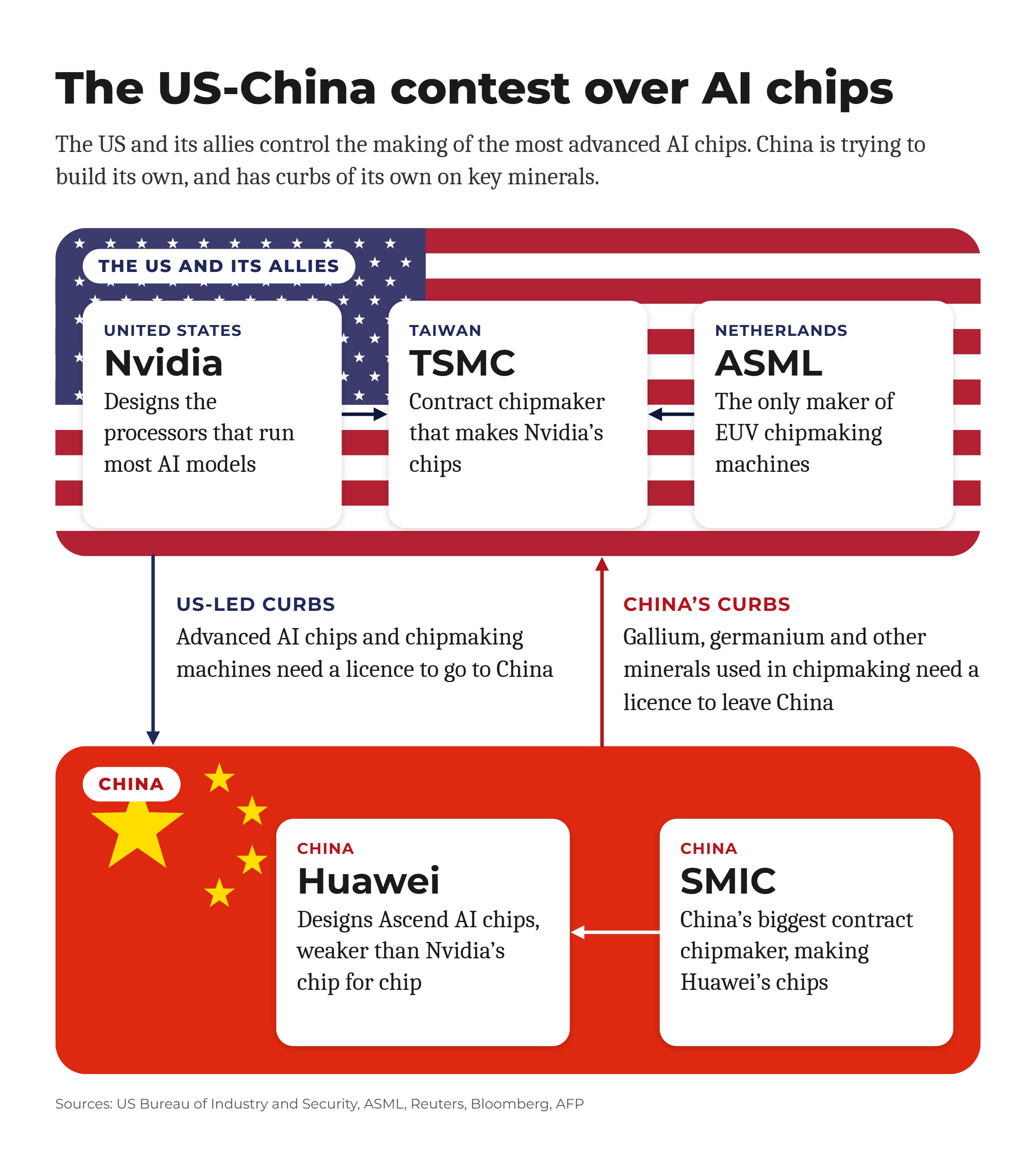
Nvidia designs the processors most widely used to develop and run AI models, known as graphics processing units (GPUs). It relies on Taiwan Semiconductor Manufacturing Co (TSMC), a contract manufacturer, to make them.
TSMC in turn depends on machines that only one company in the world can build. ASML of the Netherlands makes extreme ultraviolet (EUV) lithography systems, which use light to print the finest circuit patterns onto silicon. The most advanced of these machines are roughly the size of a school bus and weigh about 180 tons, Reuters reported.
Chinese companies cannot yet match any of these three, and the US over the past decade has tried to preserve this gap by restricting what Beijing can buy.
Washington’s wall
The US began pressing the Netherlands in 2018 to stop ASML from selling EUV machines to China. ASML says it hasn’t sold one to a customer there.
Washington widened the campaign on October 7, 2022, when it imposed restrictions on exports of advanced AI chips to China. The commerce department’s Bureau of Industry and Security (BIS), which runs US export controls, said the rules would restrict China’s ability “to both purchase and manufacture certain high-end chips used in military applications”. It said such chips were used “to produce advanced military systems including weapons of mass destruction”. The rules also covered chipmaking equipment, and barred US companies and citizens from supporting advanced chip production at certain plants in China without a licence.
Nvidia responded with slower versions of its chips for the Chinese market, the A800 and H800. Washington closed that route in October 2023 with a new performance threshold, and Nvidia designed another China-only chip, the H20.
The Netherlands followed the US lead. From September 1, 2023, ASML needed a Dutch licence to ship its most advanced deep ultraviolet (DUV) machines, an older and less precise type, to China. In January 2024 the company said the Dutch government had partially revoked a licence for some of those shipments, “impacting a small number of customers in China”. Beijing criticised the decision.
Also read: Trump says FBI probing Nvidia CEO Jensen Huang as China controversy deepens
Suspected smuggling
Export rules define whom an American company may sell to. But once a server reaches a buyer in a third country, the seller relies largely on paperwork and inspections to know where it goes next.
In March 2026, federal prosecutors in New York charged Supermicro co-founder Yih-Shyan “Wally” Liaw and two others with diverting servers fitted with restricted Nvidia chips to China. Supermicro is a California maker of AI servers. According to the indictment, a company in Southeast Asia bought about $2.5 billion of the company’s servers in 2024 and 2025, using false documents that named it as the end user. The servers were repackaged in unmarked boxes and shipped on to China, it alleged.
To get past auditors, the men allegedly staged thousands of “dummy” servers, non-working replicas, at warehouses where the real machines were supposed to be. Before one commerce department inspection, two brokers used a hair dryer to move labels and serial-number stickers onto the fakes, prosecutors said, and surveillance cameras recorded them.
Supermicro is not a defendant and says it has been “cooperating fully with the government’s investigation”. Liaw has pleaded not guilty. Ting-Wei “Willy” Sun, a broker charged alongside him, pleaded guilty in October under a deal with prosecutors, and the third accused has not appeared in the case, Bloomberg reported.
In a separate case, Alan Hao Hsu, a Texas businessman, and his company pleaded guilty in October 2025 to smuggling. US prosecutors said in December that year that the network had exported or tried to export at least $160 million of Nvidia’s H100 and H200 chips, relabelling them under a made-up brand, “Sandkyan”.
Huang had played down such risks. “There’s no evidence of any AI chip diversion,” he told Bloomberg in May 2025.
Megaspeed, the Singapore cloud company that employed the woman at the centre of the Huang affair, has been investigated by the US over suspicions that it helped Beijing get access to barred Nvidia chips. Its imports of Nvidia products topped $4.6 billion, and it rents Nvidia chips to China’s Alibaba from facilities in Southeast Asia, Bloomberg reported. The news agency found from trade records that Nvidia’s inventory checks for US officials undercounted chips sold to Megaspeed through partners by 50,000 units.
Megaspeed has denied the diversion allegations and says Singapore’s investigation ended with no adverse action against it. Nvidia has said its inquiry found no evidence of diversion.
The Dutch machines have come under suspicion too. In June 2026, Bloomberg reported that commerce secretary Howard Lutnick had told ASML executives Washington was concerned an EUV machine might have reached China. Officials said they had evidence but declined to share it.
ASML told Reuters: “ASML has never shipped an EUV machine to China nor have we shipped to China any component, module or equipment specially designed to be used in an EUV machine.” The Dutch authorities said they enforce the rules strictly.
US policy changes
Two views have pulled US policy back and forth. One holds that every advanced chip China obtains strengthens its military and its AI labs. The other, argued by Huang, holds that shutting Nvidia out pushes Chinese buyers to local suppliers and turns China into a more powerful, independent force in AI.
In April 2025, the Trump administration halted H20 sales to China by requiring licences, and Nvidia put the cost at $5.5 billion, AP reported. On May 21, 2025, Huang told a press conference in Taiwan: “All in all, the export control was a failure.”
He said Nvidia’s share of China’s market had fallen to 50% from 95% at the start of the Joe Biden administration in the US.
In December 2025, President Donald Trump said the US would let Nvidia sell its H200, its second-best AI chip, to “approved customers” in China, with a 25% fee for the US government. A commerce department rule put the change into effect in January 2026.
China’s response
Beijing has answered by building its own chips and, more recently, by turning away American ones.
Huawei, the Chinese technology company, designs Ascend AI chips, which are made by SMIC, China’s biggest contract chipmaker, on an enhanced version of its 7-nanometre process, Bloomberg reported. The nanometre figure is a rough guide to how finely a factory can etch circuits, and a smaller number indicates a more advanced chip.
Huawei’s chips, though, lag Nvidia’s. Eric Xu, Huawei’s rotating chairman, promised in September 2025 a new generation of Ascend chips every year until 2028.
In December 2025, Reuters reported that Chinese scientists in Shenzhen had built a prototype EUV machine with the help of former ASML engineers. It generates EUV light but has not yet made working chips. The official target is to do so by 2028, though people involved told Reuters that 2030 is more realistic.
In November 2025, Beijing ordered new state-funded data centres to use only Chinese AI chips, Reuters reported. “The Chinese central government has not let them, as of yet, buy the chips, because they’re trying to keep their investment focused on their own domestic industry,” Lutnick told US senators in April 2026, referring to the H200.
Nvidia has said in regulatory filings that it has sold only a small amount of H200s to China, AP reported. In May 2026, Huang said Nvidia had “largely conceded” China’s AI chip market to Huawei, Reuters reported.
Chinese companies still want the Nvidia chips they are allowed to buy. ByteDance, Alibaba and Tencent have ordered more than 3 million of Nvidia’s RTX PRO 5500, a less powerful workstation chip that can still be sold to China, worth more than $35 billion at list price, Reuters reported in October.
“The cruelest irony may be that Huang loses his influence in Washington just before China starts proving his point,” Catherine Thorbecke, who writes on Asia technology for Bloomberg Opinion, wrote in an opinion piece after the CEO’s affair became public.
Beijing also has a chokepoint of its own. In 2023, it began requiring export licences for gallium and germanium, two metals used in chipmaking, and it produces over 90% and 60% of the world’s supplies, respectively. Further, it restricted exports of rare earths, the metals used in powerful magnets, in April 2025 and widened those curbs in October, before pausing them for a year under a trade truce with Washington. On November 9, it extended that pause by two months.
Also read: Row over alleged Chinese spy puts Jensen Huang’s leadership of Nvidia under scrutiny
What happens next?
Huang has apologised to his family and to Nvidia’s staff. The company’s board has set up a committee of independent directors to examine reports that he was the target of a foreign intelligence effort, and says it has “no reason to believe that either national security or Nvidia secrets were compromised”.
China’s foreign ministry called the spy allegation “purely a groundless accusation, slander, and a smear”.
Lawmakers and advocates say the affair makes it more likely that the US Congress will tighten China’s access to AI chips through the annual defence policy bill.
The Senate’s version of the bill includes three measures. The AI Overwatch Act would give Congress power over advanced chip exports. The Chip Security Act would require exported chips to carry location-verification mechanisms. And the Match Act would push US allies to restrict more chipmaking equipment to China.
A former congressional staffer told Reuters that Nvidia is considered the biggest opponent of the first two; the company declined to comment.
Democrats also take control of congressional committees in January. Huang has been asked to appear before a closed-door joint meeting of House committees on November 18, and US President Donald Trump is set to meet Chinese President Xi Jinping at the Apec summit in Shenzhen next week. The meeting comes weeks before China’s pause on its rare earth curbs is due to end, on January 10, 2027.


