For many foreign professionals in the US, the route from a temporary work visa to a green card for permanent residency begins with a Labor Department process called PERM. On Thursday, the Trump administration closed that route at eight companies, six of them IT services companies based in India or with large operations there.
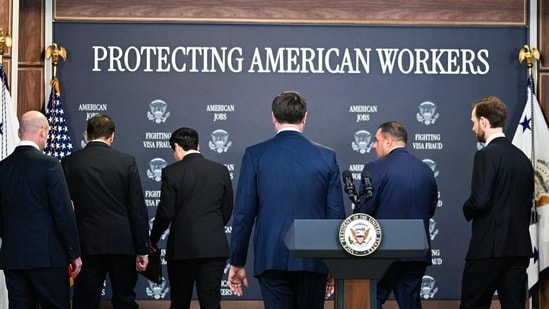
US labor secretary Keith Sonderling said his department would stop accepting new applications and processing pending ones under the Permanent Labor Certification programme (PERM) for Infosys, Tata Consultancy Services (TCS), Wipro, HCL Technologies, Cognizant, Capgemini, Microsoft and Adobe. US vice-president JD Vance alleged that the companies had used the programme to replace American workers with cheaper foreign hires.
Current holders of H-1B work visas do not appear to be directly affected. But Indian professionals at these firms lose the usual way into a green card queue in which they already wait longer than most, because US law caps the family and employment green cards issued each year to people from any one country at 7% of the total, or 25,620.
Also read: How H-1B visa holders could be affected by US green card suspension: Microsoft, TCS, Wipro in focus
How PERM works
{{/usCountry}}Also read: How H-1B visa holders could be affected by US green card suspension: Microsoft, TCS, Wipro in focus
How PERM works
{{/usCountry}}PERM came into effect in 2005, replacing a slower, paper-based process called Alien Employment Certification.
The employer starts the process, and an individual worker cannot apply on their own behalf.
The US Department of Labor must certify to US Citizenship and Immigration Services (USCIS), the agency that grants green cards, that there are not enough qualified US workers available for the job, and that hiring the foreign worker will not hurt the wages and working conditions of Americans in similar jobs.
Before filing, the employer obtains a prevailing wage determination from the Labor Department and advertises the job to test whether qualified Americans are available. Once the department certifies the application, the employer files a petition, Form I-140, with USCIS, and the worker then waits for a green card number to become available.
Vance also said on Thursday that some companies post ineffective job advertisements and then point to the lack of applicants to justify hiring lower-paid foreign workers.
Foreign professionals have routes to a green card that bypass employer sponsorship. These include the EB-1A category for people of extraordinary ability and the EB-2 National Interest Waiver, Reuters reported.
The H-1B link
The H-1B is a temporary work visa that generally lets skilled foreign workers stay in the US for up to six years. Many IT companies hire foreign staff on H-1B visas and later sponsor them for permanent residency through PERM. Microsoft relies on PERM as a major tool to retain employees, according to Bloomberg.
US law allows an H-1B worker to stay beyond the six-year limit in two situations. The first applies once a year has passed since the employer filed a PERM application or an I-140 petition, with extensions granted a year at a time. The second covers workers with an approved I-140 who cannot yet get a green card because of the per-country cap, with extensions of up to three years at a time. Workers whose employers can no longer file a PERM application lose access to both.
The rules also end the one-year extension if a PERM application is denied or closed, and the Labor Department has not said what it will do with the pending applications it has frozen.
Without PERM sponsorship, foreign workers would have to stay on temporary visas for longer.
What it means for Indian IT companies
TCS, India's largest IT services exporter, said on Friday that it does not expect the suspension to have any material impact on its workforce strategy or client engagements. The company said its PERM applications had been in "single digits" over the past two years, and that it still plans to hire 15,000 more employees in the US over the next five years. It said its US workforce strategy relies mainly on local hiring, supported by campus recruitment.
TCS was the second-largest employer of approved H-1B workers in the first nine months of the US government's 2026 fiscal year, which ended on September 30, behind Amazon and ahead of Infosys, Apple and Microsoft, according to USCIS data.
Nasscom, the industry body for India's IT services companies, said many Indian IT companies have significantly reduced their reliance on H-1B visas, which has translated into fewer requests for permanent status. "While the decision affects a specific immigration pathway, Nasscom has consistently maintained that immigration and skilled talent mobility are two distinct issues and should not be viewed through the same lens," the group said in a statement.
Indian outsourcers have cut back on H-1B visas in recent years in response to political backlash in the US and the Trump administration's move to raise fees, Bloomberg reported.
In New York trading on Thursday, American depositary receipts of Infosys reversed early losses and were trading more than 1% higher, Wipro was down less than 1% and Cognizant was up more than 5%, while Microsoft fell more than 1.3%, according to Bloomberg.
Infosys, Wipro, HCL Technologies, Cognizant and Capgemini had not reacted publicly till Friday morning.
Also read: US Green card sponsorship curb on tech firms draws praise from Trump allies, fury from Democrats
What it means for Indian workers and universities
Anyone whose PERM application was pending at the eight companies is now stuck, since the Labor Department has said it will not process those cases.
Workers at Microsoft could be the hardest hit, because the company is the largest filer of PERM applications, according to Labor Department data cited by Reuters. Microsoft said about 80% of the H-1B applications it filed in the last fiscal year were to extend or change the status of existing employees, and that it pays its H-1B staff on par with others doing comparable work.
Other large employers, including Meta, Amazon and Alphabet's Google, remain free to use the programme.
Hiring from abroad could also become harder for the eight firms. Many workers overseas consider the prospect of permanent US residency a major reason to take a job there.
The Trump administration has also turned its attention to American universities. On Thursday, it opened investigations into nine of them, including Harvard, Yale, Stanford, Brown and the Massachusetts Institute of Technology (MIT). The investigations focus on the J-1, a visa for exchange visitors. At universities, it is often held by foreign PhD students and visiting researchers.
Investigators have already served subpoenas, legal orders requiring people or institutions to hand over documents or give evidence, according to Anthony D'Esposito, the Labor Department's inspector general, who investigates fraud and misconduct in its programmes. He said they would check whether foreign influence, improper financial links or misuse of visas were compromising research paid for by the US government.
A group representing US universities has warned of the cost. International students have historically spent $40 billion a year in the US, Sarah Spreitzer of the American Council on Education, which represents the heads of US universities, told Reuters. Columbia University has already seen a sharp fall in applications from abroad because of fast-changing visa rules, Reuters has reported.