
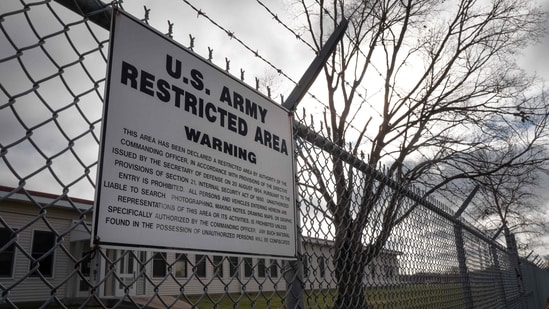
Fear of an accidental explosion has led the US Army to plan a deliberate one, blowing up 68 barrels of decaying lead azide at a munitions plant in eastern Iowa on Wednesday. The lead thrown up by the blast will then drift wherever the wind blows it, over the homes and farms downwind.
What is lead azide?
Lead azide is a primary explosive, the small and highly sensitive charge inside detonators and blasting caps. It goes off on impact, and that small blast fires the much larger main charge in a shell or bomb.
Its force lies in the unstable bonds that join a lead atom to two azide groups, each a cluster of three nitrogen atoms. Once those bonds break, the nitrogen turns into gas all at once and expands in a rapid burst.
The US made lead azide in bulk from the 1930s until the 1990s, when falling demand ended large-scale production. Around the same time, the health risks of lead compounds became a growing worry worldwide.
Why does the Army have barrels of it?
The Iowa Army Ammunition Plant in Middletown, which makes munitions, received 120 barrels of lead azide more than 20 years ago, according to an Army spokesperson quoted by the Des Moines Register. Many were later moved to other sites. The remaining 68, holding about 4,300kg, are stored in earth-covered concrete bunkers.
What went wrong in storage?
The lead azide in the barrels was held in a mixture of ethanol and water. Earlier this year, officials found that temperature swings had dissolved the compound into that liquid, after which it re-formed as pure crystals shaped like needles and thin plates. The barrels were no longer fit for making ammunition.
{{/usCountry}}The lead azide in the barrels was held in a mixture of ethanol and water. Earlier this year, officials found that temperature swings had dissolved the compound into that liquid, after which it re-formed as pure crystals shaped like needles and thin plates. The barrels were no longer fit for making ammunition.
{{/usCountry}}Large needle-shaped crystals of lead azide are extremely sensitive to friction and impact, which makes the barrels dangerous to open or move.
Also read: Army set to detonate entire U.S. stockpile of bomb-making chemicals at Iowa plant
Why not move it or neutralise it?
The Army ruled out trucking the barrels elsewhere, given the danger of moving unstable explosive, and is dealing with them on site.
Lead azide can also be destroyed chemically. Nitrous acid breaks the azide down into nitrous oxide and nitrogen gas and leaves the lead dissolved in water, and commercial neutralising agents can do similar work. Both methods need the drums opened so the material can be dissolved or soaked through, which is risky with crystals this sensitive.
The Army chose a controlled detonation instead. On November 22, it said the work would go ahead on Wednesday, citing the emergency nature of the situation.
How will the blast work?
The barrels will be covered with soil and sprayed with water to limit how much lead is thrown into the air, and engineers have built barriers around the site to control the plume. Soil and water reduce the amount of lead released but cannot stop all of it, and officials still expect a plume of lead dust to drift off the site.
The state's Department of Health and Human Services (HHS) describes a "controlled, mitigated detonation" scheduled for about 9am local time on Wednesday (8.30pm IST). Federal authorities have recommended that residents in a designated zone downwind evacuate, and people in other affected areas have been told to stay indoors.
What will the blast release?
Detonation breaks lead azide down into nitrogen gas and lead. The nitrogen is harmless, since it already makes up most of the air we breathe. The lead is thrown up as fine particles.
How far the particles travel depends on their size, while their direction depends on the wind. Iowa's health department expects the greatest risk closest to the site, particularly downwind.
How long does the danger last?
The department expects "a relatively short-duration airborne exposure event". The longer problem starts after the plume passes, as the particles settle on soil, decks, play equipment and livestock feed. Lead can stay in soil for decades, and people can pick it up again by walking on or working the ground.
The department put the warning in bold in its guidance: “The conclusion of the airborne exposure period does not necessarily indicate that precautions related to deposited lead dust are no longer necessary.”
Also read: US Army urges evacuation before explosives cache destruction
How does lead get into the body?
People can breathe in the particles while the plume passes overhead. Once the dust settles, lead enters the body as people swallow it or come into contact with contaminated soil and surfaces.
What does lead do to the body?
Lead is a neurotoxin, a poison that damages the brain and nervous system. "No safe level of lead exposure has been identified," the Iowa health department says.
Even small amounts can affect children's cognitive development and lower their IQ, with effects that can last a lifetime. In adults, low-level exposure has been linked to higher death rates from heart disease across populations. The US Environmental Protection Agency (EPA) classifies lead as a probable carcinogen.
The damage often goes unnoticed at first. "Lead exposure may not cause immediate symptoms," the department says, and it calls a blood test the only recommended way to check. It advises anyone with severe symptoms such as respiratory distress or seizures to get medical help at once.
Who is most at risk?
Infants, children under six and pregnant women are the most vulnerable, according to the department, and older adults and people with chronic illnesses may need extra help following its advice. Doctors have been told to look out for other risk factors, including pica, a compulsion to eat things that are not food, such as soil, and jobs that already expose people to lead.
What are people told to do?
Outside the evacuation zone, the department advises closing windows and doors for 24 to 48 hours after the blast and switching heating and cooling systems to recirculate indoor air. It suggests turning off exhaust fans that pull outside air in, and fitting furnace filters rated MERV 11 or higher, a grade that traps fine particles. Children and pets should stay indoors, and farmers should protect livestock feed and water from the dust.
After the Army gives the all-clear, residents should wet-clean surfaces children touch, from toys to windowsills, and avoid dry sweeping or leaf blowing, which can stir dust back into the air. Washing hands often and leaving shoes at the door limit how much dust is tracked indoors.
What happens next?
The EPA and the Army say they will monitor and sample the area before, during and after the detonation. Under the EPA's emergency permit, the Army must check the area daily and clean up high-touch surfaces where lead is found, such as parks.
Iowa is not recommending blood tests for everyone living near the site. It will draw up targeted testing advice once soil results show where the lead fell, while warning that "the absence of symptoms does not exclude lead exposure". It has also asked the US Centers for Disease Control and Prevention for help with its assessment.
The US Department of Agriculture has said about 350 farms could be affected, based on the expected direction of the plume. The state said the figure was a projection of possible impact rather than evidence of contamination.
ABOUT THE AUTHOR
HT Explainers Desk delivers in-depth explainers and analysis on the stories shaping India and the world, from SimplyPut, Hindustan Times’ dedicated explainer section. The desk unpacks the science, policy, geopolitics and market forces behind major news events, breaking down complex developments into clear, accessible reporting for readers who want more than the headline. Explainers draw on the expertise of the journalists covering the story and insight from leading subject experts, translating specialist detail into plain language without losing precision or nuance. Coverage spans national and global news — from health and science breakthroughs to trade, technology, cybersecurity, aviation, energy and public policy — going beyond what happened to explain how it works, why it matters and what to watch next. Written for readers who want context, and not just the headlines, HT Explainers Desk brings together original reporting, data and expert analysis to make sense of the news as it develops. It is part of Hindustan Times, India's leading source for news, in-depth analysis and explanatory journalism since 1924.