The 2026 US Open, and this Grand Slam season, will go down in tennis history books – not for its records or champions, but for the end of a 149-year run and another nail in the coffin of a dying art.
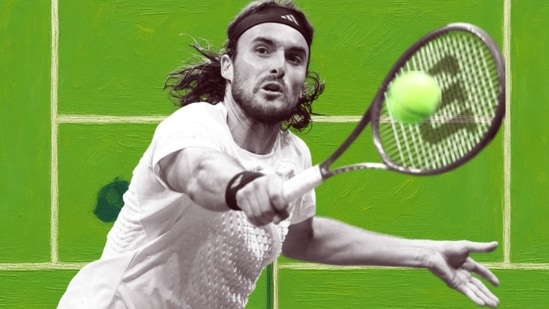
At least one men’s singles player with a one-handed backhand had reached the semi-final of a Grand Slam every year. That is. Until this year.
A streak that began with the 1877 Wimbledon Championships ended with the 2026 US Open, where Greek player Stefanos Tsitsipas was the last man standing among the one-handers before his exit in the fourth round.
The one-handed backhand's slide from the norm to an exception, amidst the rise of the two-hander, is not a recent phenomenon. Its decline has been steady over the past few decades, as the game has turned baseline-heavy.
How the backhand evolved
Back in the day, with tennis generally played with wooden racquets and on faster courts, the one-handed backhand was the standard.
Players such as Rod Laver, John McEnroe and Martina Navratilova would chip and charge to the net frequently, relying on their single-handed play. The one-handed backhand, with a larger swing, was the only preferred method even from the baseline.
{{/usCountry}}Players such as Rod Laver, John McEnroe and Martina Navratilova would chip and charge to the net frequently, relying on their single-handed play. The one-handed backhand, with a larger swing, was the only preferred method even from the baseline.
{{/usCountry}}In 1969, the first season played in the Open Era, all men's semi-finalists across all four Slams were one-handers. In 1973, when ATP rankings were first introduced, all but one singles player in the top 10 had a one-handed backhand.
The exception was Jimmy Connors.
Considered among the two-handed backhand's trailblazers, Connors used a steel racquet with a different method of stringing, unlike most other players at that time. Challenges in swinging the heavier wooden racquets on the backhand side were one of the primary factors cited by players who began playing the two-handed backhand, including Bjorn Borg and Chris Evert.
Connors, Borg and Evert all reached world No.1 with the transformed backhand. As racquets continued to evolve, courts got slower and the game more physical, the transformation became the norm. According to the ATP, 11 of the 28 players to have become world No.1 since the rankings were introduced did so with the one-hander. The last was Roger Federer, whose reign ended in 2018.
In 2024, when Tsitsipas dropped out of the top 10, it was the first time that no player with a one-handed backhand was in the top 10 since 1973. All players in the top 10 currently play the two-handed backhand.
Scientific differences
Use of muscles
The one-handed backhand has a greater extension of the forearm and relies more on upper-limb rotation and shoulder strength. The peak angular speeds are greater in the arm and forearm, according to a study by the International Journal of Racket Sports Science.
The two-handed backhand is more core-heavy, and generates greater trunk rotation and external rotation of the arm and forearm compared to the one-handed backhand, according to the same study. That generates more energy and power.
Kinematics
Another study published by the National Library of Medicine noted that the two-handed backhand is performed within a closed kinetic chain, while the one-handed backhand is performed in an open kinetic chain.
A kinetic chain is the sequence of joints and body segments — legs, hips, trunk, shoulder, arm — that work together to transfer force through a stroke. A closed chain, as in the two-handed backhand, links these segments more rigidly since both arms are fixed to the racquet, while an open chain, as in the one-hander, allows the hitting arm’s joints to move more independently.
In effect, that means the double-hander offers an additional degree of mobility compared with the one-hander.
Impact point
In the two-handed backhand, contact with the ball is usually made closer to the body, which provides more stability and better control against higher-bouncing balls and faster pace.
In the one-handed backhand, players generally hit the ball further away from the body, with a greater arm extension. The backswing is also significantly higher, providing a much greater reach.
The case for each
A well-executed one-handed backhand is elegant, one of the most pleasing spectacles, even in today's baseline-bullying game. A one-hander offers much greater reach, thanks to the longer extension of the arm. It can also be played on the run, even at full stretch along the baseline.
Volleying comes more naturally to one-handed players, whether at the net or from the back of the court. Volleys, slices and drop shots are useful tools to change the pace and rhythm of a rally.
Former women’s world No.1 and seven-time Grand Slam champion Justine Henin, a one-hander, tied the shot’s demands to how it is taught in the first place: “I can understand this for a little girl standing there waiting to play tennis. She might not have a lot of power, meaning it was important to build something which was technically very clean,” she told Sky Sports in 2021.
A two-handed backhand is not as risky, because it gives a bigger margin of error. The shot is far more stable because of the control from both arms. In modern tennis, where rallies are only getting longer and defensive skills all the more important, the double-hander is a much safer shot than the one-hander.
A two-hander also tends to generate more pace, because power from both the arms and the core comes into play. With tennis becoming more of a baseline game dictated from the back of the court, that power is almost a prerequisite.
The two-handed backhand return, with a shorter swing motion compared to a one-hander, is effective against faster serves. Modern tennis has had plenty of players whose big, booming serves are their biggest weapons.
Even players who use the one-hander concede the logic of the shift. "I think it is partly a consequence of the fact that, realistically, the two-handed backhand offers an advantage in modern tennis. In terms of efficiency, I think the two-handed backhand is more advantageous, especially in the modern game, with the speed at which tennis is played today,” Lorenzo Musetti — the current men’s world No.14 and one of only five top-100 men still playing with a one-hander — told the US Open website.
Also read: In Indian tennis, the one handed backhand is not so rare
Why the one-hander is a dying art
With modern tennis becoming more about power and physicality over touch and finesse, the two-handed backhand, which provides greater control, took precedence.
Tennis courts around the world have also grown slower over the years. That, along with evolving racquet and string technology, has diminished the appeal and efficacy of the one-handed backhand.
A weakness of the one-handed backhand was also exposed against topspin-heavy shots, where balls bounce above shoulder height, making a full, clean strike difficult. Rafael Nadal's heavy topspin against Roger Federer's backhand on clay is often cited as the clearest example.
Far from the earlier days of serve-and-volley and chip-and-charge play that made offensive tennis the norm, modern tennis is much more baseline-heavy, with defence as much in focus. The double-hander offers greater control in defence, while a flamboyant one-hander can be far more wayward.
Roger Federer, the former men's world No.1 and 20-time Grand Slam champion, offered a coaching-driven explanation for the shift at the 2026 US Open. “My coaches, when I was growing up, were, I would say, 90% one-handers. So, I think when your coach is a one-handed tennis player, you will most likely be a one-handed tennis player too. Nowadays, probably the coaches are mostly double-handed players, and it's just easier to teach a kid to have two hands on the backhand side.”
That coaching calculus plays out on the ground in India too. “At a young age, when your arm isn’t really strong, double hand helps. Unless a child insists he wants to play the single-hander, we do not encourage it. Even then, we have to tell him to be prepared to lose matches until you're 15-16 and can get physically stronger and faster on court,” renowned Indian coach Balachandran Manikkath told HT in 2024.
How many remain in the top 100
In the men's ATP top 100 rankings, as of the US Open, there were only five players with a one-handed backhand: Lorenzo Musetti (14th), Denis Shapovalov (48th), Stefanos Tsitsipas (53rd), Daniel Altmaier (58th) and Aleksandar Kovacevic (84th).
In the women's WTA top 100 charts, four players had a one-handed backhand during the season-ending Grand Slam: Diane Parry (31st), Lilli Tagger (49th), Viktorija Golubic (56th) and Tatjana Maria (83rd).
Tsitsipas, whose fourth-round exit at this year’s US Open ended the 149-year streak, summed up why fewer players are willing to bet on the one-hander. “I feel like, with a double-handed backhand, you can always save the situation… if you're a bit late or out of position, you can always use your left hand to sort of 'scoop' it in. There is no such thing with a one-handed backhand. If you're late, you're late. You missed the train,” the men’s world No.53 said at the 2026 US Open.