On Tuesday night, Nasa asked people to flash V-G-R, Voyager’s call sign, at the sky in Morse code with their phones and torches. By Wednesday morning, the 49-year-old Voyager 1 was so far from Earth that the light from those torches would take a full day to reach it, a distance no other human-made object has travelled before.
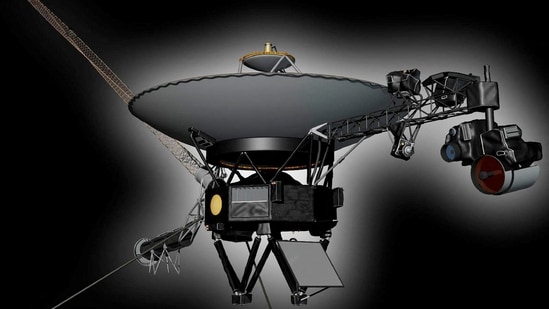
US space agency Nasa calculated that the probe crossed the one-light-day mark at 5.16am eastern time (3.46pm IST), about 26 billion kilometres out. “Reaching one light-day is an astounding feat, one that I never expected to see,” said Suzanne Dodd, who has worked with the Voyagers since 1984 and manages the project at Nasa’s Jet Propulsion Laboratory (JPL) in California.
Voyager 1 is still sending data home on a nuclear power supply that weakens every year and thrusters whose fuel tubes have been clogging since 2002. The small team that looks after it has spent years nursing both.
One light-day away
A light-day, the distance light travels in 24 hours, is about 26 billion km, or 173 times the distance between Earth and the Sun. Voyager 1 is nearly six times farther from us than Neptune and is still moving at about 61,000kmph.
For the engineers at JPL, the distance shows up as a delay. Every command now takes a day to reach the probe, and its reply takes another day to return. Dodd said in a Nasa statement last month that if you want to say “hello” to Voyager, “you send your message and then you go home”.
{{/usCountry}}For the engineers at JPL, the distance shows up as a delay. Every command now takes a day to reach the probe, and its reply takes another day to return. Dodd said in a Nasa statement last month that if you want to say “hello” to Voyager, “you send your message and then you go home”.
{{/usCountry}}Voyager 1 left the heliosphere, the protective bubble of particles and magnetic fields produced by the Sun, in 2012 and entered interstellar space, the region between the stars. It is still within reach of the Sun’s gravity, however, and will take about 300 years to reach the inner edge of the Oort cloud, the vast shell of icy bodies at the solar system’s outer edge.
Also read: How to catch a spaceship: The SpaceX Starship recovery in detail
What powers it
Voyager 1 runs on three radioisotope thermoelectric generators, or RTGs, devices that turn the heat given off by decaying plutonium into electricity. Their output falls by about 4 watts a year, as the plutonium gives off less heat and the generators convert it less efficiently with age.
Engineers have spent years deciding what to switch off to stay within that shrinking budget. The probe launched with 10 science instruments. Its cameras were among those turned off to save power, and two remain, one that detects plasma waves and one that measures magnetic fields.
The most recent loss followed a scare on February 27, when Voyager 1’s power dropped unexpectedly during a planned manoeuvre. A further dip could have tripped its undervoltage fault protection, a self-defence routine that shuts parts down on its own and would have left the team facing a long and risky recovery. On April 17, engineers shut down the Low-energy Charged Particles experiment, an instrument that measured charged particles, including cosmic rays, and had run almost without a break since 1977. (The command took about 23 hours to reach the probe.)
“While shutting down a science instrument is not anybody’s preference, it is the best option available,” said Kareem Badaruddin, Voyager’s mission manager at JPL.
In early September, the team pulled off an operation it nicknamed the “Big Bang”, switching off three devices aboard Voyager 1 at once and replacing them with three lower-power ones, about six weeks after doing the same on Voyager 2.
Without it, Nasa said, another instrument could have gone as early as summer 2027.
Surviving the cold
The swap was delicate because the six devices involved also help warm the spacecraft. Engineers had to make all three changes at the same moment to cut power use without upsetting how heat spread through the probe.
Heaters have been among the first things given up to save power, and the team has to stop short of letting the spacecraft grow so cold that its fuel lines freeze. By 2024, parts of Voyager 1 had become so cold that switching on one group of its thrusters risked damaging them.
By then, Nasa classed everything still running aboard as essential.
Moving onwards
Voyager 1 is travelling at about 61,000kmph, but its fuel is no longer moving it forward. It is coasting on the speed it gained from the rocket that launched it in 1977 and from its flybys of Jupiter and Saturn in 1979 and 1980. Jupiter’s gravity hurled it on towards Saturn, adding roughly 57,000kmph to its speed relative to the Sun, and Saturn’s gave it enough of a push to break free of the Sun’s pull in the long run.
The fuel on board, liquid hydrazine, goes to small thrusters that turn it into gas and release it in puffs lasting tens of milliseconds, nudging the probe so its dish antenna stays pointed at Earth. If that aim drifted, Voyager 1 could neither take commands nor send its data home.
Its thrusters have been clogging for more than two decades. As a rubber diaphragm inside the fuel tank ages, it sheds silicon dioxide, the main component of sand, and the residue builds up in the narrow tubes inside the thrusters. By 2024, the opening of one tube had shrunk from 0.25mm to 0.035mm. Engineers have moved the job between the probe’s three groups of thrusters three times between 2002 and 2024 as the clogging worsened.
In 2017, they fired four thrusters that had not been used since 1980, after digging through decades-old data and software written in an outdated assembler language, a programming language that talks almost directly to the hardware, to make sure the test was safe. In March 2025, they revived Voyager 1’s main roll thrusters, which turn the probe to hold it locked on the guide star it uses to orient itself. The team had written them off as dead in 2004, after two small heaters lost power. Engineers suspected a switch had flipped to the wrong position and sent commands to flip it back. Within 20 minutes of Voyager 1 executing them, the heaters’ temperature rose sharply, though the team in California saw the readings almost a day later.
“These thrusters were considered dead,” said Todd Barber, the mission’s propulsion lead at JPL, who called the fix “yet another miracle save for Voyager”.
On October 18 and 19 this year, Nasa’s Deep Space Network listened for Voyager 1 twice, 24 hours apart, and heard nothing. The signal returned on October 20. One group of thrusters had gone offline and the probe had switched itself to the backups, an automatic safety response JPL calls fault protection, and engineers are still trying to work out why. Badaruddin said it was “the first time we’ve seen the spacecraft do something like this”.
Also read: The rocket science behind Tesla's flying Roadster, and the air thrusters that SpaceX helped build
Communicating and fixing it
The Deep Space Network is Nasa’s international array of giant radio antennas, at three sites around the world. Only one dish, a 70-metre antenna near Canberra in Australia, has enough signal power to send the Voyagers commands. Data from the probe trickles back at about 160 bits per second.
A skeleton team at JPL sends commands about once a week. The work ramps up if something goes wrong, and a couple of retirees who once worked on the project sometimes lend a hand.
A computer fault that began in November 2023 left engineers without usable data for five months. Voyager 1 started sending home data that made no sense, and by March 2024, engineers had found the cause in the flight data subsystem, one of the probe’s three onboard computers, which packages its science and engineering readings for the trip home. A single chip holding part of that computer’s memory, including some of its own code, had stopped working. Unable to repair it, the team moved the code to other parts of the memory. They sent the commands on April 18, 2024, and usable engineering data came back on April 20, nearly two days later.
Its findings
Dodd told Reuters the probe is “sending back continuous measurements” that reach Earth whenever the Deep Space Network points its antenna at it. Its instruments have detected a faint, monotonous hum caused by the constant vibrations of the small amounts of gas present in interstellar space.
Dodd described one puzzle in the magnetic field readings. The field did not swing into the interstellar direction after Voyager 1 crossed the heliopause, the outer boundary of the Sun’s bubble, as scientists had expected, and still points in “a direction governed by our sun”.
“We are watching to see when that rotation might occur,” she said.
Storms on the Sun, such as coronal mass ejections, the huge bursts of charged gas the Sun throws out, still send shocks and pressure fronts as far as Voyager 1 and beyond, Dodd said. “Where does the sun’s influence end and pristine interstellar space begin? Perhaps Voyager may last long enough to answer that question.”
The end
A JPL representative told Reuters that recent power-saving measures could give the two Voyagers enough power to stay in communication with Earth for three to four more years. There is enough to run the current instruments through the 50th launch anniversary next year. “Beyond that is hard to predict, and of course these are nearly 50-year-old spacecraft, and there are always things the team cannot anticipate that might happen,” the representative said.
After its radio falls silent, Voyager 1 will go on coasting. Nasa expects it to take another 18,000 years to get a full light-year from Earth. In about 40,000 years it should pass within about 1.7 light-years of Gliese 445, an obscure star more than 17 light-years away in the constellation Ursa Minor.
Voyager 1 also holds a 30cm gold-plated record of greetings in 55 languages along with images and diagrams, a product of the efforts of the Cornell University astronomer Carl Sagan, with a stylus and instructions for any finder. “It’s a time capsule of life on Earth from 1977,” Dodd told the Associated Press. “I hope something, someone, finds it maybe 1,000 years from now.”