
 E-Paper



The rocket science behind Tesla's flying Roadster, and the air thrusters that SpaceX helped build
Tesla unveiled the Roadster at a SpaceX site on Thursday. How the air jets and suction fan work, what they do for speed and grip, and whether buyers get them.

 Prefer HTon Google


Every car accelerates, brakes and turns through four small patches of rubber where its tyres meet the road, and no car can push harder than those tyres grip. The Roadster's two headline systems deal with that limit in two ways. Its thrusters push the car directly and need no grip at all, while a fan underneath sucks the car down so its tyres press harder into the road.
What did Tesla show?
Tesla unveiled the car on Thursday at a SpaceX rocket testing facility near Waco, Texas, and streamed the event online, Bloomberg reported. SpaceX lists the site as its rocket development facility. The Roadster seats two and uses a steer-by-wire system like the Cybertruck's, in which the steering wheel sends electronic signals to motors that turn the wheels, with no mechanical shaft between them.
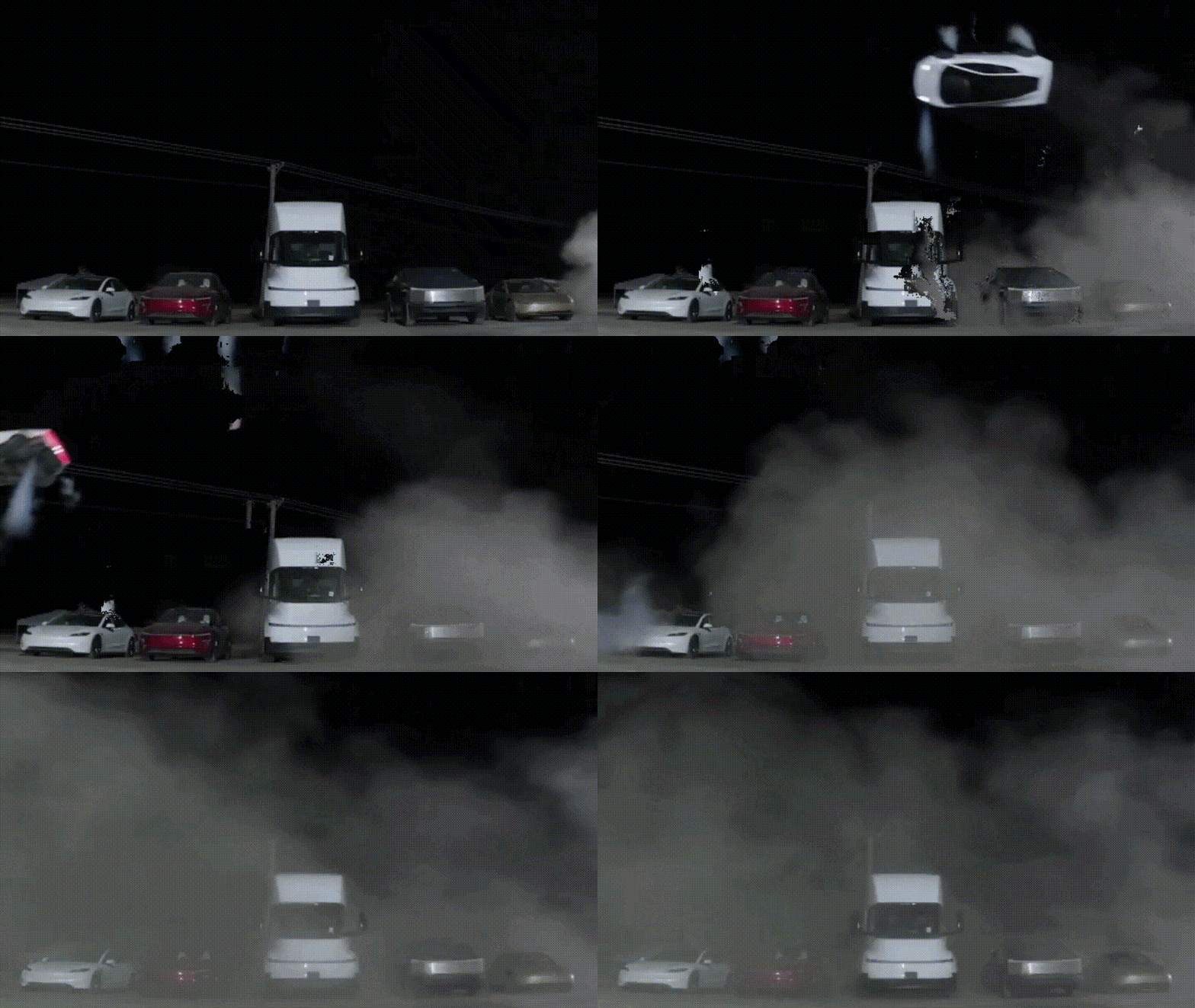
Tesla staged two stunts. In the first, the car drove up a curved ramp, its fan holding it on until it hung upside down, then fired its thrusters to launch off the end, flip in mid-air and come down on its wheels. In the second, it lifted itself over a Cybercab, a Cybertruck, a Tesla Semi truck, a Model Y and a Model 3 while moving.
Elon Musk, chief executive of both Tesla and SpaceX, told the audience: "You're going to see the results of what happens when you have a collaboration with the world's best car company and the world's best rocket company," according to Bloomberg.
Tesla also showed a video of the car reaching 60mph (about 97km/h) from standstill in under a second, Bloomberg reported. The Drive put Tesla's claimed time from a run at the event at 0.81 seconds. Production is not expected to start until 2028.
Also read: Tesla’s flying Roadster defies gravity, and will be a regulatory puzzle
How can a car fly?
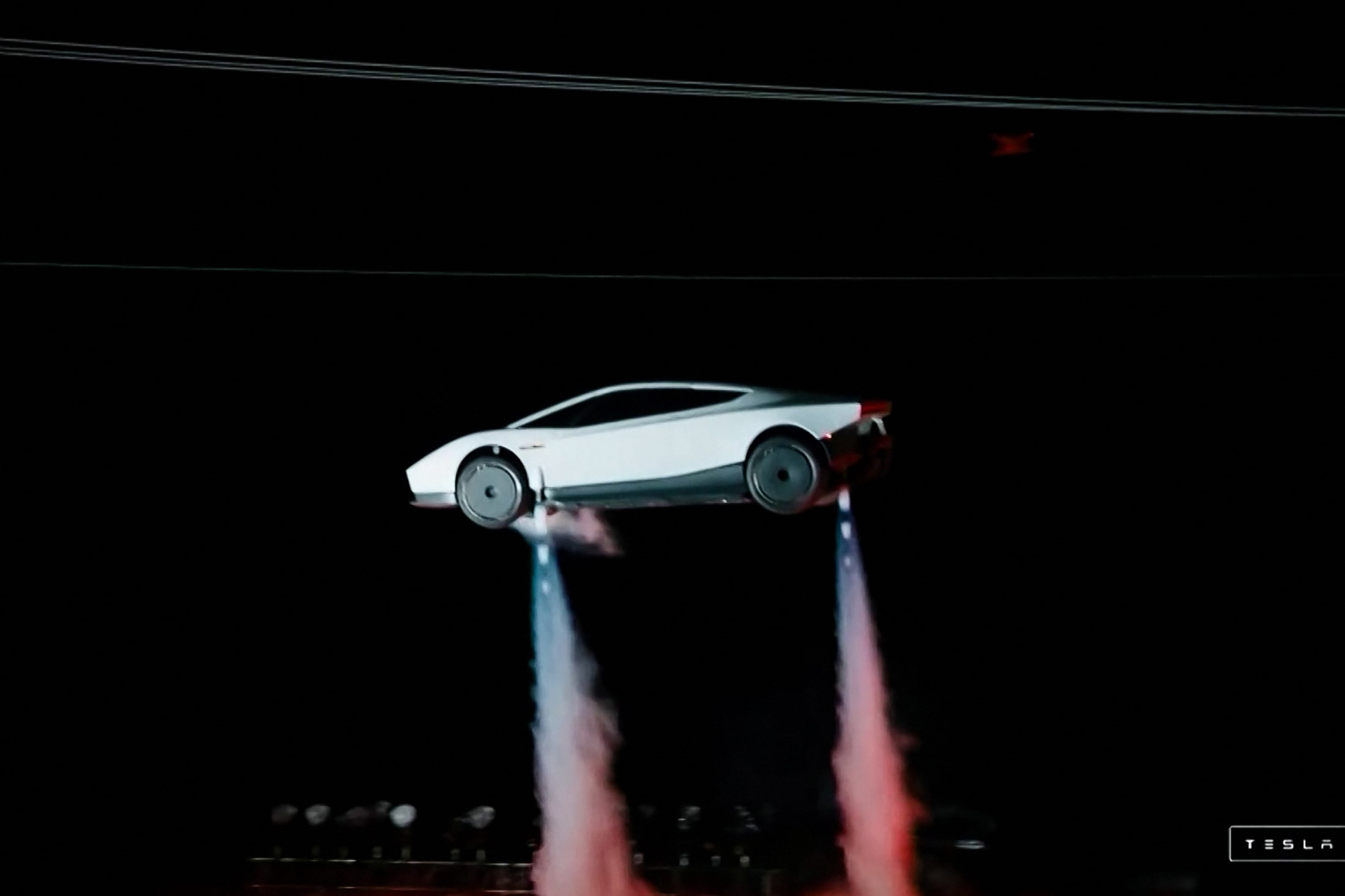
The Roadster flies on cold-gas thrusters, which store gas under high pressure and release it through small nozzles, a process that does not involve any ignition (or burning). The escaping jet shoves the vehicle the other way.
Nasa describes cold-gas systems as the simplest and most developed form of propulsion for small satellites, which use them to turn and steady themselves in orbit. Nasa's technical notes add that the specific impulse of the gas is "very low" compared with conventional rocket propellants. Specific impulse measures how long a kilogram of propellant can keep pushing with a force equal to its own weight, so a higher figure means more push per kilogram.
Simply put, a cold-gas thruster works like an inflated balloon let go before it is tied. Squeezed air rushes out of the neck and the balloon shoots the other way. The thruster does the same with a tank of compressed air and a valve, and since nothing burns to heat the gas and speed it up, each kilogram of air gives only a modest push.
Tesla's page says the thrusters use "all-electric actuators", meaning electric motors open and shut the valves, and complete "micro adjustments within a fraction of a second". Lars Moravy, Tesla's vice-president of vehicle engineering, said the car carries 10 thrusters fed by 600 litres of compressed air, and that the tank can be refilled, TechCrunch reported. Tesla said at the event that an electric compressor tops the air back up while the car is driving.
How long can it stay up?
The Roadster can stay airborne for a few seconds at most. Accounts of the event put the stored air at 250kg.
Nasa's survey of small-spacecraft propulsion puts the specific impulse of cold-gas systems at 65 to 70 seconds. In plain numbers, that means one kilogram of air can push with a force equal to its own weight for a little over a minute. The Roadster's 250kg of air could therefore hold up 250kg for about a minute, or a full tonne for about 15 seconds, because a load four times heavier drains the tank four times faster. A two-tonne car, close to what the Roadster might weigh, would get about half that.
The flips, the forward thrust and the braking burn before touchdown all draw on the same tank, so the real time in the air is far shorter, which matches the short hops Tesla showed.
Lifting a car needs far more push than spacecraft jets are built for. The same Nasa survey puts the thrust of a typical small-satellite cold-gas thruster at no more than 10 newtons, about the weight of a 1kg bag of rice. Holding up a tonne of car takes nearly 10,000 newtons.
The Wall Street Journal: The carmaker vying with Tesla to conquer the robot future
How does it reach 60mph in under a second?
The Thrust version of the Roadster fires jets of air backwards on top of the push from its wheels. A conventional car can only accelerate as hard as its tyres hold the tarmac before they spin. A 0-60mph time of 0.81 seconds works out to an average of more than three times the pull of gravity. TechCrunch reported that the Thrust version carries rear-mounted cold-gas thrusters for sub-one-second acceleration, and Tesla claims those thrusters produce four to five times the force the tyres can handle, Electrek reported. The Drive reported that the thrusters are built into the rear diffuser, the shaped underside at the back of the car. Thrust from a jet of air needs no grip, so it adds to whatever the tyres can manage.
How does it drive upside down?
A fan under the car sucks it onto the surface. Tesla's page says the Roadster's "multi-mode fan and ground sealing system acts as a downforce generator, pulling air out from beneath the vehicle", with "enough suction to hold the vehicle upside down, even when stationary". Downforce is the force pressing a car into the road. Moravy said the fan system pulls 2g, a force equal to twice the car's weight, Yahoo Finance reported.
Racing cars usually get their downforce from wings, which work like aircraft wings mounted upside down. Nasa's Glenn Research Center notes that a wing's lift depends on the square of its speed, so a car's wing gives four times the downforce at double the speed, and none at a standstill. A fan works at any speed. Tesla's own chart shows its fan curve starting above zero and climbing past a line labelled "Tire Load Limit", the most weight the tyres are rated to carry. On the ramp the fan held the car on; on the road it presses the tyres down harder, which raises the grip available for braking and cornering.
Has anyone tried this before?
Racing cars used fans in the 1970s, and the best known raced only once. Motor Sport magazine credits the Chaparral 2J, a 1970 car from the North American CanAm sportscar series, as the inspiration for fan cars. Brabham's BT46B, known as "the fan car", won the 1978 Swedish Grand Prix on its Formula One debut and never appeared again, the magazine recorded.
Also read: Tesla’s autos engine is under strain as Musk pivots beyond cars, shares fall 15% in 2026
What does SpaceX have to do with it?
SpaceX engineers worked on the thrusters, and SpaceX rockets use the same kind of hardware. Bloomberg reported that the air thrusters were developed in partnership with SpaceX engineers. SpaceX's Falcon User's Guide says the Falcon 9 first stage uses nitrogen gas thrusters to control its orientation when it returns for recovery, and that the second stage uses a cold nitrogen gas system to point and roll. On Falcon 9, the jets only steer while the main engines do the lifting. On the Roadster, the jets do the lifting as well, which is why the car needs so much air.
Musk first floated the idea in 2018, when he wrote on Twitter that a "SpaceX option package for new Tesla Roadster will include ~10 small rocket thrusters arranged seamlessly around car", TechCrunch reported. Tesla's page now says: "We already put Roadster in a rocket. Now we put a rocket in Roadster." The first line refers to February 2018, when SpaceX's first Falcon Heavy rocket carried Musk's own red Roadster, with a spacesuited dummy at the wheel, into a long orbit around the Sun, as AP reported at the time. Tesla also says the car's Ano White paint draws on coatings that protect rockets from ultraviolet light, extreme cold, static build-up and corrosion.
Can anyone buy one?
Buyers can reserve one now, with production due in 2028. Tesla will sell the Roadster in three versions, TechCrunch reported: Performance, described as "road ready", with the fan and active aerodynamics; Thrust, "race ready", with the rear thrusters; and Rocket, "air ready", a single-seater with 10 thrusters around the car. Tesla's reservation page listed payments of $50,000 for Performance and $250,000 for Thrust, with Rocket by invitation only, Fox Business reported. Tesla has not named a price for the car itself.
Before the event, Reuters reported, citing The Information, that the thruster-equipped version was not expected to be street legal. Bloomberg reported that Tesla is unlikely to sell a flying Roadster to the public, given the challenges of cost, safety, regulation and practicality.


