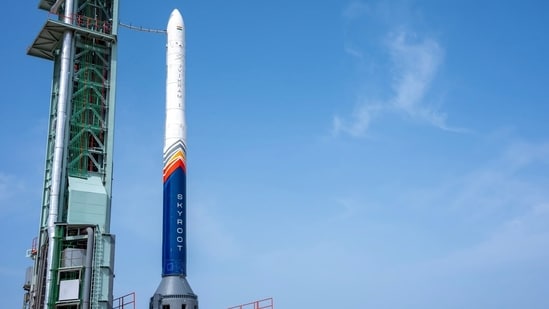
Recently, a slender carbon-composite rocket lifted off from the first launch pad at Sriharikota and did something no Indian launch vehicle has done in the country’s six-decade space history: It reached orbit without a single component of it having been built by the government. Skyroot Aerospace’s Vikram-1, on a maiden flight aptly named Mission Aagaman, that is, arrival, deployed its payloads into an orbit of roughly 450 kilometres, and in doing so made India only the third country, after the US and China, whose private sector has independently demonstrated orbital launch capability.
It is worth pausing on what, precisely, was achieved--because the temptation in the coming days will be to either overstate it or undersell it, and both would be a disservice.
Vikram-1 is a relatively diminutive vehicle. Approximately seven storeys high, Vikram-1 is a four-stage small-lift launch vehicle comprised of three solid-state fuel stages and a liquid Orbital Adjustment Module (OAM). The OAM contains a 3D-printed engine that is capable of performing multiple on-orbit operations, thus enabling the vehicle to place satellites in a variety of orbits along the same trajectory. With a payload capacity of 350 kg to low Earth orbit, Vikram-1 is much smaller than the PSLV. The loads scheduled for the launch demonstrate this class of vehicle. They include technology demonstrators from Grahaa Space, the debris capture start-up, Cosmoserve, the German component manufacturer DCubed, and Skyroot’s SCOPE payload, in addition to a handwritten postcard from the Prime Minister.
In terms of mass, this was a modest mission. In terms of the value associated with the achievement, this launch was significant. The monumental difficulty and expense associated with the development of a small class orbital launch vehicle is illustrated by the many small launch vehicle startups that have been unable to successfully complete the development of their vehicles. That a Hyderabad company founded in 2018 by two former ISRO engineers, having raised over $160 million across eight years, cleared this bar on its first orbital attempt, an outcome that eluded early flights of several celebrated western counterparts, says something about the depth of engineering talent India’s space programme has quietly cultivated, and about the ecosystem the 2020 space-sector reforms set out to build.
{{/usCountry}}In terms of mass, this was a modest mission. In terms of the value associated with the achievement, this launch was significant. The monumental difficulty and expense associated with the development of a small class orbital launch vehicle is illustrated by the many small launch vehicle startups that have been unable to successfully complete the development of their vehicles. That a Hyderabad company founded in 2018 by two former ISRO engineers, having raised over $160 million across eight years, cleared this bar on its first orbital attempt, an outcome that eluded early flights of several celebrated western counterparts, says something about the depth of engineering talent India’s space programme has quietly cultivated, and about the ecosystem the 2020 space-sector reforms set out to build.
{{/usCountry}}Mission Aagaman is the first testament to the return of the Government of India’s investment in the space policy gamble. In 2020, the space policy opening was made by the government with the establishment of the space regulator and agency (IN-SPACe) and the commitment was made that India’s private sector could graduate from being a supplier of components to ISRO into an independent builder and operator of space systems. For six years, that promise rested on suborbital demonstrations, ground tests and announcements. As of Saturday, it rests on flight heritage.
The timing is significant for another reason. India’s small satellite (for earth observation and communication) and even more so, defence satellite, systems have been constrained by supply issues. Launch services have been limited and reliance on the single state-operated launch service has created a bottleneck. A private launch service, constructed with a facility to eventually manufacture a rocket per month, has strategically important flexibility and responsiveness. The ability to place a satellite in the required location when needed, with no wait time, is the critical advantage in the Indo-Pacific when the situations dictate that several satellite systems need to be replaced or launched.
Being realistic about boundaries is equally important. Vikram-1 is an expendable rocket and nothing in the flight on Saturday involved reusability, the technology that has driven launch costs down most dramatically in all other markets. Firms like LandSpace and Space Pioneer from China are already testing reusable rockets, and a large part of what makes SpaceX the most dominant launch service provider is their capability to launch boosters several times. India’s private sector is now capable of reaching orbit and the next challenge will be pricing.
A successful flight is not sufficient for a sustainable launch service. The small-launch market is cut-throat, and Skyroot like Agnikul and Rocket Lab before them, will have to prove reliability and affordable pricing over many missions before the applause converts to a sustainable order book. It is, based on the company’s own words, mainly a test flight to gather data, and the real challenge will begin with the second flight and continue with the third, and the tenth.
Additionally, India’s launch raises several specific policy questions that have previously been addressed in broad strokes. As Low Earth Orbit (LEO) increasingly congests, early access and availability become increasingly critical. IN-SPACe must transition from granting launch authorizations to regulating the space industry. This includes the adoption of the emerging standards for space industry regulation, and the binding acceptance of space debris mitigation and the end-of-life disposal framework. IN-SPACe must ensure continuous regulation to avoid fragmentation that has plagued the US space market. The Indian Space Policy 2023 alludes to the above framework and the launch is the most compelling case for instituting the proposed framework.
It is well appreciated that India’s space programme is the manifestation of Vikram Sarabhai’s belief that developing countries must not miss the opportunity to keep pace with the advanced technologies. The launch signifies India’s commitment to commercial space services with the establishment of an industry. The challenge of the future will be the creation of regulations, the demand for commercial services, and the ambition that surrounds the industry. Only time will tell if Aagaman will be a seminal milestone in space history or a basic commercial space service.
(The views expressed are personal)
This article is authored by Khyati Singh, research analyst, Centre for North America and Strategic Technologies, MP-IDSA.