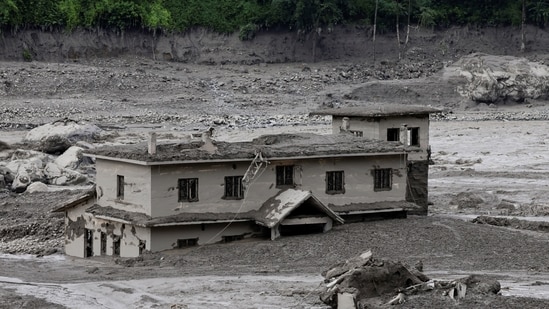
Recently, a catastrophic flash flood surged into the Bhote Koshi River, tearing through the tranquil Himalayan valley along the border with Nepal and China. Soon, the death toll in Nepal had climbed to at least 904, with more than 4,000 people still missing, among them foreign tourists, hydropower workers, customs staff and dozens of soldiers and police officers stationed near the border. India's response has been immediate, and personal in a way a foreign government's rarely is: Hundreds of Indian nationals were caught up in the disaster themselves. At least 63 Indians working on the Trishuli 1 hydropower project were rescued and remained in touch with the Indian Embassy in Kathmandu, even as the ministry of external affairs said around 320 Indian nationals remained uncontactable days after the flood. MEA spokesperson Randhir Jaiswal said a tunnel rescue team was being readied for deployment at Kathmandu's request, alongside a bailey bridge already in the country, and that India had offered to send National Disaster Response Force (NDRF) teams. Congress president Mallikarjun Kharge wrote to Prime Minister (PM) Modi and home minister Amit Shah urging NDRF deployment "wherever required," a reminder that the pressure on New Delhi is coming from inside India as much as from Kathmandu. The images of destruction and suffering coming out of Nepal are heart-breaking, but they tell only part of the story. Twice in barely a year, a deadly flood has torn down the same Himalayan river and into the same communities. Nepal responded quickly both times. That is precisely the problem: It is still better equipped to react to disaster than to anticipate it, leaving evacuation as one of its few defences once the water is already on its way. PM Balendra Shah convened an emergency meeting and ordered district officers to move residents out of low-lying areas along the river. The emerging evidence about what caused the disaster has complicated the initial account. Officials first believed the flood had surged into Nepal from Tibet, possibly as a glacial lake outburst flood. Satellite imagery and subsequent analysis, however, indicate that a massive ice-and-rock avalanche may have broken from a glacier on the Nepalese side of the border, roughly 12 miles northeast of the Rasuwagadhi crossing. The avalanche appears to have crashed into the Lhende Khola, temporarily damming the river with ice, rock and debris. Water accumulated behind the blockage until it gave way, sending a catastrophic surge of water, mud and boulders downstream into the Bhote Koshi and Trishuli river systems. A seismic event recorded in Tibet shortly before the flood initially raised another possibility: That an earthquake had triggered the collapse. Scientists are still investigating that sequence, and some now believe the seismic signal may instead have been generated by the avalanche itself. There had been no significant rainfall in the immediate catchment, making an ordinary rain-driven flood unlikely. This is the second time in just over a year that this stretch of river has overflowed its banks, killing nearby residents. But the distinction between the two disasters matters. A flood on July 8, 2025, originated upstream in Tibet and killed at least nine people, left 19 missing, swept away the Miteri Bridge linking Nepal and China, and wrecked the Rasuwagadhi dry port and nearby hydropower plants. It also cut Nepal's main overland trade route with China for months. What stands out is how little had changed in Nepal's ability to anticipate a catastrophe in this unstable border region. Last year's flood demonstrated the danger posed by glacial lakes and rivers originating in Tibet. The latest disaster suggests something broader: Catastrophic floods can be generated with little warning on either side of a border running through one of the world's most unstable high-altitude environments. The upper Bhote Koshi watershed drains a belt of glaciers and glacial lakes across Nepal and the Tibetan plateau that hydrologists have flagged for years as prone to sudden, rainfall-independent floods. Japanese glaciologists have studied this kind of hazard in the Nepal Himalaya since 1985, when a lake called Dig Tsho burst near Everest and destroyed a hydropower plant under construction. None of that expertise has translated into an effective alarm system on the ground. The Trishuli feeds into the Narayani, which becomes the Gandak once it crosses into Bihar. In September 2024, a sudden release from the Kosi barrage put Darbhanga, Saharsa and Madhubani underwater. That flood began upstream, without much warning, in a system nobody downstream was watching closely enough. This one stopped short of the border. The next one might not.
(The views expressed are personal)
This article is authored by Brabim Karki, writer and columnist, Kathmandu.