Of late, the global focus had shifted to the ongoing 81st United Nations General Assembly in New York as the platform of the summit transformed into a space for the respective leaders to contribute to the continuing deliberative discourse shaping public opinion and policy. Noteworthy is India’s national statement, delivered by external affairs minister S Jaishankar, enunciating that India will continue to exercise its right to defend itself against terrorism while focusing on the impact of sporadic conflicts on the Global South. This was in response to the speech made by the Prime Minister (PM) of Pakistan, Shehbaz Sharif, in which he had criticised India for launching Operation Sindoor. Jaishankar firmly asserted and contended that countries far from the conflict theatres were being penalised for no fault of their own, referring to the four Fs (food, fuel, fertiliser, and finance). He also highlighted how those most impacted often have the least say, and how new disturbing trends arise to challenge State capabilities.
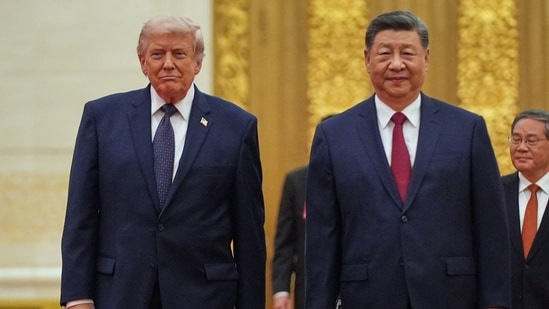
Yet behind the optics of such recrimination a new chemistry was being unveiled as the Sino-US dialogue was unfolding, with the Chinese President Xi Jinping and the American President Donald Trump finding ways for the two superpowers to coexist, as China and the US agreed to a $30 bn reciprocal tariff-reduction arrangement and an AI dialogue. The two countries set up a trade council and a significant communication channel for Artificial Intelligence (AI)-related incidents. The Chinese counterpart valued America’s usage of the term super-intelligence in place of AI.
The rapid stride made by AI is nothing less than opening the Pandora’s Box with possible ramifications for how global politics would be shaped, how countries would fight wars, and how economic relationships would be determined. The World Energy Council’s World Energy Trilemma Report highlights how global power is rebalancing toward new geographic hubs and energy-abundant zones that can successfully integrate massive digital infrastructure with stable power grids. Similarly, the report by the National Security Commission on Artificial Intelligence (NSCAI) frames AI possession and infrastructure development as the ultimate lever for global supremacy. In this context, the US and China hold a duopoly over global AI potential, far ahead of the rest of the world. The US has an edge when it comes to hardware dominance, as it has the world’s leading chip designers and hyperscale cloud investments. On the other hand, China, though being constrained by sanctions, has an edge when it comes to having more than 40% of global top-tier AI researchers. An AI dialogue can help them streamline and share resources with each other, which could create a centre of power.
This uneven AI structure, developing and transforming the potential of both these countries, is poised to create a stratified digital order with the Global South (excluding China) pushed towards an increasingly disadvantaged position. India holds a unique position to disrupt the duopoly, as it ranks 4th globally according to the State of India’s Digital Economy (SIDE) Report in standalone AI performance. While India’s ambitious AI Mission, with an allocation of ₹10,372 crore, has a capital push, Stanford’s HAI indicators state that India’s AI intervention remains structurally underrepresented in top-tier foundational model breakthroughs, coupled with inadequate scaling of AI into active, multi-functional operations. There have been numerous governmental interventions to keep India in the AI race, but it still lags in several domains, with time ticking.
{{/usCountry}}This uneven AI structure, developing and transforming the potential of both these countries, is poised to create a stratified digital order with the Global South (excluding China) pushed towards an increasingly disadvantaged position. India holds a unique position to disrupt the duopoly, as it ranks 4th globally according to the State of India’s Digital Economy (SIDE) Report in standalone AI performance. While India’s ambitious AI Mission, with an allocation of ₹10,372 crore, has a capital push, Stanford’s HAI indicators state that India’s AI intervention remains structurally underrepresented in top-tier foundational model breakthroughs, coupled with inadequate scaling of AI into active, multi-functional operations. There have been numerous governmental interventions to keep India in the AI race, but it still lags in several domains, with time ticking.
{{/usCountry}}For India to address the issues of global power dynamics, it needs to decouple itself in calculative manner from the traditional rivalry matrix with Pakistan and instead focus its resources on advanced analytics and smart techs because that would allow India to assert its stand as a global power for times to come to voice the concerns of the Global South. The Global South, whose cause Jaishankar championed adroitly at the Assembly, will look for a voice in that conversation, and India is best placed to be it, but only if it is in the room. The Four Fs he namedmay soon acquire an indispensable fifth, i.e. frontier AI. India’s answer should be to run two tracks at once: To deter on the western front while investing in the technological R&D. That means to expedite semiconductor capacity and the retention of AI talent as instruments of national security rather than mere industrial policy, and seeking a seat where norms on AI incidents are shaped instead of inheriting rules settled by twin capitals of Washington and Beijing. Thus, the point we precisely emphasise is that India doesn’t need to soften its stand on Pakistan, but we strongly and urgently intend to caution that this rivalry has so often absorbed India’s diplomatic bandwidth, parliamentary attention and strategic imagination. Rather, the global benchmark for India should be higher, addressing the traditional security challenges through advanced technological infrastructure. To navigate beyond Pakistan is not to forget it; it is to refuse to let it become the ceiling of India’s ambition, lest the multipolar world he anticipates turn out to be one of superpowers with super-intelligence, and India at its margins.
(The views expressed are personal)
This article is authored by Ayush Majumdar, assistant professor, department of political science, Jalangi Mahavidyalaya, Murshidabad and Gouri Sankar Nag, professor & head, department of political science, SKB University, Purulia, West Bengal.