India's tourism sector stands at an inflexion point. In FY23, it created 7.6 crore jobs and contributed 5% to GDP. The sector accounts for over 5% of GDP and supports over 13% of total employment. In the Union Budget 2026-27, the government allocated ₹2,438 crore to tourism, announced plans to transform 15 iconic archaeological sites into experiential heritage destinations, launched thematic tourism trails across mountains, coasts, and biodiversity zones, and proposed a National Institute of Hospitality to professionalise the sector (source). The ambition is clear. What remains less clearly articulated is how visitors encounter our heritage on the ground. Between monument and experience lies an interface — storytelling infrastructure — the visitor centres, site museums, craft villages, food courts, interpretation systems, and guided experiences that help people move from looking at places to understanding, valuing, and returning to them that helps people move from looking at places to understanding, valuing, and returning to them.
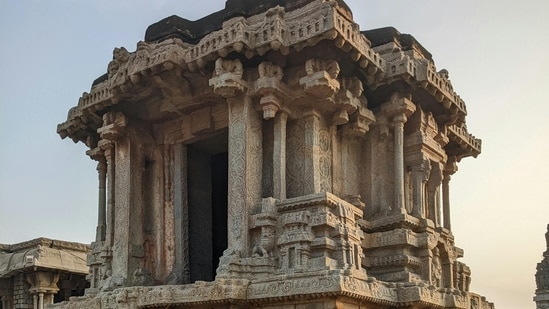
Walk through Hampi at dawn, when the granite boulders still hold the night's coolness and the Tungabhadra catches the first light. This UNESCO World Heritage Site spans 4,187 hectares and contains over 1,600 surviving remains of what was once, in 1500 CE, the world's second-largest city. Medieval European travellers crossed oceans to document its splendour. The capital of the Vijayanagara Empire continues to speak through every carved pillar and every temple gopuram rising against the boulder-strewn landscape.
And yet, Hampi receives approximately 4.5 lakh visitors annually (2024 data records 4,66,279 visitors). Cambodia's Angkor Wat, comparable in historic and cultural significance, welcomes over two million (20 lakhs). The difference is one of storytelling infrastructure that helps people understand what they are seeing and stay long enough to participate in it. India is home to 44 UNESCO World Heritage Sites and over 3,600 centrally-protected monuments. Across these, there are approximately 50 site museums — roughly one for every 70 protected sites. Italy, with a long history of investing in cultural institutions, offers a useful contrast: over 4,500 museums and a dense network of local cultural infrastructure that invite engagement over time.
In Hampi's villages, artisans continue to practise black pottery, stone carving, basketry, and metalwork — traditions carried through generations. At the Konark Sun Temple, at Thanjavur, and dozens of other remarkable sites, the pattern is the same: visitors encounter the monument alone, with little assistance in understanding the engineering, symbolism, or worldview that shaped it. Consider what these sites could become if each had a visitor centre to situate what is being experienced, a craft village, maybe something modelled on the Delhi Haat, where artisans demonstrate and sell their work, food courts rooted in regional cuisine, and the kind of collaborations between designers, artisans, local chefs, and brands entering regional markets that can anchor livelihoods around heritage. Spaces curated to this level of cultural relevance would also generate social media storytelling organically, extending the allure and reach of a site well beyond the visit itself.
{{/usCountry}}In Hampi's villages, artisans continue to practise black pottery, stone carving, basketry, and metalwork — traditions carried through generations. At the Konark Sun Temple, at Thanjavur, and dozens of other remarkable sites, the pattern is the same: visitors encounter the monument alone, with little assistance in understanding the engineering, symbolism, or worldview that shaped it. Consider what these sites could become if each had a visitor centre to situate what is being experienced, a craft village, maybe something modelled on the Delhi Haat, where artisans demonstrate and sell their work, food courts rooted in regional cuisine, and the kind of collaborations between designers, artisans, local chefs, and brands entering regional markets that can anchor livelihoods around heritage. Spaces curated to this level of cultural relevance would also generate social media storytelling organically, extending the allure and reach of a site well beyond the visit itself.
{{/usCountry}}Transportation and connectivity — road, rail, and air, of which air is the most critical to attract high-value tourism — are all equally necessary but insufficient. Konark is served by Bhubaneswar's international airport, barely an hour away; Thanjavur by Tiruchirappalli's, under an hour's drive — the connectivity exists. What is missing is the interpretive layer that transforms a day trip into a reason to stay longer and return.
When heritage sites lack this infrastructure, visitors spend less time, participate less deeply, and are less likely to return. The impact is felt most directly by local communities. When traditions are not made visible through storytelling, artisans lose opportunities for exchange. Without an understanding of the skill, time, and knowledge embedded in a stone carving or woven textile, visitors are unlikely to recognise its worth. This is how local food traditions and handmade practices are gradually replaced at heritage sites — because they are less understood.
What follows is quieter but more enduring. When cultural practices no longer sustain livelihoods, communities disengage from their care and younger generations move elsewhere. The diversity that gives India its cultural depth risks becoming uniform through the absence of connection.
The loss we are facing is economic, yes, but more than that, it is one of cultural inheritance and memory.
Kyoto offers the most instructive example of what becomes possible when policy, preservation, and storytelling work as a single system. The city attracted 56 million visitors in 2024, with tourist spending reaching a record ¥1.9 trillion (roughly ₹1.1 lakh crores) (source), and it achieves this through an ecology of cultural life where heritage and everyday infrastructure reinforce each other at every turn.
The foundation is regulatory, built over nearly a century. Kyoto first designated Scenic Landscape Districts in 1930 across 3,400 hectares (now expanded to nearly 18,000), established Japan's first City Ordinances on Urban Landscape in 1972, and decisively tightened controls through its 2007 New Landscape Policy, structured around five instruments: Building height, building design, vistaed views and borrowed landscapes, outdoor advertisements, and historical townscapes. Building heights were lowered across 30% of the city's urban area. In historical townscape zones, where rows of traditional kyo-machiya houses set the human scale, limits were reduced from 31 metres to 15 metres; along central arterial roads, from 45 metres to 31 metres — calibrated to step down from the city centre toward the surrounding mountains, preserving the visual relationship between the built city and its natural basin. A Vistaed View Creation Ordinance, the first of its kind in Japan, identified 38 specific views — temple, street, waterfront, mountain, borrowed garden landscapes — and imposed controls to keep them unobstructed. Rooftop signs were prohibited across the entire city, all flashing signage was banned, and protruding signboards were restricted along central roads. Historical townscapes are preserved through layered district designations, each with repair and improvement support, while a Kyo-machiya House Development Fund, supported by government and citizen donations, incentivises renovation of traditional townhouses rather than demolition (source).
On this regulatory foundation, the city has built a dense ecosystem of craft and visitor experience. Kyoto is home to 74 designated categories of traditional industries, 17 holding national status, spanning nishijin textiles, kiyomizu ceramics, lacquerware, bamboo craft, and dozens more. The city government supports these through artisan subsidies, training programmes for young practitioners, and initiatives connecting traditional skills with contemporary markets. The Kyoto Museum of Crafts and Design displays all 74 categories alongside daily artisan demonstrations, while a dedicated artisans concierge service connects visitors directly with private studios for hands-on workshops. As a result of all these policies and systems, tea ceremonies are still held in rooms unchanged for centuries. Family-run craft shops still line Kyoto’s temple paths. Festivals animate neighbourhoods, with floats stored in historic townhouses between celebrations. The visitor encounters not a collection of monuments but a city where heritage circulates through daily life.
India already holds comparable depth. Its diversity of traditions, continuity of practice, and community-held knowledge remain remarkable. From Ahmedabad's pols and textile markets to Maheshwar's riverside weavers, from Pune's Marathi theatre traditions to the forts of Chhatrapati Shivaji, the foundations for meaningful storytelling are present across the country.
What is needed is a deliberate effort to support this through storytelling infrastructure developed via public-private partnerships, combining private expertise in visitor experience with public responsibility for conservation and community benefit. Visitor centres, multilingual interpretation, pilot programmes at high-potential sites, craft villages and food experiences curated with designers, artisans, and local chefs, digital platforms that extend learning beyond the visit, and ways of integrating artisans into tourism economies through workshops and markets — these can together transform visiting into understanding.
The government has identified heritage as a key driver of long-term livelihoods and committed meaningful resources toward it. What now needs attention is the connective tissue between policy and place — stortytelling infrastructure as an interface that allows monuments to be understood as living sites, and visitors to engage with the cultures that continue to sustain them.
(The views expressed are personal)
This article is authored by Shimul Javeri Kadri, founding partner, SJK Architects.