When Barun Kashyap joined Shri Ram College of Commerce (SRCC) in 2010, he had no plans of becoming a screenwriter. The Economics graduate from Delhi University is now one of the writers of the recently released six-part OTT series Operation Safed Sagar, which dramatises the Indian Air Force’s role in the 1999 Kargil War and the Golden Arrows squadron.
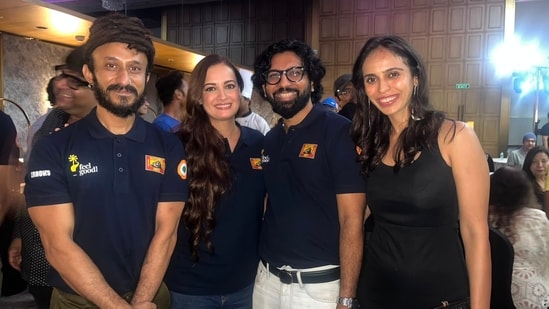
“I wanted to explore more opportunities and hence decided to step out of Guwahati,” Kashyap recalls. He focused on Classes 11 and 12, secured the marks he needed and got Economics at SRCC. But by his first year, he had made another discovery: “I loved the subject, but I don’t want to make a living out of it.”
SRCC, instead, gave him the space to explore. “Every university has a very vibrant culture of music and arts. So I again got inclined towards that.” He played music and performed at several places, while also becoming part of the college’s photography society and Students in Free Enterprise (SIFE), now known as Enactus. “We used to design business models for socially disadvantaged groups.” One of their projects involved a microfinance model for rickshaw pullers in North Campus.
Writing began to take shape alongside all this. In his second year, Kashyap started writing promos for Discovery India through A Little Anarky Films, a production house founded by his college senior Koval Bhatia. Bhatia, an SRCC Economics graduate herself, is now a filmmaker and producer. “I got an opportunity to work with her. This was my film school technically. I learnt everything from pre-production to post-production there, and the best part was I was getting paid for it," Kashyap tells us.
{{/usCountry}}Writing began to take shape alongside all this. In his second year, Kashyap started writing promos for Discovery India through A Little Anarky Films, a production house founded by his college senior Koval Bhatia. Bhatia, an SRCC Economics graduate herself, is now a filmmaker and producer. “I got an opportunity to work with her. This was my film school technically. I learnt everything from pre-production to post-production there, and the best part was I was getting paid for it," Kashyap tells us.
{{/usCountry}}His growing interest in work outside college also meant he was, by his own admission, “barely in class”. But he says the faculty understood what he was doing. “My professors knew that I was doing something with my life. I was not just bunking classes and doing nothing new. So they were really supportive of me.” He adds, “They were very proud of me, and they just said that you at least maintain the minimum attendance so that you can be in the right amount of your programme. It’s not that, okay, you are not interested in Economics, so we don’t care. They were just very supportive of what I was doing in life.”
That support, Kashyap says, gave him confidence. “I think SRCC just gave a lot of exposure, and it raised my confidence because I come from a small town. I think the college and the faculty are really good. They really encouraged me.”
The connection with his college remains strong. After Operation Safed Sagar released on Netflix on August 7, he says, “I got a lot of messages from my SRCC batchmates, and they were really proud of the learning that I took.”
From Assam’s blackouts to Kargil
There is another thread connecting Kashyap’s childhood to his eventual career: storytelling. He grew up in Guwahati in the 1990s, during what he describes as “the peak of insurgency in Assam”. His father was a theatre actor and painter by hobby, and during curfews and blackouts, he turned to films to keep his children away from the violence outside.
“There used to be a lot of curfews and blackouts in my city,” Kashyap says. “I realised that he deliberately wanted us to be in the arts rather than getting influenced by the violence that was happening outside.”
One of those stories was Sholay (1975). “I have actually heard Sholay first from my father before even watching it on screen. Those were very fond memories that I have.”
His father later pushed him towards the violin, theatre and painting. “That shaped me.” Barun lost his father when he was 16, but says he remains grateful for those early lessons: “I am very grateful that he did that because he didn’t want us to get affected by the violence.”
Kashyap moved to Mumbai in 2014, but the transition was hard. “It’s very difficult for people like us with no film background in Bombay to make a mark.” Before Operation Safed Sagar, he spent three to four years developing an independent series about the Assam insurgency movement. That project did not materialise, while a short film he wrote also remained unmade. Its screenplay, however, opened another door.
“When Abhijit (Singh Parmar, series’ co-creator) was looking for writers, I gave that screenplay as a sample work, and he really enjoyed reading it. That’s how I got the chance to work with him,” Kashyap says.
‘This is technically my first big break’
After almost 12 years in Mumbai, Kashyap sees Operation Safed Sagar as a beginning rather than a culmination. “It’s almost 12 years in Bombay, and this is technically my first big break.”
Barun is developing several stories based on real influences, but does not want to be confined to one genre. “I don’t want to stick to one particular genre. So I am exploring all the genres right now.”
For now, the bigger takeaway is persistence. “I just see this as a big entry point for people like us with no film background. And I would not take this for granted and work even harder on the journey because I have so many stories to tell as a writer.”
He calls that persistence “resilience”. “It can be like, one day can be a little humbling, and after a few years you really question yourself: where are you going? But I never had that doubt. I just kept doing my work, and I’m like, it will pay off someday.”
Barun's advice remains simple: “You just need to keep doing your work.”