Are you worried about the November 1 deadline, the day when Delhi will restrict the entry of non-BS-VI vehicles till January 31, 2027, to curb winter pollution? Reports suggest that nearly 10 lakh vehicles registered outside Delhi will be affected in this drive. If you fall in this category, here’s how to plan your commute over the next three months.
Is your vehicle barred from entering Delhi?
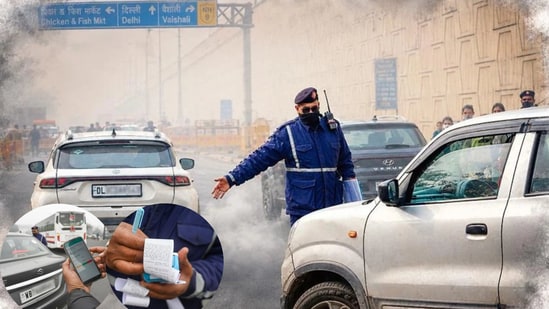
If you have a petrol or diesel run vehicle, which is registered outside Delhi and is older than 2020 then it doesn’t meet the Bharat Stage-VI (BS-VI) emission standards specifying the permissible emission levels for pollutants. CNG and electric vehicles are exempt, as are ambulances, fire tenders and specified essential-service vehicles.
How much is the challan if you flout the rule?
A fine of up to ₹20,000 can be imposed for violating entry restrictions, or ₹10,000 if caught without a valid Pollution Under Control Certificate (PUCC) under the rule of No PUC, No Fuel.
NCR commuters, here’s how to figure out alternative options to commute:
1. Figure out carpool beforehand
For those who need to commute daily from NCR to Delhi, uncomplicate your life by getting into the habit of sharing your ride with people whose vehicles comply with the set restrictions. “I’ve already spoken to my colleagues who travel to Delhi regularly, and considering to carpool with them,” says Rhea Mehrotra, a marketing consultant who lives in Gurugram’s Sector 56. She adds, “Come what may, I need to travel from Gurugram to Delhi for work every day and so many of my acquaintances have BS-VI vehicles. It’s gonna be challenging to depend on someone else for my daily commute, but then what are friends for! Coordinating timings and routes has become like my everyday evening plan of late as I need to be prepared for any eventuality like if one colleague decided to take sick leave then I have two friends on my speed dial to drop me to the closest drop off stop to my office in Saket.”
2. Map the Metro route, factor in last mile connectivity
For commuters switching from personal cars to public transport, the journey may involve much more than just boarding a Metro. Take for instance, Aditya Sharma, 29, who lives in Indirapuram, Ghaziabad, and says switching to the Metro for his daily travel to Nehru Place is right now the most practical option. “But I still need to calculate all the time that I will be spending in getting to the nearest station close to my house. Interchanging between lines is not as easy as it look because if anyone needs to board the Pink Line from anywhere then must know that the walking distance is quite a lot between interchange stations. Fortunately, I need to stick to Blue and Violet Lines, which are better connected. Yet it’s going to be one long commute for me, and in any case winter days mein subah jaldi uthna is a task. Guess I’ll compensate on my sleep in the train itself,” shares Sharma, who works in research in the IT industry.
3. Recalculate budget for cabs, autos
{{/usCountry}}For commuters switching from personal cars to public transport, the journey may involve much more than just boarding a Metro. Take for instance, Aditya Sharma, 29, who lives in Indirapuram, Ghaziabad, and says switching to the Metro for his daily travel to Nehru Place is right now the most practical option. “But I still need to calculate all the time that I will be spending in getting to the nearest station close to my house. Interchanging between lines is not as easy as it look because if anyone needs to board the Pink Line from anywhere then must know that the walking distance is quite a lot between interchange stations. Fortunately, I need to stick to Blue and Violet Lines, which are better connected. Yet it’s going to be one long commute for me, and in any case winter days mein subah jaldi uthna is a task. Guess I’ll compensate on my sleep in the train itself,” shares Sharma, who works in research in the IT industry.
3. Recalculate budget for cabs, autos
{{/usCountry}}Must increase your budget for travelling through cabs, autos booked via mobile apps is expected to get expensive in the eventuality of a higher demand. “Every day taking a cab is going to cost me a bomb. But I don’t really have an option. So, I’ve started culling out from my eating out budget to fulfil this new expense for the coming winter,” shares Lakshita Mehta, who works in a finance firm and needs to travel everyday from Noida’s Sector 62 to Greater Kailash. “I’m not going to get an option to work from home unlike some of the government officials. So, I have to factor in all these things from now because public transport such as buses are not convenient to me, at least not for the route that I travel on. My car is still in working condition but I’ll have to ditch it for this period and it does feel annoying ki jis travel ke liye I usually spend around ₹300 if I drive then for the same I’ll have to shell out double, more so because festive time also makes cabs expensive.”
4. Essential service? Keep docs handy
If your work falls under essential services and you need to travel to Delhi from NCR, keep your official identity card and relevant work documents handy to show them to the traffic police. Shayuk Kumar, a lawyer who travels from Gurugram to his office in Lajpat Nagar and in between courts and meeting locations, says: “If I’m wearing my black coat, I hope the cops may be lenient since they understand that I’m on legal duty.”
Adding to this, a brand manager on condition of anonymity shares, “Last year during Grap-IV restrictions, I was challaned twice for ₹10,000 each, at the same spot, and within a span of a few minutes because I was driving to my work and by the time I could tell the traffic policeman on duty that I work in media that falls under essential services, I was already found breaking the rules.”
For more, follow @htcity.delhijunction