Imagine undergoing a total knee replacement in the afternoon and walking out of the hospital the very next morning, or even the same evening, unassisted and ready to resume your daily life. For former Army Chief General JJ Singh, 83, this isn’t a high-tech fantasy; it’s his recent reality.
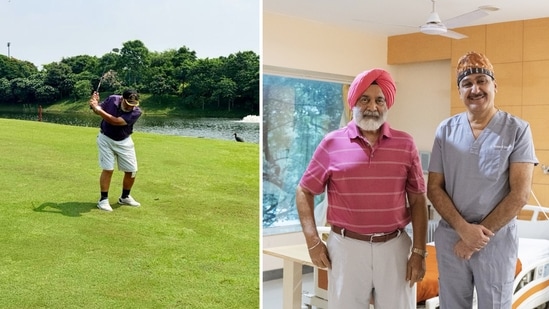
Just a day after surviving a mid-air engine failure on a flight from Goa to Delhi, the veteran walked into the operation theatre for a robotic-assisted total knee replacement (TKR) on his right knee. Within hours of the procedure, he was walking without support. Days later, he was back on the green, swinging his golf club and sending updates to his surgeon, Dr Rajeev K Sharma, chairman, orthopaedics & chief robotic surgeon, Moolchand Medcity, Delhi.
“General JJ Singh is a very spirited man,” says Dr Sharma, adding, “He was admitted at 9am, underwent surgery at 4pm, and left the next morning, walking without support in less than 24 hours. He told me, ‘I need to play bridge and golf, and go swimming.’ A few days later, he even sent me a picture of him attempting a golf shot.”
For General Singh, who famously trekked an ice wall at an altitude of 14,500 feet shortly after his left knee replacement last year, the fast-track approach was a game-changer. “I told the surgeon, ‘Let me go in the night itself,’” he laughs. “It was a very comfortable, easy surgery.”
{{/usCountry}}For General Singh, who famously trekked an ice wall at an altitude of 14,500 feet shortly after his left knee replacement last year, the fast-track approach was a game-changer. “I told the surgeon, ‘Let me go in the night itself,’” he laughs. “It was a very comfortable, easy surgery.”
{{/usCountry}}The end of long hospital stays
Contrary to the long-held belief that joint replacement requires weeks of bed rest, severe pain and prolonged hospital stays, modern medical advances are turning total knee arthroplasty (TKA) into a daycare or short-stay procedure.
“It’s a fast-track daycare surgery where the patient can go home the same day, no long ICU stay or room admission needed,” explains Dr Sharma. “General JJ Singh was walking with support within an hour of surgery and could bend his knee to 100 degrees. One can even resume swimming because we use waterproof dressings. I’d compare it to a dental procedure, where the dentist performs the surgery, puts a cap, and sends you home,” he adds.
Dr Aashish Chaudhry, managing director, senior consultant & head, Department of Orthopaedics & Joint Replacement, Aakash Healthcare, says his patients are surprised when told they don’t have to stay in hospital for days. “The common notion in the community is that TKR is a very big surgery, and we need to stay in the hospital for a long time, along with the expectation of severe pain, disability and being bedridden for a longer time. But with the advancement of technology, refinement in surgical techniques and better post-operative care, patients are getting discharged much faster. But one has to really strike a balance on when to discharge with respect to the patient’s medical condition.”
What makes daycare knee replacement possible?
Recently, knee replacement surgeries have undergone a radical change, Dr Sharma explains, primarily due to advancements in surgical skills, AI-driven robotic precision, minimally invasive surgery (MIS) and exceptional pain-management techniques. What was once a complex procedure with prolonged recovery has transformed into a daycare surgery, allowing most patients to achieve a 100-degree knee bend and walk unsupported within an hour of surgery. There is no blood loss in the surgery; hence, no blood transfusions are needed. Sutureless surgery has further streamlined post-operative recovery.
This dramatic reduction in recovery time comes down to two major innovations:
1. Robotic-assisted surgery
The experience of the surgeon and the robotic system together ensure that the surgery is performed with greater precision.
Less bone damage: Unlike traditional methods that rely on alignment rods inside the thigh bone, robotic systems use a 3D map of the patient’s knee
Enhanced accuracy: Real-time tracking of knee position and alignment reduces the chance of malpositioned components
Precise ligament balancing: Accurate measurement of soft-tissue tension helps the new joint move smoothly, facilitating easy bending
Customised execution: The system guides the surgeon within set safety boundaries, allowing customised cuts tailored to individual anatomy
2. Advanced, targeted pain relief
Pain-management approach focuses on specific nerves surrounding the knee rather than relying solely on systemic medications.
Spinal anaesthesia: Numbs the lower body without full general anaesthesia, minimising post-operative grogginess
Adductor canal block: Targets sensory nerves in the inner thigh to relieve front-knee pain while preserving quadriceps strength, enabling early ambulation
IPACK block: Directs pain relief to sensory nerves at the back of the knee without impairing knee movement