A bouquet of pleas filed by Hindu petitioners seeking worshipping rights inside the Gyanvapi Masjid complex and the removal of the mosque is not barred by the 1991 Places of Worship Act, the Allahabad high court ruled on Tuesday, marking a crucial turn in the decades-old dispute that will have reverberations across a raft of similarly sensitive cases.
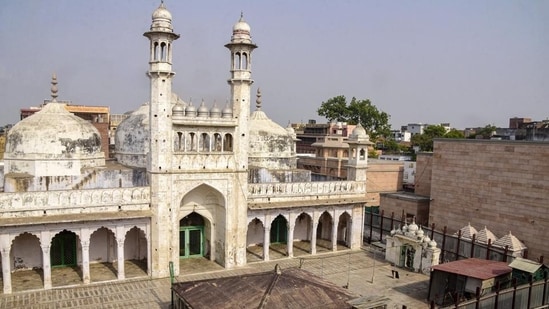
The high court’s decision to dismiss pleas by the Anjuman Intezamia Masjid Committee (AIMC), which manages the 17th-century Gyanvapi mosque, and the Uttar Pradesh Sunni Central Waqf Board (UPSCWB), also signifies a setback for Muslim petitioners who have thus far relied, unsuccessfully, on the 1991 law that was meant to forestall religious disputes on the lines of the Ram Janmabhoomi-Babri Masjid suit.
Read here: ASI’s Gyanvapi report filed in a sealed cover
A single-judge bench of justice Rohit Ranjan Agarwal also asked lower courts to hear the dispute expeditiously and reach a decision within six months while vacating all interim stays in the matter.
“The dispute raised in the suit is of vital national importance. It is not a suit between the two individual parties. It affects two major communities of the country,” said the judge in the 63-page order.
“Due to the interim order operating since 1998, the suit could not proceed. In the national interest, it is required that the suit must proceed expeditiously and be decided with utmost urgency with the cooperation of both the contesting parties without resorting to any dilatory tactics,” he added.
{{/usCountry}}“Due to the interim order operating since 1998, the suit could not proceed. In the national interest, it is required that the suit must proceed expeditiously and be decided with utmost urgency with the cooperation of both the contesting parties without resorting to any dilatory tactics,” he added.
{{/usCountry}}The court was hearing five petitions by the two Muslim bodies against two sets of decisions by lower courts – one, to hear a 1991 plea filed by Hindu groups that seeks to restore an ancient temple at the site of the Gyanvapi Masjid and says that the mosque was built by medieval Islamic rulers after demolishing part of the temple, and second, to order a survey by the Archaeological Survey of India (ASI) of the complex.
The Muslim side had argued that the Hindu suits violated the 1991 law, which locks the religious character of holy sites as it existed on the day of Independence, with the exception of the Ram Janmabhoomi-Babri Masjid site. But the court disagreed, saying the religious character of a place can only be determined by court proceedings, and not concluded at the preliminary stage.
“Either the Gyanvapi compound has a Hindu religious character or a Muslim religious character. It can’t have dual character at the same time. The religious character has to be ascertained by the court considering pleadings of the parties, and evidences led in support of pleadings. No conclusion can be reached on the basis of framing of preliminary issue of law,” the judge said.
He said that the law only barred the conversion of place of worship, but it did not define or lay down any procedure for determining the religious character of a place of worship that existed on August 15, 1947. “More than 32 years have elapsed since filing of Original Suit No. 610 of 1991, and only issues have been framed after filing of written statement by defendants. Proceedings of the suit had remained pending for almost 25 years on the strength of interim order granted by this court on 13.10.1998,” he added.
“We are not satisfied with this verdict (judgment)... We will contest the judgment,” said SM Yasin, joint secretary of the AIMC. “We have received a verdict, not justice.”
Advocate Vijay Shankar Rastogi, who appeared as the next friend of the idol of Lord Vishweshwar, said, “The truth has prevailed.”
The development in the case not only clears the decks for the lower courts to hear the arguments but it will have wide ramifications across similar suits filed by Hindu groups and petitioners in Mathura and Agra – all part of what experts have called the new temple movements, where Hindu groups and individuals have approached lower courts to file petitions seeking legal solutions to decades-old religious disputes, instead of using street mobilisation to push for change.
In all three cases, Hindu petitioners argue that medieval-era Islamic structures were built by demolishing temples and demand praying rights. The Muslim sides reject the contention and say that any such legal action violates property and religious laws, including the 1991 Act.
The high court’s order came a day after ASI filed before the court of the Varanasi district judge a report on the scientific survey of the Gyanvapi mosque that is set to open the next chapter in the dispute. The report, in a sealed packet, was filed before district judge Ajaya Krishna Vishvesha. In another sealed packet, the ASI team submitted a list of objects found during the survey.
AIMC urged the court that the report remain sealed, and not be given to any of the parties unless a personal undertaking on an affidavit is submitted that it will not be leaked. Vishnu Shankar Jain, the counsel for the four Hindu women, also filed an application on their behalf, seeking a copy of the survey report.
This ASI survey was the second such controversial exercise to be carried out at the premises. Last year, on the final day of a similar survey ordered by a local court, Hindu groups claimed the discovery of a shivling, a structure the Muslim side said was part of a ritual ablution fountain. The area remains sealed under the orders of the apex court.
Last week, the Allahabad high court had ordered a similar survey of the Shahi Eidgah abutting the Krishna Janmabhoomi temple in Mathura, but on Monday, it postponed to January 11 its next hearing on the modalities and composition of the commission that will conduct the survey. The Supreme Court, meanwhile, is scheduled to take up the issue on January 9.
A key aspect of all cases in Varanasi and Mathura is also the 1991 law, which barred any court from entertaining a matter that sought to alter the religious nature of a place but has proved ineffective in preventing a spate of litigation in recent months.
A batch of petitions — some seeking to scrap the 1991 Act and some others asking for tight enforcement of the same law — are pending before the top court since March 2021. The court has asked for the government’s stance in the case; last September, Chief Justice of India Dhananjaya Y Chandrachud, while hearing the Gyanvapi case, observed that the religious character of a site also had to be led by evidence.
In the 1991 plea, the Hindu said a portion of a temple of Lord Vishweshwar lies at the centre of the Gyanvapi compound, above the mosque’s cellars (tahkhana).
It also claimed that the Gyanvapi compound (mosque) was surrounded by the temple’s boundary wall, which also framed four mandaps and its ruins, as well as idols of Hindu deities.
Further, according to the suit, the complex also houses a jyotirlinga that was built well before the advent of Islamic rule in India.
On the preliminary issue that the suit is barred by law, the court observed, “It is clear defendants have no case for dismissal of the plaint under Order 7 Rule 11 C.P.C. as they could not make out from the plaint that suit is barred by any provisions of law. Moreover, the issues were framed after considering the pleadings of both parties.”
Read here: HC dismisses pleas against suit for temple restoration at Gyanvapi Mosque site
On the defendant’s argument that the structure is a waqf property, the court said, There is no material on record to demonstrate the creation of Waqf and construction of mosque.”
The court said, “Thus, I find that religious character of the disputed place as it existed on 15.08.1947 is to be determined by documentary as well as oral evidence led by both the parties. Unless and until the court adjudicates, the disputed place of worship cannot be called as a temple or mosque.”