The leaders of the Quadrilateral Security Dialogue or Quad are set to hold their first summit in a virtual format this month, with the US administration taking the initiative to set up the meeting, people familiar with developments said on Friday.
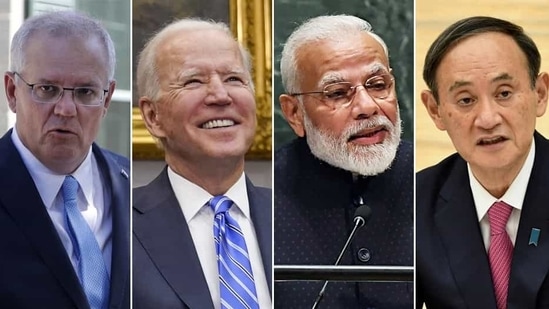
Confirmation about the meeting came from Australian Prime Minister Scott Morrison, who told a news conference that he had discussed the matter with US President Joe Biden, Prime Minister Narendra Modi and Japanese Prime Minister Yoshihide Suga in recent conversations.
“So, I am looking forward to that first gathering of the Quad leaders. It will be the first-ever such gathering,” he said in response to a question from a reporter on whether he had received an invitation for the meeting.
The people cited above said on condition of anonymity that the virtual summit is expected to be held on March 12.
There was no official word from the Indian side on the development.
Also read: 'India wants normal ties with all neighbours, including Pakistan' - MEA
The US had also taken the lead in organising the third meeting of the foreign ministers of the Quad on February 18, against the backdrop of continuing concerns over China’s actions across the region. That meeting had reiterated the group’s commitment to a rules-based world order underpinned by respect for territorial integrity and sovereignty.
{{/usCountry}}The US had also taken the lead in organising the third meeting of the foreign ministers of the Quad on February 18, against the backdrop of continuing concerns over China’s actions across the region. That meeting had reiterated the group’s commitment to a rules-based world order underpinned by respect for territorial integrity and sovereignty.
{{/usCountry}}Formed in 2007, the Quad was revived in 2017 as a gathering of senior officials of the four countries. It was upgraded to the level of the foreign ministers in September 2019, reflecting the desire of the four countries to work more closely on shared interests in the Indo-Pacific and India’s comfort with the group.
Morrison told the news conference that the four Quad leaders are looking forward to the first virtual summit and follow-up face-to-face meetings.
“This will become a feature of the Indo-Pacific engagement but it’s not going to be a big bureaucracy with a big secretariat and those sort of things. It will be four leaders, four countries working together constructively for the peace, prosperity and stability of the Indo-Pacific, which is good for everyone in the Indo-Pacific,” he said.
“It’s particularly good for our ASEAN friends [and] those throughout the southwest Pacific to ensure that they can continue with their own sovereignty and their own certainty for their own futures,” he added.
Morrison said the Quad Summit was one of the first things he and US president Joe Biden had discussed when they spoke on phone on February 3. The Quad, he added, was central to ongoing arrangements between Australia and the US.
“The Quad is very central to the US and our thinking about the region and looking at the Indo-Pacific also through the prism of our ASEAN partners and their vision of the Indo-Pacific,” he said.
Biden and US secretary of state Antony Blinken had made clear that their re-engagement in multilateral organisations is “key to building stability and peace in the Indo-Pacific”, Morrison said. “We share that view, we encourage that view, and we strongly welcome that view,” he added.
The move to hold the first Quad Summit fits in with the Biden administration’s position that China is its biggest security challenge and competitor on the global stage.
While the former Trump administration had talked of formalising and expanding the Quad, questions have been raised on whether the Biden administration will adopt a more cautious approach to the group as a counter-balance to China.
Chinese officials have likened the Quad to a “mini NATO” and said its activities are aimed at targeting third parties, a charge rejected by the four members of the group.