After 51 days of tracking the two cubs of tigress T-1 or Avni, forest officials on Saturday darted and rescued the female cub near Loni village in Pandharkawada forest in Ralegaon, Yavatmal. The cub has been shifted to Pench Tiger Reserve. The male cub is likely to be rescued by next week. T-1, an alleged man-eater, was killed on November 2, leading to an uproar among activists and public.
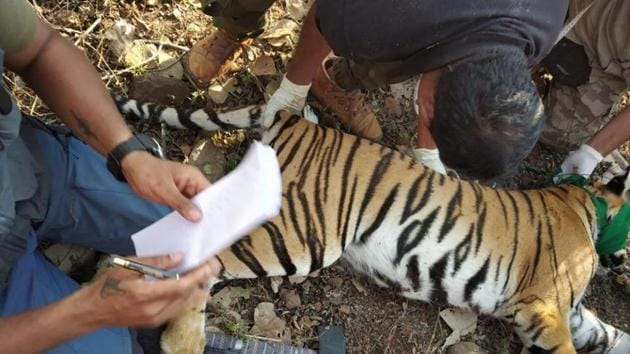
According to officers involved in the rescue operation, the cub, now almost a year old, was darted by a veterinarian from Madhya Pradesh, Dr Akhilesh Mishra. She was darted around 3pm in compartment 655 near Loni village in Pandharkawada forest in Ralegaon, Yavatmal. She was then shifted to Pench Tiger Reserve by Saturday evening.
The male cub is yet to be tranquillised and the rescue operation is likely to be completed by next week, said forest officers. “For three days, four elephants manned by their mahouts, eight vehicles, and foot patrolling by forest staff and labourers identified the exact area where the cubs were. We set up another live bait (calf) on Friday to safely tranquillise them,” said Sunil Limaye, additional principal chief conservator of forest, Nagpur, heading the operation.
On Saturday, as the cubs approached the bait, the male cub, slightly aggressive, sensed fear and escaped but the female moved steadily within the lantana vegetation, said Limaye. “The four elephants cordoned off the area and the female cub could not escape. She charged at us a few times but once we had a clear view of the animal, Dr Mishra shot the dart from a distance of 10 metres and within 10 minutes the animal succumbed,” he said, adding a preliminary medical examination was done. “She was declared fit and transported in a trap cage to Pench.”
{{/usCountry}}On Saturday, as the cubs approached the bait, the male cub, slightly aggressive, sensed fear and escaped but the female moved steadily within the lantana vegetation, said Limaye. “The four elephants cordoned off the area and the female cub could not escape. She charged at us a few times but once we had a clear view of the animal, Dr Mishra shot the dart from a distance of 10 metres and within 10 minutes the animal succumbed,” he said, adding a preliminary medical examination was done. “She was declared fit and transported in a trap cage to Pench.”
{{/usCountry}}The forest department had been searching for the cubs since November 2, when T-1, an alleged man-eater, was shot and killed. The cubs had to be rescued as they are too young to fend for themselves in the wild, and may fall prey to infighting as tigers are territorial animals. There are worries that the cubs may also become maneaters like T-1, and the department plans to rehabilitate them in captivity.
For 20 days, the rescue teams allowed the two cubs to feel safe in the 80-hectare forest patch by providing them with over 20 live baits. “Since they realised food was readily available in this area, they did not look elsewhere. During this time, we fenced off this zone with 10-foot-high barbed wires so that they would not leave this territory,” said Limaye. Limaye was assisted by Dr Parag Nikam from Wildlife Institute of India (WII), scientist Bilal Habib, deputy conservator of forests (DCF) KM Abharna, state veterinarians Dr Chetan Patond, Dr Ankush Dubey and Dr V Kadu.
The Wildlife Conservation Trust (WCT), a conservation group that had deployed more than 10 staff members for the past two months and also during rescue, said the exercise was done in a professional manner. “This is a one-of-its-kind example of a successful rescue operation of mammoth proportion. Something like this has never been tried in any tiger range country,” said Dr Anish Andheria, president, WCT.