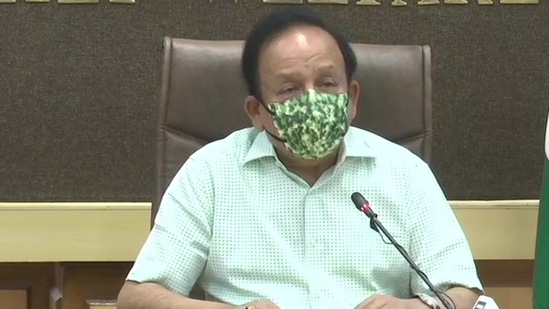
Around 7.3% of the approximately 980000 active Covid-19 cases in the country as on Thursday night were in ICUs, on oxygen support, or on ventilators, according to data discussed at the 24th meeting of the group of ministers on Covid-19 , chaired by Union health minister Harsh Vardhan. That’s a little over 70,000 people.
Hospitalizations due to Covid-19 are increasing, and India’s recovery rate has seen a sharp drop from 97.07% a month ago to 91.22% on , owing to a surge in cases, although this is purely a mathematical feature -- recoveries always lag cases by a few weeks.
At the meeting, Vardhan attributed rising new cases across the country largely to casual behaviour adopted by people such as not wearing a mask or doing so improperly. To be sure, India’s cases have been on a decline since mid-September, people have become more careless, and governments have eased even more restrictions on movement and activities, but the sudden surge seen since mid February is likely caused by mutant strains of the virus, especially in Maharashtra and Punjab, two of the worst affected states in the second wave, although India isn’t sequencing enough viral genomes to establish this.
The good news according to the meeting was that there have been no fresh cases in the past seven days in 149 districts, and for the past 28 days in as many as 63 districts.
{{/usCountry}}The good news according to the meeting was that there have been no fresh cases in the past seven days in 149 districts, and for the past 28 days in as many as 63 districts.
{{/usCountry}}Governments have substantially ramped up the hospital infrastructure for management of the viral disease amidst the surge. There are 2084 dedicated Covid hospitals(Centre:89 and States:1995) that have been set up in the country with 4,68,974 beds. Of these, 2,63,573 are isolation beds, 50,408 are ICU beds and 1,54,993 are oxygen supported beds.
In addition, India has 4,043 (Centre:85 and States: 3,958) dedicated Covid health centres , with 3,57,096Covid beds, out of which 2,31,462 areisolation beds, 25,459 are ICU beds and 1,00, 175 are oxygen supported beds.
The country also has 12,673 quarantine centres and 9,313 total Covid care centres.
Speaking on the vaccine drive at the metting, the health minister said, “For those between age 45 and 59, first dose has been received by over 26.1 million people and second dose has been received by 5,23,268 people. Over 37.5 million people, above 60 years of age, have received their first dose, while over 1.3 million people have received a second dose.”
Just about 11 States together contribute to 54% of the total cases and 65% of the total deaths in the country, the minister pointed out.
Disproportionately higher deaths in Maharashtra and Punjab have further increased during the last 14 days (64% of the total deaths in the country). According to the discussions at the meeting, a majority of the cases is being reported in the younger population (15-44 years of age) and the majority of the deaths reported among the elderly population (> 60 years). Maharashtra (25%) and Chhattisgarh (14%) have extremely high positivity rates .
Amidst worried about a vaccine shortage, the minister reassured everyone that there are enough vaccines and that the government is taking all appropriate measures to ensure production capacity of existing vaccines is scaled up, and potency and timeline of those undergoing clinical trials.
...