The crisis between Tamil Nadu and neighbouring Karnataka over the sharing of water from the Cauvery is not, by any means, a new one.Common people in both states have recently found themselves again mired against the clamour of heated, accusatory political posturing and an evasiveness that clouds consensus and derails any approach towards meaningful dialogue on the matter, which is a shame, really, considering that both state governments have remained quite consistent with their stances over the years.
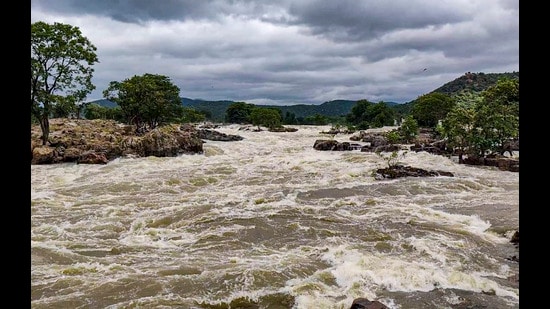
‘How can we hold back water?” observed Karnataka chief minister DK Shivakumar recently, when asked about the release of water from the Kabini dam, which reached Tamil Nadu early on Tuesday. Shivakumar’s argument that the Mekedatu Dam Project is intended to act as a balancing reservoir to regulate the flow of Cauvery water while generating hydroelectric power that can pose a “permanent solution” to the problem of Cauvery water management is at the centre of Karnataka’s stance. It insists that the go-ahead for the project does not require any approval from Tamil Nadu’s government, based on Clause XVIII of the Cauvery Water Disputes Tribunal (CWDT), 2007 and reaffirmed in the Supreme Court in 2018. The clause states that every riparian state could rightfully regulate waters within its borders so long as it stayed consistent with the CWDT award.
The Tamil Nadu government has maintained that the setup of any reservoir in an upper riparian state could curtail downstream flow and needed detailed scrutiny by the statutory bodies overseeing Cauvery water management, as well as the consent of all states sharing the Cauvery water system.
{{/usCountry}}The Tamil Nadu government has maintained that the setup of any reservoir in an upper riparian state could curtail downstream flow and needed detailed scrutiny by the statutory bodies overseeing Cauvery water management, as well as the consent of all states sharing the Cauvery water system.
{{/usCountry}}The Central Water Commission (CWC)’s decision to return the Karnataka government’s detailed project report (DPR) on Mekedatu and seek a revised report that complies with the CWDT award and existing technical guidelines by CWC comes in this backdrop.
The Karnataka government picked a somewhat pendulous approach after the Cauvery Water Management Authority order to ensure a flow of 3,500 cusecs a day for 15 days, despite warnings that reservoir levels were under severe pressure from drought. After an unsuccessful bid to challenge the order, and the postponement of a planned meeting between the chief ministers of both states in Bengaluru (reportedly scheduled at Tamil Nadu CM C Vijay Joseph’s behest), the state released 25,000 cusecs of water from the Kabini dam last Saturday, and scaled the output down to 10,000 cusecs the following day.
Farmers and pro-Kannada organisations have, meanwhile, intensified their grassroots struggle, with Shivakumar’s call to withdraw a planned statewide bandh on August 13 likely to remain unheeded.
In keeping with the state’s mood, Shivakumar maintained that the release was not meant specifically for Tamil Nadu, but because the reservoir reached full capacity after a recent wet spell in the Cauvery catchment and the release meant to ensure safety. As far as the state opposition is concerned, the BJP seems aligned with the government’s vision for the Mekedatu project. It received bipartisan backing at the all-party meeting convened by Shivakumar on Sunday, and state BJP chief BY Vijayendra has reportedly urged Tamil Nadu’s CM Vijay to support the project. While the Cauvery debacle is not the only issue behind the call for the August 13 bandh, it is the leaden keystone that keeps the state dispensation under pressure to maintain its hardline position, regardless of whatever ecological calamities may afflict its downstream neighbour.
On the other hand, in Tamil Nadu, there is much furore in political circles but little cohesion or bipartisan unity. While the chief opposition Dravida Munnetra Kazhagam (DMK) beat the state government in moving the top court to order Karnataka to comply with the CWMA order, the general consensus regarding the issue seems to be that there a need for the state government to consult all political parties, farmers’ groups and other stakeholders before presenting its case through a clear political and legal strategy. While the government has reportedly sent out feelers to Karnataka, the Tamizhaga Vetri Kazhagam (TVK)-led dispensation seems to have failed in reaching out to its challengers DMK and AIADMK to present a strong home front.
Negotiations may be out of the window for the moment. While Shivakumar’s decision to postpone his meeting with Vijay does make sense considering the prevailing political climate in the state, the Tamil Nadu dispensation’s awkward reticence to address the people transparently and call an all-party meeting to seek political consensus defies political common sense.
To illustrate with an example, the current rural development and water resources minister N Anand has consistently avoided speaking on the issue with the media. When one considers Anand’s public call for TVK cadre to come out in droves to celebrate the release of Vijay’s film career swan song, Jana Nayagan, which spurred a frankly embarrassing spectacle of executive and legislative bigwigs filling seats in theatres across the state, the reluctance here is even more difficult to understand.
To trace out again an oft-borrowed piece of wisdom that “water is nature’s property” (most recently offered by none other than Shivakumar himself), and considering the role of the State as a mediator, the need of the hour is to come up with stronger, sustainable and democratic water-sharing agreements that better fit our nature as a multi-ethnic and linguistic federal polity.
(Prof.Ramu Manivannan is a Political Scientist – Scholar-Activist in areas of education, human rights and sustainable development. He is currently the Director, Multiversity – Centre for Indigenous Knowledge Systems, Kurumbapalayam Village, Vellore District, Tamil Nadu)